# Welcome to LUNR!

There’s a **pivotal challenge in the realm of mobile technology**: the need to revolutionize the way people interact with their devices. At Lunr, **we’re committed** to spearheading this **change** by crafting **mobile devices** that not only redefine user experiences but also **uphold the highest standards of privacy and data protection** through robust communication solutions.

Our dedication extends beyond mere innovation; **it’s a responsibility to humanity**. Sustainability isn’t an afterthought for us—it’s a core principle woven into every aspect of our operations. **We’re not just manufacturing mobile devices; we’re pioneering the path towards sustainable and ethical mobile manufacturing.**

However, achieving this vision isn’t without its hurdles. That’s why **we seek out brilliant minds who share our passion** for transformative change. To attract and retain top talent, we’ve reinvented the traditional management model.

Many organizations still adhere to outdated, hierarchical structures that stifle creativity and hinder progress. But at Lunr, we’ve embraced a flexible and agile management approach that empowers employees to drive meaningful change.

In this guide, you’ll delve into Lunr’s innovative management model, exploring:

• **Mission and Vision:** How we inspire our team to push the boundaries of mobile technology while upholding our commitment to sustainability and ethical practices.

• **Leadership:** How we manage our teams and structure our Leadership to ensure everyone is accountable for their work and has the chance to learn and contribute to our strategy.

• **Knowledge Management:** Facilitating seamless collaboration and access to resources for informed decision-making in our pursuit of sustainable and ethical manufacturing.

• **Development Paths:** Providing clear pathways for career advancement within a company that values growth, innovation, and ethical standards.

• **Competitive and Transparent Compensation:** Attracting top talent through fair and transparent compensation practices that reflect our commitment to excellence and ethical principles.

Whether you’re a new addition to our team or a seasoned veteran, this guide serves as a roadmap for understanding Lunr’s ethos, culture, and operational principles as we continue to redefine the mobile landscape with a focus on privacy, security, and ethical manufacturing.

Take your time and get to know our approach better by deep diving into our Management model and Employee Handbook.<br>

<details>

<summary>How to use it?</summary>

This space is designed to be read linearly, so start with our Vision, Mission & Focus and work down from there! We recommend reading everything through in one sitting and then revisiting and re-reading if you need to.

</details>

{% embed url="<https://www.canva.com/design/DAGGmuCmOBw/Cwm3PP88tCV13rdYatdrcw/view>" %}

{% hint style="warning" %}
📜 The 'Lunr Management Model and Employee Handbook' © 2024 by Dominic Gingras is licensed under a Creative Commons CC BY-NC-ND 4.0 license. Feel free to share it under the terms of the license, but please refrain from adapting or using it for commercial purposes without permission. For more details, refer to the [full license agreement](https://creativecommons.org/licenses/by-nc-nd/4.0/?ref=chooser-v1)[ ](https://creativecommons.org/licenses/by-nc-nd/4.0/?ref=chooser-v1)🌐
{% endhint %}

{% file src="/files/q0LED9XtSNCaDaWocG49" %}


# Vision, Mission & Focus

Lunr is a **product development** and **manufacturing** company. We make **products** that are **good for humanity.** <br>

Lunr has grown from a small startup to a leading company in ethical mobile technology. Our journey began with a simple idea: to create products that are not only useful but also uphold the highest standards of privacy and benefit the world. Over the years, we have expanded our reach and improved many lives through our innovative solutions.\
\
Get familiar with our vision, mission, pillars and history here.&#x20;


# Vision

We envision a <mark style="color:blue;">**future**</mark> where <mark style="color:blue;">**every mobile device**</mark> we produce not only <mark style="color:blue;">**enhances digital well-being**</mark> but also embodies th<mark style="color:blue;">**e highest standards of privacy, and data sovereignty and ethical technology.**</mark> By transforming the mobile landscape, we aim to inspire a widespread <mark style="color:blue;">**shift towards more responsible and user-focused technology**</mark> while fostering new sustainable business models.


# Mission

Our mission is to <mark style="color:blue;">**ensure**</mark> that <mark style="color:blue;">**mobile technology benefits**</mark> all of <mark style="color:blue;">**humanity**</mark> by creating products that empower people, foster genuine connections, increase productivity, and enhance quality of life. \
\
By <mark style="color:blue;">**prioritizing ethics**</mark>, we aim to redefine the <mark style="color:blue;">**role of mobile technology**</mark> in society, making it a <mark style="color:blue;">**force for positive change**</mark> and collective advancement.\
\ <br>


# Pillars

These pillars serve as the bedrock of our endeavors, shaping every decision and innovation we undertake. Rooted in the principles of **ethical technology**, we prioritize transparency, eco-friendliness, and the protection of digital rights in all our endeavors.

Our stringent security protocols are meticulously crafted to shield personal communications and data, while our unwavering commitment to privacy underscores our mission to provide individuals with freedom of choice in the technological realm.

### <mark style="color:blue;">Ethical Technology</mark>

Focuses on transparency through open source, eco-friendly environment, data and digital rights, and freedom of choice.

### <mark style="color:blue;">Top-Level Privacy</mark>

Prioritizes key technologies that protect our mobile devices and ensure the security of personal communications and data from digital attacks.

### <mark style="color:blue;">Respect for Privacy</mark>

Raises awareness and strives to mitigate the prominent risk from Big Tech collecting, analyzing, storing and monetizing on personal data.

### <mark style="color:blue;">Digital Well-being</mark>

Fosters a healthy relationship with technology without harming personal life and interactions.

### <mark style="color:blue;">Equitable Working Practices</mark>

Ensures the implementation of a framework that promotes accountability, security, fulfilment, respect and an ethical workplace to balance workers rights and responsibilities.

***

Here you could also learn more about our NGO - "The good phone foundation", which inspired our pillars. **The foundation’s leaders come from a broad range of backgrounds** and have a diversity of expertise and experience that spans science and technology, communications, law, and business. Our leaders are guided by the foundation’s aim to create a world in which every person can make a stand for their inherent human right to privacy.\
\
"The good phone foundation" is helping startups with positive impacts. We empower them to create meaningful change and drive impact in areas such as sustainability, accessability, mental wellbeing, social inclusion, and privacy.

{% hint style="info" %}
[**https://goodphone.foundation/**](https://goodphone.foundation/)
{% endhint %}

<figure><img src="https://476013847-files.gitbook.io/~/files/v0/b/gitbook-x-prod.appspot.com/o/spaces%2FCdGkCxKDvQdgeyQPlLua%2Fuploads%2FW13KODKb9e0vBoBKGkNK%2F%D0%9D%D0%B5%D0%BE%D0%B7%D0%B0%D0%B3%D0%BB%D0%B0%D0%B2%D0%B5%D0%BD%20%D0%B4%D0%B8%D0%B7%D0%B0%D0%B8%CC%86%D0%BD.png?alt=media&amp;token=607d21fa-d561-456b-8f97-fdb7cb81101f" alt=""><figcaption></figcaption></figure>


# Strategy

In today’s tech-driven world, the way people utilize their phones presents unique challenges. As these devices become central to daily life, accessing data, whether legally or illegally, has become increasingly prevalent. However, traditional security measures have often proven inadequate in addressing the evolving landscape of cyber threats.

At Lunr, our mission transcends mere functionality. We’re driven by a **vision to ensure that mobile technology benefits all of humanity.** Our **goal is to create products that empower individuals, foster genuine connections, boost productivity, and enrich overall quality of life.**

In an ideal scenario, **technology serves as a catalyst for positive change and collective advancement**, enhancing not only individual experiences but also contributing to the betterment of communities worldwide. Users would wield control over their data, deciding who can access it. At Lunr, we prioritize user feedback and concerns, striving to deliver intuitive and user-friendly products that meet stringent security standards. To achieve this, we focus on:

• Innovating and reshaping the landscape with a heightened emphasis on security and ethics.

• Proactively mitigating cybersecurity risks while changing the way people interact with mobile technology.

• Competing with established giants by offering superior security and user control.

However, realizing our ambitious vision requires more than just innovation. It demands exceptional talent from around the globe, individuals who share our passion for ethical technology and our commitment to making a positive impact. That’s why we’re not only offering competitive compensation but also revolutionizing traditional management practices to create a work environment that fosters creativity, autonomy, and collaboration.<br>

While many tech companies rely on rigid hierarchical models, we recognize that such structures can stifle innovation and hinder progress. As such, we’ve embraced a flexible and agile management ethos, empowering our employees to take ownership of their work and contribute to our shared vision.

This philosophy is the cornerstone of our Lunr Management Model, a framework that champions collaboration, innovation, and employee empowerment. Continuously evolving, this model remains aligned with our mission of revolutionizing the tech industry while upholding the principles of ethical technology and user privacy.

**Together, we’re not just building smartphones—we’re shaping the future of technology, one ethical innovation at a time.**


# Context, not control

We focused on **three things** while creating our Management Model:

* **innovation** drives the most value in a product-led business, so we made it the main priority
* **micro-management doesn't work,** so we need a more effective approach
* the company’s business **vision and development strategy needs to be reflected** across the whole company to align teams’ goals

As a result, we replaced the command and control approach with a **Context, Not Control mantra**. This approach gives talent the freedom to manage their tasks and find the best way to support the business' goals.&#x20;

We believe in **Context, not Control** to provide the insight and understanding **to make sound decisions**. Setting appropriate context such as company's strategy, objectives, assumptions and metrics, rather than by trying to control people leads to High Performance. We believe **this will also attract ethical people** and give them the environment to be creative and innovative. But, to enable innovation, people need to know and understand what the company is trying to achieve ([the Mission & Vision](/about-us/vision-mission-and-focus)).

So the questions remains... how should we manage projects, without micro-managing teams and still keeping the focus on innovation?  With the help of a Strategic Management model. And that is why we created this material - to empower and manage high-performing people with the freedom to make a big impact.


# Strategic management

**Strategic management is the ongoing planning, monitoring, analysis and assessment of all that is necessary for an organization to meet its goals and objectives.**

In today's fast-paced business world, success often hinges on the ability to adapt to new challenges. That's why we've developed an innovative approach to addressing adaptive challenges on a departmental level, with a **focus on clear communication and top-to-bottom visibility.** By aligning day-to-day work with strategic goals, prioritizing projects and products, and monitoring progress towards key performance indicators, we're able to achieve the most ambitious objectives.

With a deep understanding of the unique needs and challenges faced by different departments, our approach allows us to **create a comprehensive strategy that fosters maximum performance and empowers teams to excel.** By emphasizing [context over control,](/how-we-make-decisions/strategy/context-not-control) we create a supportive environment that allows for creativity, collaboration, and continuous improvement.&#x20;

{% hint style="info" %}
When it comes to managing projects, technology companies need a tool that can keep up with their fast-paced, dynamic environment. That's why **we recommend Project Management tools like Jira** - a versatile, user-friendly platform that helps us stay on top of all our projects, no matter how complex or varied.
{% endhint %}

Our unique approach to using Jira **ensures that all employees have visibility into which part of the strategy their tasks are affecting**, regardless of department or project type. Here's how we break it down:

* **Department projects:** these tasks are directly related to improving the processes within a specific department, and are all linked to an initiative that addresses an adaptive challenge.
* **Cross-department process projects:** these tasks involve improving processes that cross multiple departments and are typically company-wide initiatives.
* **Product projects:** these tasks relate to all aspects of our products, from bug fixing and feature development to product stories and overall improvements.

By organizing our projects using **Kanban and Scrum boards**, we're **able to ensure that everyone is on the same page** and working towards the same strategic goals.&#x20;

***

In conclusion, when Strategic Management is done right:

* Strategy and goals are clear, specific and globally understood.
* Team interactions are focused on strategy and goals, rather than tactics.
* Management time is transparent, articulate and perceptive

<figure><img src="https://476013847-files.gitbook.io/~/files/v0/b/gitbook-x-prod.appspot.com/o/spaces%2FCdGkCxKDvQdgeyQPlLua%2Fuploads%2FHzHYyxyqpnNyXL1rqxQz%2FScreenshot%202024-05-31%20at%2012.15.50.png?alt=media&amp;token=cdb2f0f7-5974-4002-b81e-9e4a9c12e1d9" alt=""><figcaption></figcaption></figure>

{% hint style="warning" %}
However, to ensure security in all aspects, there're some situations where **control is required:**<br>

* When we need to prevent irrevocable risks, ie. possibility of data breaches.
* When people are still learning they need mentoring: junior employees
* When there are escalated conflicts: Moral, Ethical and Legal issues.
  {% endhint %}


# Culture code

**LUNR has innovation at the center of our business so people need to deliver it.** That's also why we embrace diversity. Being innovative requires people from different backgrounds with different ideas, and we want to get the best from everyone.

This diverse community of bright people from different backgrounds work together to achieve a shared goal. To achieve this **we need to share the same set of corporate values**, regardless of background.

Therefore, to ensure that everyone is working towards the same vision, we've developed a **Culture Code.**&#x20;

Our Culture Code is built on 6 essential permission to play values that we believe are essential to our business model.

Permission to play means exactly that: minimum standards of behavior we expect within our "free to create" environment.

We only hire people that demonstrate these values, and we don't tolerate employees who don't exhibit these values.

<figure><img src="https://476013847-files.gitbook.io/~/files/v0/b/gitbook-x-prod.appspot.com/o/spaces%2FCdGkCxKDvQdgeyQPlLua%2Fuploads%2Fpj6tjPj7gk9tFVK8DoDK%2FScreenshot%202024-05-31%20at%2012.17.25.png?alt=media&amp;token=e880e240-8f0a-4b2b-a76e-89b8403da4d1" alt=""><figcaption></figcaption></figure>

<table data-view="cards"><thead><tr><th></th><th></th><th></th></tr></thead><tbody><tr><td><mark style="color:blue;"><strong>INTENSITY</strong></mark><br>Building something great requires hard work and a sense of urgency.</td><td></td><td></td></tr><tr><td><mark style="color:blue;"><strong>RESPONSABILITY</strong></mark><br>We put our trust in people who can take responsability for their actions and deliver quility work on time.</td><td></td><td></td></tr><tr><td><mark style="color:blue;"><strong>DEVOTION TO LEARNING</strong></mark><br>Bringing value to humanity through innovation requires a curiosity mindset.</td><td></td><td></td></tr><tr><td><mark style="color:blue;"><strong>RESPECT</strong></mark><br>Lunr is a diverse community with people from different backgrounds. Being open, respectful and open-minded is the only way to fit in our culture.</td><td></td><td></td></tr><tr><td><p><mark style="color:blue;"><strong>INNOVATION</strong></mark></p><p>Constant improvement is essential for delivering quality products with a positive impact on society.</p></td><td></td><td></td></tr><tr><td><mark style="color:blue;"><strong>ADAPTIVENESS</strong></mark><br>Technology, market trends, and regulations change at rapid pace. Adaptiveness is key in staying ahead of the game and successfully tackle future change and challenges.</td><td></td><td></td></tr></tbody></table>

{% hint style="warning" %}
Even though we strive to gather dedicated and reliable people, we realize sometimes people can lose their focus on our mission. We are all human and prone to mistakes from time to time. Occasionally during hiring, someone who is not a good culture fit will slip through the net. We need a way to manage these culture mismatch scenarios. You may have a high performer at a technical level in your team, but what if he/she doesn't embrace the culture? We believe it is fair to give everyone a second chance. We work to the premise that people can change – and we developed a process called [Corrective Action Plan (CAP)](/how-we-ensure-peoples-growth/performance/cap) to manage this. The CAP also provides a last opportunity for the employee to reflect if the job is right for him/her.

This procedure clearly sets out the behaviors and attitudes that need improving and asks them to come up with an action plan for themselves. This way we give people a chance to realign with our culture and take corrective action before we take further measures.
{% endhint %}

In the midst of today's digital landscape, riddled with vulnerabilities and risks to user data, Lunr envisions a future where individuals wield control over their digital privacy. We craft secure mobile technology products inspired with ethical principles, putting the power of data protection squarely into the hands of users.&#x20;

However, we understand that this journey cannot be traveled alone. We seek out individuals who share our commitment to ethical innovation, inviting them to join us in our quest to redefine the boundaries of digital privacy and security. Together, let's build a safer, more responsible digital world.

&#x20;<mark style="color:blue;">**LUNR is a demanding workplace, but also one that will allow you to express your greatness, work the way you perform best, and push you to your limits.**</mark>

**Do's and Dont's at LUNR**

<figure><img src="https://476013847-files.gitbook.io/~/files/v0/b/gitbook-x-prod.appspot.com/o/spaces%2FCdGkCxKDvQdgeyQPlLua%2Fuploads%2FBr4F79J1N7dRiofJXSit%2FScreenshot%202024-05-31%20at%2012.18.33.png?alt=media&amp;token=678788d1-6815-41fb-9351-909273fbb072" alt=""><figcaption></figcaption></figure>


# Leadership

We have seen that by setting **the right context,** e**mployees can understand the company's mission and vision** and create a great product. However, the leadership style in the companies need to support this. Regardless of your role, to ensure effective people management and growth, **you should strive to shift away from "controlling activities" towards a synergistic relationship** between team members. Within complex organizations, leaders need to ensure that the team is heading in the right direction and that any changes throughout the organization will be handled effectively, with minimum disruption to our performance.&#x20;

What makes a good leader is a concept that can vary per team, organization and people's personal opinion. However, in a[ "Context, not Control"](/how-we-make-decisions/strategy/context-not-control) environment, you still need people to coach and provide directions, but this is not the traditional role of a leader. That’s why we believe that they key to success is to always l**ook for the ones that can embrace the core principle of caring for others and giving up control rather than seeking control.**

At LUNR, we have two types of leaders: [Managers](/how-we-make-decisions/leadership/managers) and [Tech Leads](/how-we-make-decisions/leadership/tech-leads). Learn more about them and what do you need to become one in the next chapters.


# Managers

We currently have **4 leadership Levels** with different expected traits but similar objectives: l**ending support to addressing the needs and wants of the people and the organization**. This is our priority. This contrasts with the leader-first perspective, where a person aims to gain control quickly, often driven by material gain or influence but it’**s our way to ensure autonomy, accountability, innovation and high-performance.**

### <mark style="color:blue;">Level 1 Managers - Our pace setters</mark>

<figure><img src="https://476013847-files.gitbook.io/~/files/v0/b/gitbook-x-prod.appspot.com/o/spaces%2FCdGkCxKDvQdgeyQPlLua%2Fuploads%2F6TILJQPvkVDts1O06Eyj%2FScreenshot%202024-05-31%20at%2012.20.04.png?alt=media&amp;token=32a283ba-d069-49bc-afa0-ab5f7bc8c65a" alt="" width="348"><figcaption></figcaption></figure>

The core duty of a manager Level 1 is to **get the work done through process management.** They are in contact with customers, suppliers and employees of all levels, therefore they need to navigate frequently between difference audiences to set-up the right context. Our Level 1 managers are required to deliver **fast results.** These leaders are primarily **focused on performance.** They often **set high standards** and hold their colleagues accountable for hitting the department’s goals. The fast-paced work environment fostered by them can also create miscommunications so to ensure effectiveness they have to be able to provide clear instructions and have an outstanding ability to manage adversities, chaos and change.

### <mark style="color:blue;">Level 2 Managers - Our coaches</mark>

<figure><img src="https://476013847-files.gitbook.io/~/files/v0/b/gitbook-x-prod.appspot.com/o/spaces%2FCdGkCxKDvQdgeyQPlLua%2Fuploads%2FLWs9PuYaRcXAgHI7Zh1Y%2FScreenshot%202024-05-31%20at%2012.20.17.png?alt=media&amp;token=19fc1f30-5781-4532-b460-9c14a5bbfca2" alt="" width="352"><figcaption></figcaption></figure>

The Level 2 managers are **responsible for people's growth and performance**. They are **involved in strategic decisions** and are required to anticipate technical issues and complex and ambiguous problems or opportunities that are often systemic with no readily understood answers. They are **responsible for identifying these situations in their teams**, requiring a change of mindset or attitude, and providing the right corporate context.

They are quickly to **recognize their team members’ strengths, weaknesses, and motivations to help each individual improve**. They assist team members in **setting smart goals**, **ensure quality** and efficiency through processes management and **provide regular feedback** with challenging initiatives to promote growth. They’re **skilled in setting clear expectations** and creating a positive, motivating environment. Level 2 Managers **promote the development of new skills, innovation, free-thinking and empowerment** while building high-performing teams.

### <mark style="color:blue;">Level 3 Managers - Our visionaries and servant leaders</mark>

<figure><img src="https://476013847-files.gitbook.io/~/files/v0/b/gitbook-x-prod.appspot.com/o/spaces%2FCdGkCxKDvQdgeyQPlLua%2Fuploads%2FbGHkUhpQuvOZIIsYz0S7%2FScreenshot%202024-05-31%20at%2012.20.36.png?alt=media&amp;token=4e4c2252-68a3-4ec9-a8cc-b4364ba3738c" alt="" width="326"><figcaption></figcaption></figure>

The core duties of our Level 3 Managers are **strategic and high-level.** They are r**esponsible for providing direction for different teams** and at the same time **ensure there are no knowledge gaps** in them. They are constantly **monitoring the market and strategy to ensure our competitive advantage**. They have a **powerful ability to drive progress** and usher in periods of change by inspiring employees and earning trust for new ideas. They are also **advisors in establishing a strong organizational culture** by fostering confidence among direct reports and colleagues alike. These managers **live by a people-first mindset** and believe that when team members feel personally and professionally fulfilled, they’re more effective and more likely to produce great collaborative work regularly. These leaders are **exceptionally skilled in building employee morale and helping people re-engage with their work**. **Focused on the big picture**, they have capacity to boost employee productivity, improve employee development and decision-making, cultivate trust, and create future leaders. Level 3 Managers **help the company to grow, unite teams and improve outdated technologies or practices.**

### <mark style="color:blue;">Level 4 Managers - Our transformational leaders</mark>

<figure><img src="https://476013847-files.gitbook.io/~/files/v0/b/gitbook-x-prod.appspot.com/o/spaces%2FCdGkCxKDvQdgeyQPlLua%2Fuploads%2FbHGeBwPKL5Soaneak0gB%2FScreenshot%202024-05-31%20at%2012.20.53.png?alt=media&amp;token=31589fdb-abbd-4e0b-b82a-e8c07df4da60" alt="" width="300"><figcaption></figcaption></figure>

Our Level 4 Managers ar**e responsible for setting strategic direction, developing context and fostering our corporate culture in an organizational level.** They focus on clear communication, goal-setting, and the company’s productivity. Instead of placing the majority of the energy into each employee’s individual aspects, they are **driven by a commitment to organizational objectives**. However, they are als**o committed in developing the next generation of leaders and build a strong relationship with our shareholders.** These Managers also value the company’s ethics and teams while focusing on high-performance in the long-term.

All of our **managers' responsibility is the growth of individuals.** Their activities include:

* provides 1:1 coaching based on data
* responsible for Career Development and Performance Reviews (with inputs from Scrum Master and Tech Lead)
* levels up a functional skillset
* organizes communities of practices that encourage members from different cross-functional teams and divisions to share knowledge through regular meetings, raising the bar in their area of expertise
* protects teams and divisions from distractions and unrelated or unnecessary work
* understands, teaches, or sponsors the software and hardware engineering skills needed to support the development of high-quality code, components, systems, and solutions.

And of course **the focus of a manager is the performence**. This is why they:

* provide context, coaching, and training
* help to build Agile Milestones and Roadmaps, and the plans to enable them
* helps to develop, implement, and communicate the strategic framework
* support teams and divisions by helping them remove systemic impediments and by implementing continuous improvement.

<br>


# Tech leads

<figure><img src="https://476013847-files.gitbook.io/~/files/v0/b/gitbook-x-prod.appspot.com/o/spaces%2FCdGkCxKDvQdgeyQPlLua%2Fuploads%2FnxE6R9ULmMPIIbYV9Fib%2FScreenshot%202024-05-31%20at%2012.21.01.png?alt=media&amp;token=32272b20-de6c-4bc6-9be5-7bb936002dcd" alt="" width="329"><figcaption></figcaption></figure>

While a [manager is responsible for their  team's career management as we already learnt](/how-we-make-decisions/leadership/managers), a **Tech Lead** as the name implies **is the leader of a department when it comes to operations**. This position is assigned to a subject matter expert that masters the department's processes and tools. It's under **their responsibility to manage the department's standard operating procedures** and also to **ensure cross-department processes are well-documented and understood on an organizational level.**

His **responsabilities is technology.** His activities are as follows:

* to provide expert opinion and direction regarding processes
* to transfers LUNR knowledge and department's knowledge to others in our tech-session.<br>

Tech leads' **focus is on processes improvement.** To do so they:

* resource allocation
* identifie and addresses process inefficiency
* establishe SOPs, Best Practices, and Playbooks
* provide the necessary tools
* maintain the documentation in the department's Confluence space
* ensure the department’s Knowledge Hub is correctly documented and up-to-date
* delegate tasks in Process Improvement project in Jira
* do task management and tracking
* do fire fighting.

{% hint style="info" %} <mark style="color:blue;">**Who should ideally become a tech lead?**</mark> \
It can be an [Individual Contributor](/how-we-ensure-peoples-growth/performance/paths/individual-contributors-path) Level 3 and UP, or a manager Level 1 or Level 2, Step 1 or 2. A manager at Level 2 Step 3 and above should have already grown another member of their team to be a Tech Lead, and be able to move on from being a Tech Lead themselves. You will learn more about the steps in the next chapter.
{% endhint %}


# Traits of leadership

Even though Tech Leads and Managers from each level in our model have specific leadership traits that are expected according to their core duties, there are some **qualities** you should look for **in each one the best leaders leaders:**

* <mark style="color:blue;">**Ensure adaptiveness:**</mark> Leaders should easily navigate between adaptive and technical challenges. They have to excel at guiding their teams when dealing with consequential changes in uncertain times when no clear answers are forthcoming.
* <mark style="color:blue;">**Cultivate a culture of trust**</mark>**:** People are comfortable to go about their activities in an environment of mutual trust and support. There is no back-stabbing and sharing is encouraged.
* <mark style="color:blue;">**Develop other leaders:**</mark> Leaders need to provide opportunities for learning and growth, demonstrating by example and teaching others to lead. They give up power and have deputies lead, replicating this mindset through the organization.
* <mark style="color:blue;">**Value diverse opinions**</mark>**:** Leaders have to value everyone’s contributions and regularly seeks out opinions.
* <mark style="color:blue;">**Encourage:**</mark> The hallmark of great leaders is encouragement. The true leader says, “Let’s go do it,” not, “You go do it.”.
* <mark style="color:blue;">**Sell instead of tell:**</mark> Effective leaders are the opposite of a dictator. The aim is to persuade rather than command.
* <mark style="color:blue;">**Thinks you, not me:**</mark> There’s a selfless quality about what to expect from great leaders. Those who only think, “How does this benefit me?” should be disqualified.&#x20;
* <mark style="color:blue;">**Think long-term:**</mark> Great leaders are constantly thinking about the next generation, the next leader, the next opportunity. They make continual tradeoffs between what’s important for today versus what needs to be done for the future.
* <mark style="color:blue;">**Act with humility:**</mark> The best leaders are not concerned with job titles. A title is not a way to show he/she is in charge or “better than everyone else”. Instead, they act in a caring way towards others. Nothing is beneath them and they may be seen picking up trash or cleaning a table. They set an example of service. For us, it is not about the leader, it is about others.&#x20;

In conclusion, **true leadership is not about seeking personal gain or control, but rather about supporting and serving the needs of the organization and its members.** It is a selfless pursuit that goes beyond prestige and status. Leaders who embody this ideal understand that their role is to empower and uplift others, offering coaching and providing opportunities for growth. By leading by example and exhibiting the expected behaviors, they inspire those around them to strive for excellence. In this way, authentic leadership creates a positive ripple effect, fostering a culture of collaboration, trust, and collective achievement. As we embrace the essence of true leadership, we unlock the potential within ourselves and those we lead, creating a brighter future for all.


# Leaders Performance

So, we have learned that LUNR has managers at four levels: L1, our pace setters; L2, our coaches; L3, our visionaries; and L4, our transformational leaders. Each level has four steps that a leader can grow into. We also have our [Tech leads](/how-we-make-decisions/leadership/tech-leads) who are our leaders in terms of operations.\
\
To progress within our organization, leaders have **two pathways for advancement:** \
A. **Level Up,** which aligns with the nature of their role, or\
B. **Step Up,** which reflects their performance as managers.&#x20;

<figure><img src="https://476013847-files.gitbook.io/~/files/v0/b/gitbook-x-prod.appspot.com/o/spaces%2FCdGkCxKDvQdgeyQPlLua%2Fuploads%2F45zpWTOxEfWWk7Au1u5H%2FScreenshot%202024-05-31%20at%2012.29.40.png?alt=media&amp;token=a0aa03da-bb99-41b4-b9ad-ed5c27a8194f" alt="" width="278"><figcaption></figcaption></figure>

It's essential to foster a culture that encourages them to continuously strive for growth and aim higher, facilitating their transition from one Level or Step to the next.&#x20;

{% hint style="info" %}
To ensure readiness for these transitions, **we recommend thorough evaluations,** defined here as Level & Step reviews, which assess leaders across four key criteria:&#x20;

1\. Technical Leadership\
2\. People Management Leadership\
3\. Business leadership, and \
4\. Adaptive Leadership.&#x20;

\
Each criterion is further divided into Completeness and Achievement sections, allowing for a comprehensive assessment of their capabilities and accomplishments.
{% endhint %}

&#x20;

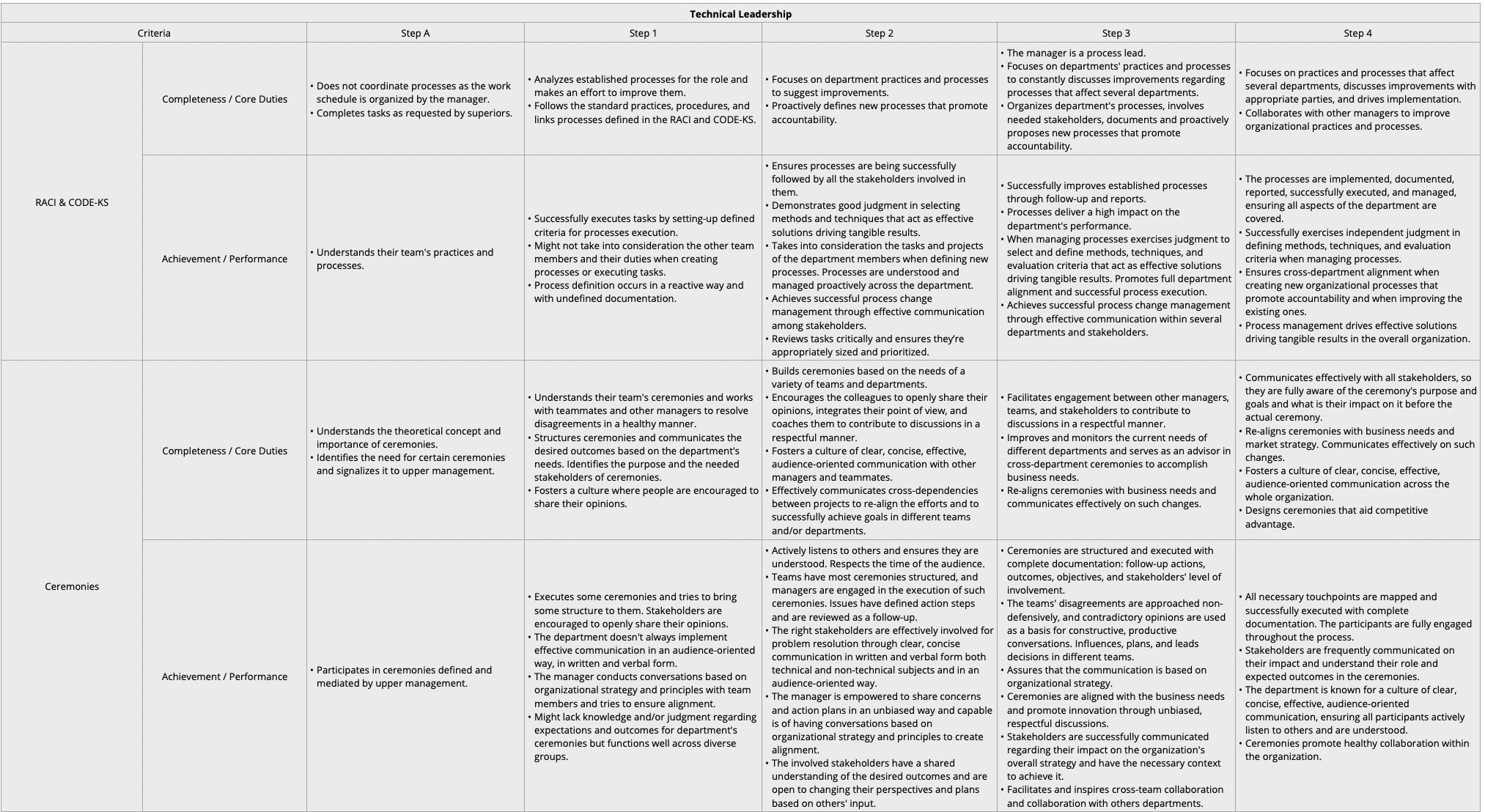
### Technical Leadership - the focus of Managers Level 1 (the Pace setters)

Technical Leadership encompasses the technical skills and know-how of leaders, which are closely connected to Process Management, Knowledge Management, and Team Management models.

* **Completeness**: focuses on how effectively leaders manage processes. It considers their ability to establish, enhance, and adapt processes to drive efficiency and productivity.
* **Achievement**: centers on performance and accountability. We assess how leaders continuously improve and adapt their technical knowledge to meet the evolving demands of their roles.

### People Management Leadership - the focus of Managers Level 2 (the Coaches)

In today's dynamic workforce, understanding and effectively managing diverse employees is paramount. Our solution revolves around the concept of:

* **Completeness:** the ability of a manager to seamless mapping positions within the company to achieve performance goals and project completion.
* **Achievement**: managers need to ensure that the right individuals are in the right roles, offering them ample opportunities for continuous growth and development. By nurturing talent and empowering them to thrive, your company will reach new heights of productivity and innovation.

### Business Leadership - the focus of Managers Level 3 (our Visioneries)

Business Leadership encompasses the skills and abilities required to find business opportunities, overcome strategic challenges, and create a supportive context for subordinates and stakeholders.

* **Completeness:** focuses on the leader's support in developing and completing strategic initiatives, as well as defining, monitoring, and reporting Key Performance Indicators (KPIs). It assesses how effectively leaders contribute to the strategic planning and execution processes
* **Achievement:** relates to the team's successful attainment of KPIs and goals, through the effective execution of initiatives. It evaluates how leaders drive their teams towards achieving business objectives and delivering measurable outcomes.

{% hint style="info" %}
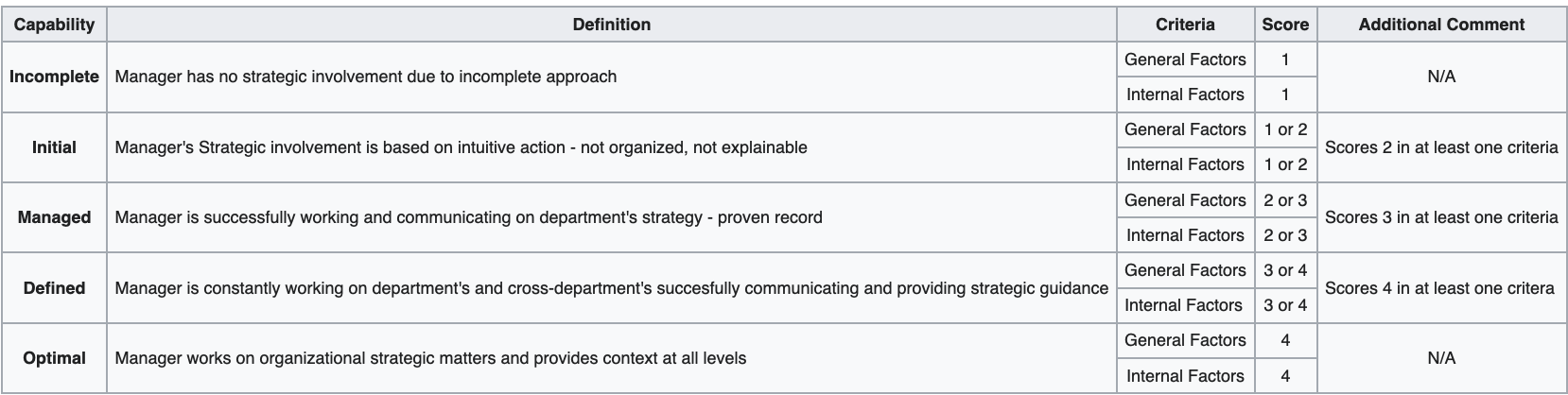
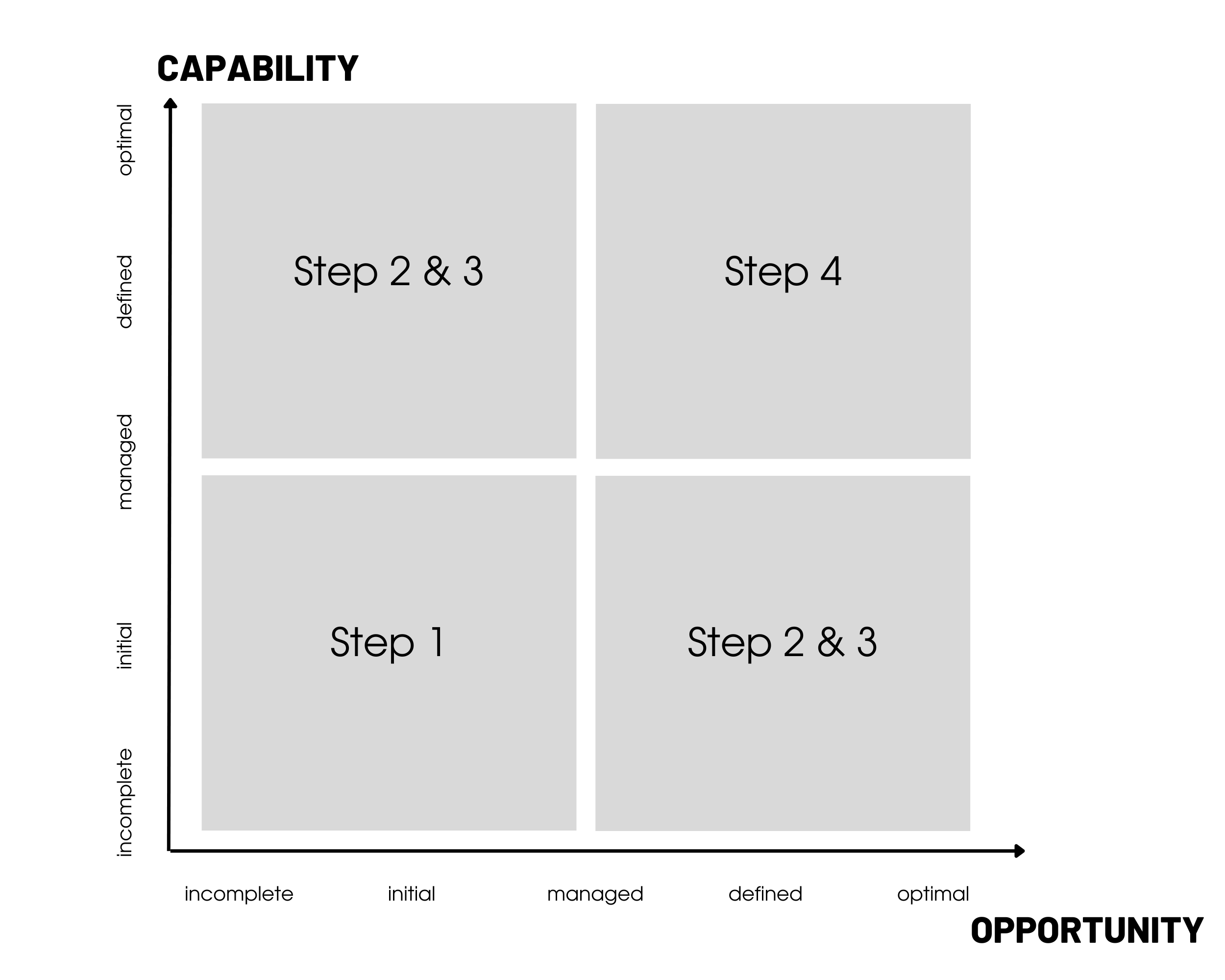
In addition to these factors, we also recoomend **Capability Assessment**, which measures the likelihood of success and execution of the strategy. This involves evaluating the leaders' ability to excel in their core responsibilities by effectively assessing their team's and division's capabilities to manage campaigns, business plans, projects, initiatives, and achieve business goals.
{% endhint %}

&#x20;**Capability Assessment** is further divided into two sub-categories:

* **General Factors:** This includes **possessing the necessary technical knowledge for the role,** understanding the domain of their team, and assessing the feasibility of their team's technical knowledge within the broader company context.
* **Internal Factors**: This pertains to **the leaders' understanding and familiarity with the company's unique identity, values, and offerings.**

{% hint style="info" %}
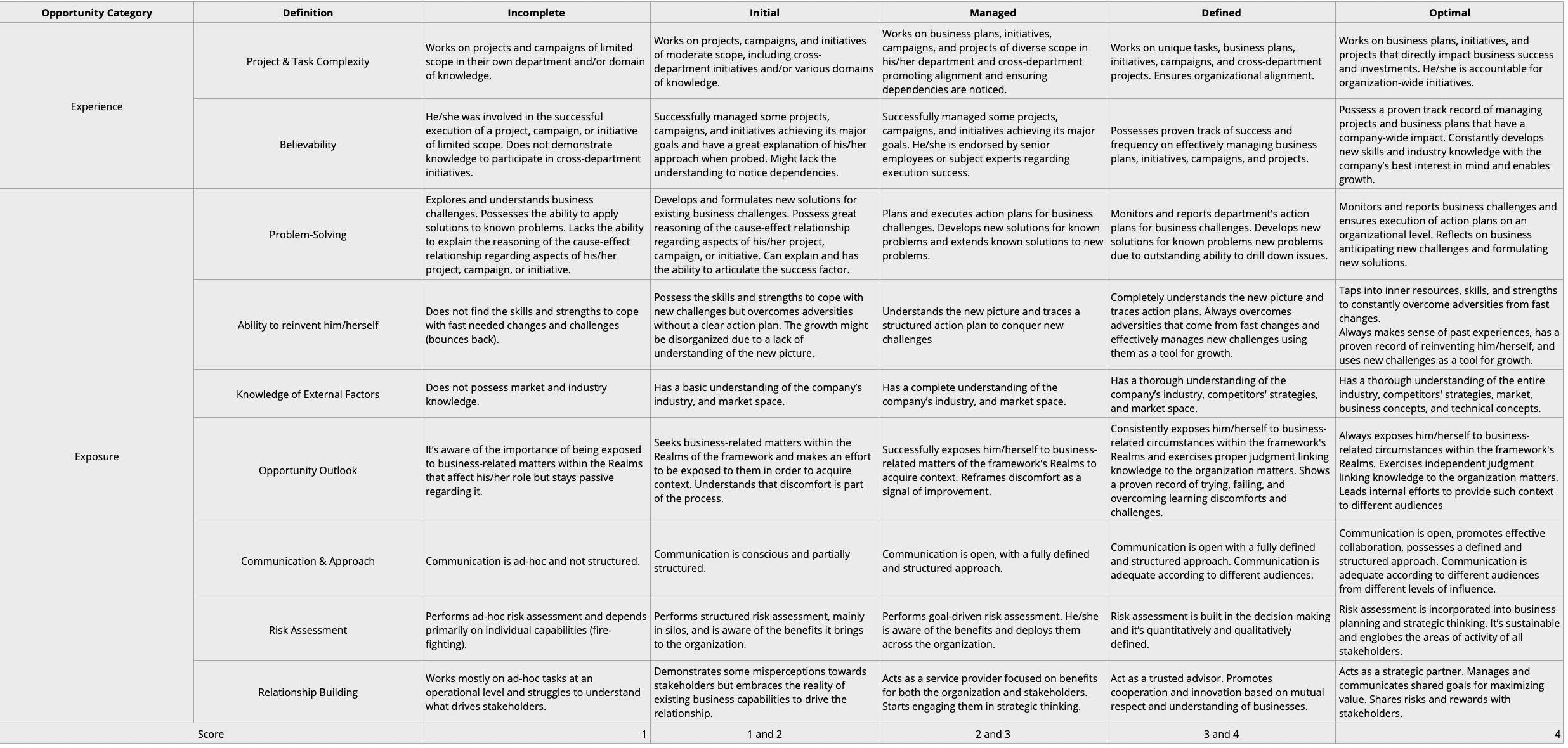
Furthermore, **Opportunity Finding** plays a crucial role in Business Leadership. **Leaders must possess the ability to identify potential business opportunities** and effectively address challenges.&#x20;
{% endhint %}

We divided this through **two sub-categories: Experience,** which evaluates the leaders' past experiences in recognizing and seizing opportunities, **and Exposure**, which measures their level of exposure to different business contexts and challenges.

* **Experience:** We recognize that invaluable learning and skill development occur through on-the-job experiences. Leaders who have navigated cross-departmental projects, engaged with stakeholders, and handled complex tasks possess a deep understanding of how their roles intertwine with others within the organization. When assessing candidates during the hiring process, we prioritize their relevant experiences in line with our business goals. This enables us to identify individuals who bring valuable insights and perspectives to our IT product landscape.
* **Exposure:** Adaptability is paramount in the ever-changing world of technology. Top leaders must possess the ability to reinvent themselves in the face of challenges and stay updated on market and industry trends. We assess a leader's level of exposure to the unique challenges we encounter in our business domain. Additionally, we recommend evaluating how they approach problem-solving in unfamiliar situations. Even if a candidate or employee hasn't directly encountered our specific challenges, we appreciate proactive efforts to seek exposure and gain insights into similar situations.

<details>

<summary>The ability to find opportunity also refers to:</summary>

<img src="https://476013847-files.gitbook.io/~/files/v0/b/gitbook-x-prod.appspot.com/o/spaces%2FCdGkCxKDvQdgeyQPlLua%2Fuploads%2FVvfwiwQ3H61kicQfIozO%2F1000px-TenTypesInnovation_Configuration.png?alt=media&amp;token=4af966a3-bd30-4e12-9609-13b9708411de" alt="" data-size="original">

<img src="https://476013847-files.gitbook.io/~/files/v0/b/gitbook-x-prod.appspot.com/o/spaces%2FCdGkCxKDvQdgeyQPlLua%2Fuploads%2F4xF5tlW1RUDqTZvoAWxE%2F1280px-TenTypesInnovation_Experience.png?alt=media&amp;token=f09ebafa-a323-475e-bc89-a00371c81288" alt="" data-size="original">

</details>

By evaluating Business Leadership you gain valuable insights into the strengths and areas of growth for leaders in driving the success of your organization.

### Adaptive Leadership - the focus of Managers Level 4 (the Transformational leader)

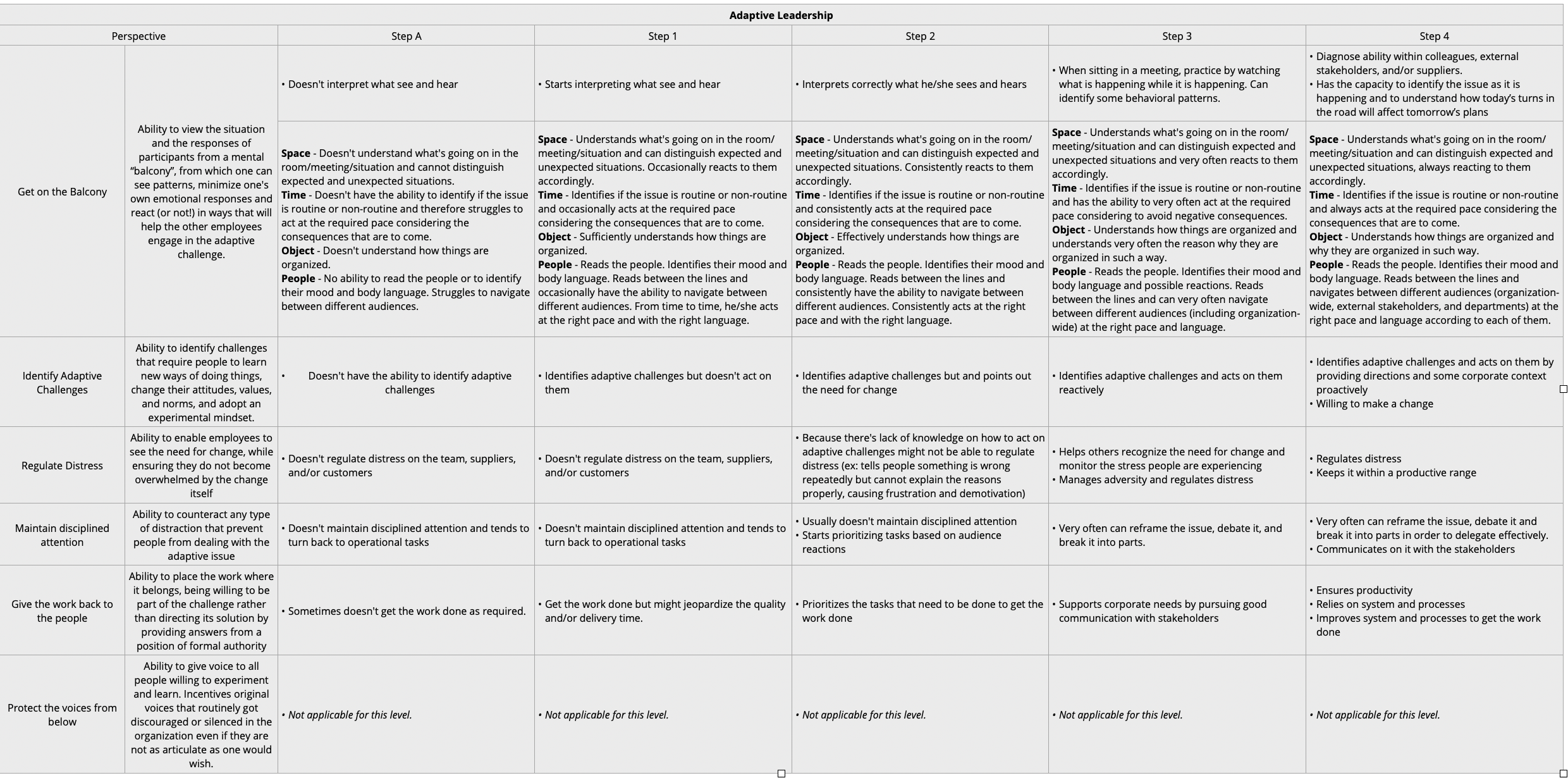
In a fast-moving industry like Tech things can change quickly and bring a certain amount of chaos. Those situations require our staff to adapt fast, which can be a challenge. These are the situations in which a true leader can shine. We consider 6 perspectives for success in this issue:

<table data-view="cards"><thead><tr><th></th><th></th><th></th></tr></thead><tbody><tr><td><strong>GET ON THE BALCONY</strong><br>This is the leader’s ability to distance themselves from the situation and take a birds-eye view. This allows them to see the bigger picture and act in an objective way, which is most beneficial to the company.</td><td></td><td></td></tr><tr><td><strong>IDENTIFY ADAPTIVE CHALLENGES</strong><br>Finding opportunities that require people to learn in an adaptive way and open their minds to new possibilities and ways of doing things.</td><td></td><td></td></tr><tr><td><strong>REGULATE DISTRESS</strong><br>Supporting the transition of employees during challenging times of change, by managing the pressure on them and their stress.</td><td></td><td></td></tr><tr><td><strong>MAINTAIN DISCIPLINED ATTENTION</strong><br>To ensure maximum focus, a leader should bring attention to what is important and shield the team from disruptive distractions.</td><td></td><td></td></tr><tr><td><strong>GET THE WORK DONE</strong><br>Motivating people and directing the workflow to make sure the work is done efficiently.</td><td></td><td></td></tr><tr><td><strong>PROTECT VOICES FROM BELOW</strong><br>Be inclusive and allow the opportunity to experiment with everyone and be capable of weighing their voices.</td><td></td><td></td></tr></tbody></table>

\
Regardless of their Level or Step, we believe **leaders have a crucial role in the operation of an orgnization.** Just as with other employees, they should be held accountable for their work and their performance, and only through excelling at their tasks can they rise up the Management Path. **The requirements are challenging, but only because excellent leadership is so important to the industry landscape.** \
\
You can find all [Levels and Steps in the next pages](/how-we-ensure-peoples-growth/performance/paths/management-path) and how we evaluate them.


# Team management

In the fast-paced world of tech companies developing cutting-edge mobile products for a global audience, **effective team management is the key to success**. Just like you, we understand the importance of [Strategic Management](/how-we-make-decisions/strategy/strategic-management) in driving our business forward. But we also firmly believe in empowering our workforce through [Context, Not Control](/how-we-make-decisions/strategy/context-not-control), which has proven to be a winning leadership style.

As our teams continue to grow at an exponential rate, providing the right context for every team member becomes a challenge we must address head-on. The key lies in striking a **balance between Strategic Management and Leadership**. **Our leaders** are not just taskmasters; they **are strategic thinkers** who guide the team towards achieving common goals. To achieve this, we follow some core principles:

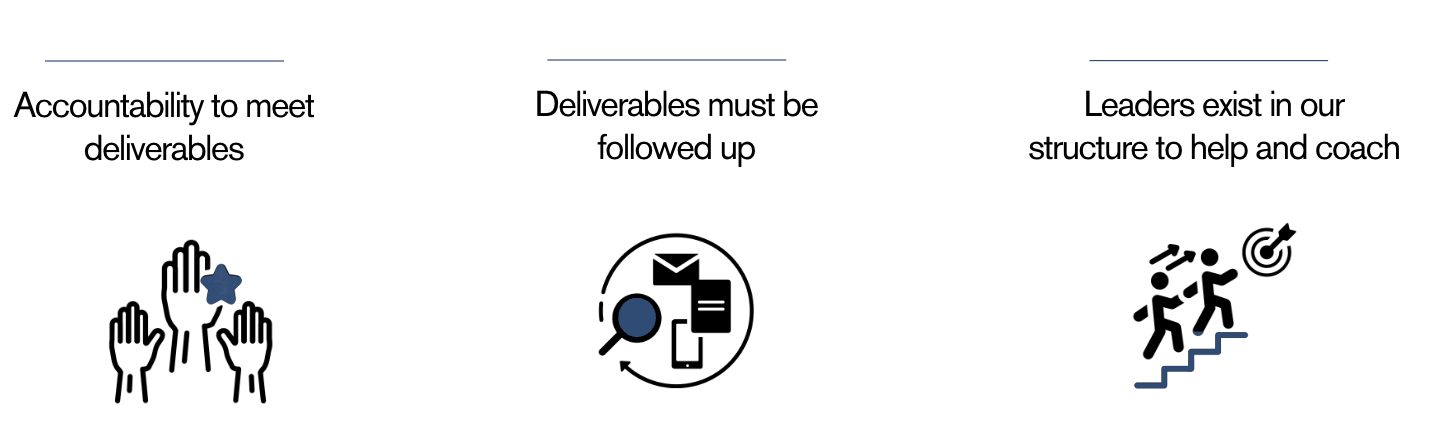
* **accountability for deliverables:** We hold ourselves accountable for meeting deliverables, ensuring that everyone knows their responsibilities.
* **following Up on deliverables:** Deliverables aren't just set and forgotten; we proactively follow up to track progress and provide necessary support.
* **coaching and assistance**: Our leaders are here to help and coach the team, fostering a collaborative and growth-oriented environment.

<figure><img src="https://476013847-files.gitbook.io/~/files/v0/b/gitbook-x-prod.appspot.com/o/spaces%2FCdGkCxKDvQdgeyQPlLua%2Fuploads%2FEVSCh3dNmUYgenyFHkfP%2FScreenshot%202024-05-31%20at%2012.30.46.png?alt=media&amp;token=50fb5b06-90d7-4ebe-abd2-3f865037f3f2" alt=""><figcaption></figcaption></figure>

At the same time, **we understand the importance of providing context to our employees**. Our leaders play a vital role in:

<table data-view="cards"><thead><tr><th></th><th></th><th></th></tr></thead><tbody><tr><td> <strong>Identifying and Supporting Employees</strong><br>Recognizing team members in need of assistance or those who may need additional support to improve their performance.</td><td></td><td></td></tr><tr><td><strong>Empowering High Performers</strong><br>We appreciate and encourage high performers, nurturing their potential to become future leaders.</td><td></td><td></td></tr><tr><td> <strong>Motivating Teams through Empowerment</strong><br>We firmly believe in empowering our teams, allowing them to flourish without unnecessary micromanagement.</td><td></td><td></td></tr></tbody></table>

Of course, in the tech industry, data breaches and information leaks are constant concerns. To combat this, we emphasize accountability between teams and individuals through robust processes that prioritize data security.


# Team Structure Designed for Success

Our team structure is carefully **crafted to ensure optimal performance and growth** across all levels.

| Entity         | Goal                                                                                                                                                                                                                |
| -------------- | ------------------------------------------------------------------------------------------------------------------------------------------------------------------------------------------------------------------- |
| **Division**   | Acting as separate entities, divisions are managed by experienced Level 3 or Level 4 managers. Their expertise ensures the smooth functioning of teams and departments, while also providing valuable coaching.     |
| **Department** | Comprising groups of frameworks divided into teams, departments are the backbone of our organization. Led by Level 2 managers, they oversee team growth and maintain essential documentation.                       |
| **Team**       | Teams form the heart of our company. From HR and Operations to various specialized teams, each is managed by a dedicated Level 1 manager, coordinating processes, and a Level 2 manager, driving the team's growth. |


# Embracing Effective Ceremonies

**To foster open communication, accountability, and minimize micro-management,** we employ structured touchpoints, or **ceremonies**, that keep everyone informed about company happenings. These ceremonies are essential for our success, as they:

1\.     **Eliminate Hierarchical Barriers:** Unlike traditional top-down communication, we empower every employee to communicate directly with others, regardless of rank or level. This approach ensures that information flows freely without any loss or distortion.

2\.     **Foster Collaboration and Innovation**: Strategic Sessions are a core part of our ceremony framework. These sessions enable teams to collaborate, exchange ideas, and find innovative solutions to achieve our business goals.<br>

Most traditional companies have a hierarchical, top-down structure of communication, in which the lower-level employees communicate with their leader/manager, who then shares information to their superior and to other managers connected to the project. This leads to slow communication and can result in some information being lost or changed in the process.

In LUNR, **we don’t use intermediaries and message carriers**. Instead, **every employee has the chance to talk directly to every other employee-related to their project to share information and updates, regardless of rank or Level.** The role of the leader in this structure is not to pass messages around, but to guarantee that both parties reach an agreement that will help LUNR reach its goals.\
\
&#x20;

<figure><img src="https://476013847-files.gitbook.io/~/files/v0/b/gitbook-x-prod.appspot.com/o/spaces%2FCdGkCxKDvQdgeyQPlLua%2Fuploads%2Fo566bg9cMYnNZpCT8BqD%2FScreenshot%202024-05-31%20at%2012.34.07.png?alt=media&amp;token=aaba48c5-7707-4427-b072-8c9bb999eeee" alt=""><figcaption></figcaption></figure>


# Strategic Sessions: Empowering Innovation

Strategic Sessions are **designed to spark ideas and solve problems** that drive us towards our objectives. Led by managers, these sessions consist of two vital stages:

**Discussion stage 1: Problem Framing**\
The goal of this stage is to define a single problem statement, which needs to answer these questions:

* <mark style="color:blue;">**Who**</mark> - Who has this problem? Can they validate that the problem is real? Can they prove it?
* <mark style="color:blue;">**What**</mark> - What is the nature of the problem? What research or supporting evidence can be provided?
* <mark style="color:blue;">**Why**</mark> - Why is the problem worth solving? What is the impact on the customer?
* <mark style="color:blue;">**Where**</mark> - Where does this problem arise? Has someone observed this problem occurring?

**Discussion stage 2: Analysis of strategic goals and definition of initiatives to address the problem**\
\
This stage deals with defining how the problem impacts our strategic goals and how to find the best way to solve it.


# Operations and roles

In the ever-evolving world of tech, success often paves the way for growth and expansion. As we aim to make a bigger impact on our industry and community, our organization naturally experiences an increase in size, including a surge in the number of employees and management layers.

However, **with growth comes complexity**, and without proper management, chaos can ensue. Many companies, in an attempt to retain control, resort to adding layers of bureaucracy and administrative processes. While this may temporarily boost productivity and stability, it often hampers the company's ability to respond swiftly to market changes and stifles the creativity of our talented workforce.

Why do most companies curtail freedom and become more bureaucratic as they grow?

The answer is:

* Desire for bigger positive impact creates growth.
* Growth increases complexity.
* Growth also often shrinks talent diversity (people tend to like stability when they realize some sort of chaos).
* Chaos emerges.

<div align="left"><figure><img src="https://476013847-files.gitbook.io/~/files/v0/b/gitbook-x-prod.appspot.com/o/spaces%2FCdGkCxKDvQdgeyQPlLua%2Fuploads%2Fy4OojrtlIKHxDqHTxlU2%2FScreenshot%202024-05-31%20at%2012.36.48.png?alt=media&amp;token=db52a108-0ee0-4fac-8a30-681519211403" alt="" width="375"><figcaption></figcaption></figure></div>

Bureaucracy emerges to stop the chaos but drives more talent out.

<figure><img src="https://476013847-files.gitbook.io/~/files/v0/b/gitbook-x-prod.appspot.com/o/spaces%2FCdGkCxKDvQdgeyQPlLua%2Fuploads%2FO7UaGPE0C5UuJcehErUY%2FScreenshot%202024-05-31%20at%2012.38.46.png?alt=media&amp;token=491c8a30-d21f-4834-870e-bde696b2620c" alt=""><figcaption></figcaption></figure>

We are acutely aware of the challenges that growth can bring in a dynamic industry like ours. We believe that there are three paths a company can take when faced with this situation and they are related to avoiding chaos as we grow with even more High-Performance people - not with rules. We will make this happen by those paths:

* <mark style="color:blue;">**Minimize rules as we grow.**</mark>
* <mark style="color:blue;">**Inhibit chaos with even more high performing people.**</mark>
* <mark style="color:blue;">**Flexibility is more important than efficiency in the long term**</mark>

This means we can continue to mostly run informally with self-discipline, and avoid chaos. Running informally enables and attracts creativity.

<div align="left"><figure><img src="https://476013847-files.gitbook.io/~/files/v0/b/gitbook-x-prod.appspot.com/o/spaces%2FCdGkCxKDvQdgeyQPlLua%2Fuploads%2FaB9YZDHBAzW28MooUUf1%2FScreenshot%202024-05-31%20at%2012.41.55.png?alt=media&amp;token=abeb6067-101d-4a32-8101-03aefff668d0" alt="" width="346"><figcaption></figcaption></figure></div>

This means we can continue to mostly run informally with self-discipline, and avoid chaos. Running informally enables and attracts creativity.


# How We Navigate Growth and Complexity

Instead of burdening our teams with a plethora of rules and administration, **we place our faith in our employees' drive and self-discipline**. We grant them the freedom they need to continue working effectively and remaining creative, even as our company expands. For us, the long-term benefits of flexibility and the free flow of ideas outweigh mere short-term efficiency gains.

**Our Approach in Two Simple Steps:**

1. <mark style="color:blue;">**Minimize Rules:**</mark> We believe in minimizing unnecessary rules and processes to make room for superior performance and innovation.
2. &#x20;<mark style="color:blue;">**Attract High-Performers:**</mark> Our emphasis lies in attracting and retaining the highest performers who possess the adaptability and responsibility needed to thrive in our dynamic environment.

#### Embracing Empowering Processes <a href="#epicmap-embracingempoweringprocesses" id="epicmap-embracingempoweringprocesses"></a>

While we recognize that not all processes are bad, we only implement those that empower our employees and promote accountability. Before introducing a new process, we carefully assess its potential impact by asking the following questions:

* &#x20;**Flexibility and Change**: Does the process accommodate changing tactics and circumstances?
* **Eliminating Bias:** Does it help eliminate biases and assumptions, fostering a fair and transparent working environment?
* **Data-Driven:** Can the process be evaluated using both qualitative and quantitative data to determine its effectiveness?
* &#x20;**Clear Goals:** Does it ensure explicit and transparent communication of objectives to all team members?
* **Encouraging Creativity:** Does the process provide teams the opportunity to draw on their creative intelligence?

But then how do we manage our company without lots of rules and administration getting in the way? Simple – we believe that not all processes are bad. For us, a **good process is one that empowers our employees and promotes accountability.** We only add those processes that are absolutely necessary and will not get in the way of our staff.

To minimize the necessary processes and rules, we ask ourselves a few questions before we introduce a new process. We determine whether it:

* Represents the current tactic with full knowledge that the tactic may change
* Tries to eliminate individual biases and assumptions
* Allows us to reflect on what is and isn’t working using both qualitative and quantitative data
* Helps us be explicit and transparent, so that everyone knows what we are trying to accomplish.
* Provides our teams with the opportunity to work flexibly, drawing on creative intelligence.

For cross-department, cross-division, and cross-team processes the same rules apply, with the point of attention that when one employee is handing over a part of a process to another employee in the chain, the relevant part has to also promote accountability.

So only when we answer YES to all those points we add the new process to our Responsibility Assignment Matrixes:

* [RACI for cross-department processes](/how-we-build-processes-and-a-great-product/operations-and-roles/our-responsibility-assignment-matrixes-raci-and-code-ks)
* [CODE-KS for in-department processes](/how-we-build-processes-and-a-great-product/operations-and-roles/our-responsibility-assignment-matrixes-raci-and-code-ks)

\
\
Learn more in the next pages.


# Our Responsibility Assignment Matrixes: RACI & CODE-KS

To **maintain clarity and accountability**, we utilize the **RACI matrix for cross-department processes and the CODE-KS matrix for in-department processes.** These matrices help us track roles, responsibilities, and progress efficiently.

### RACI MATRIX

<div align="center"><figure><img src="https://476013847-files.gitbook.io/~/files/v0/b/gitbook-x-prod.appspot.com/o/spaces%2FCdGkCxKDvQdgeyQPlLua%2Fuploads%2F9RRWB3FVmhGdNdMJQ2G9%2FScreenshot%202024-05-31%20at%2012.43.17.png?alt=media&amp;token=c01e1426-e36c-4d7f-b429-73adace3f211" alt="" width="330"><figcaption></figcaption></figure></div>

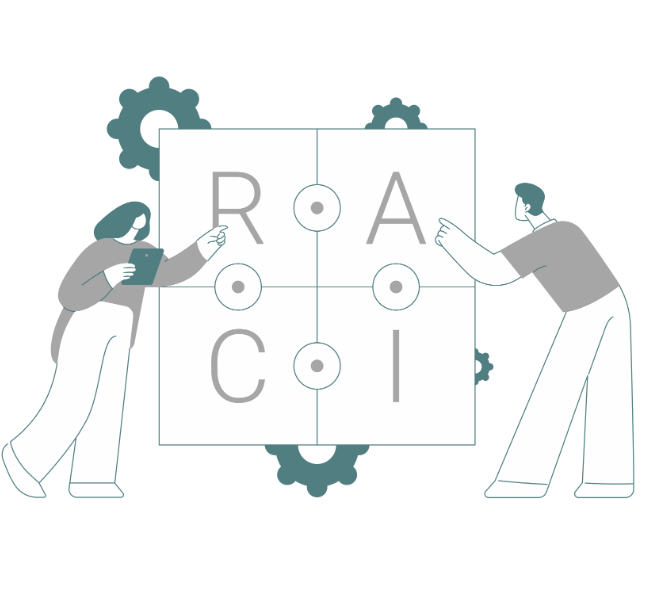
The RACI matrix is a snapshot of all the roles within a cross-department process. It allows us to track accountability and visualize who is responsible for tasks and make sure all assignments are running effectively. This way every member of a project can be informed and easily updated on the progress. It usually contains only 4 roles people can be assigned to, but in LUNR we have 6. They are:

<table data-view="cards"><thead><tr><th></th><th></th><th></th></tr></thead><tbody><tr><td> <mark style="color:blue;"><strong>R</strong></mark><strong>esponsible</strong><br>The person responsible for completing a task or project.</td><td></td><td></td></tr><tr><td><mark style="color:blue;"><strong>A</strong></mark><strong>ccountable</strong><br>The individual accountable for the overall execution of the task and final approval.</td><td></td><td></td></tr><tr><td><mark style="color:blue;"><strong>C</strong></mark><strong>onsulted</strong><br>Experts whose opinion is sought during the project.</td><td></td><td></td></tr><tr><td><mark style="color:blue;"><strong>I</strong></mark><strong>nformed</strong><br><strong>I</strong>ndividuals who need to be updated on the project's progress.</td><td></td><td></td></tr><tr><td><mark style="color:purple;"><strong>S</strong></mark><strong>upport</strong><br>This is someone who offers support with some specific process or concept on the task.</td><td></td><td></td></tr><tr><td><mark style="color:purple;"><strong>K</strong></mark><strong>nowledge-Lead</strong><br>This is someone who's responsible for documenting and delivering training regarding a specific process.</td><td></td><td></td></tr></tbody></table>

### CODE-KS MATRIX

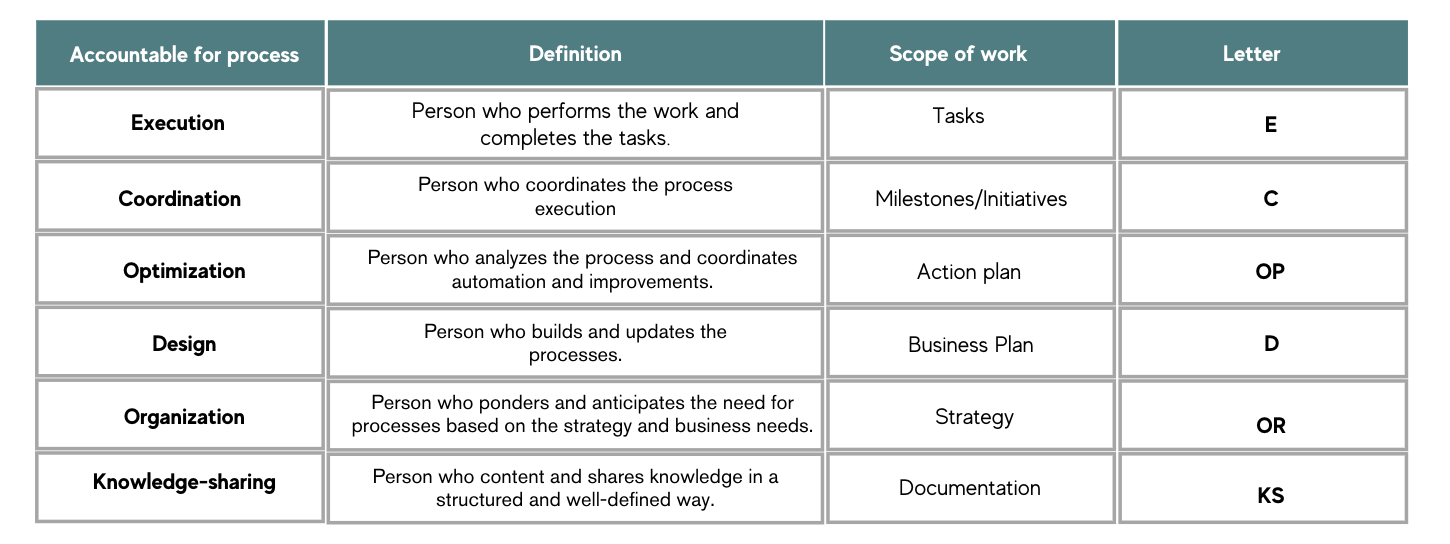
The CODE-KS matrix is used for in-department processes and it defines the accountability of each team member in every part of every process. An employee can be accountable for the process:

<figure><img src="https://476013847-files.gitbook.io/~/files/v0/b/gitbook-x-prod.appspot.com/o/spaces%2FCdGkCxKDvQdgeyQPlLua%2Fuploads%2FTyBeusrSKvPrJQ6CPdh3%2FScreenshot%202024-05-31%20at%2012.45.34.png?alt=media&amp;token=6905e19e-d7a8-4fa4-8aac-6e4e46e98efb" alt=""><figcaption></figcaption></figure>

&#x20;

**Benefits of RACI & CODE-KS Matrixes:**

* &#x20;**Increased Productivity**: Clearly defining roles reduces confusion and stress, enabling team members to focus on their responsibilities.
* **Targeted Training:** Proper role allocation ensures employees receive relevant training.
* **Streamlined Communication:** Knowing whom to approach for help reduces frustration and saves time.
* **Efficient Meetings:** Inviting only relevant individuals to meetings eliminates unnecessary attendance.
* **Alignment with Strategy:** The matrixes tie individual tasks to the organizational strategy, fostering a collective sense of purpose.
* **Enhanced Performance:** Empowering employees with clear expectations leads to higher performance.

We believe that by trusting high-performing teams and employing empowering processes, we can navigate growth and complexity while maintaining our agility and innovative spirit.


# Knowledge management

Our knowledge management strategy enables our organization to create, apply, and share information, breaking down silos and increasing the usage of valuable data.

We developed a **culture in which people feel independent and autonomous when working.** We believe traditional rigid management structures do not create a supportive environment, but cause unnecessary stress and distracts employees, which jeopardizes performance. Because of that, **we respect our people's skills and knowledge and support them to pursue the company’s goals in their own way.** This mutual respect between parties is essential to our Knowledge Management strategy and we can only afford this level of trust in our people if we know they are fully capable of doing their work and can fill any knowledge gaps quickly and efficiently.

It's a no-brainer that **knowledge enables us to grow and innovate**. But, it's a fact also that this is easier said than done. Before we reached our ideal Knowledge Management strategy, we faced some problems as the old way we managed information at was inefficient. Information was shared in a fragmented way, through email and messaging apps. When people needed information, they’d go to an expert and ask them, which not only wasted time but would only benefit one person. It was difficult for the person to retain the new information, especially if it was shared in passing conversation or buried among emails. The process was also not being overseen, so embellishments and inaccuracies could slip through, which could jeopardize the information. Finally, when a knowledge gap formed, we had no way to fill it, as the one-to-one nature of knowledge sharing was impossible to scale, and the gap would remain.

After learning from these past mistakes, we then decided where knowledge should NOT be. We realized our **knowledge should be easily accessible by our employees.** It should not be stuck in someone’s head, where it is of no use to anyone but the person - it would even be unhelpful since people would constantly interrupt their work with questions. It should also not be chaotically thrown around emails and messages, where it is impossible to track and collect. Nor should it be dumped in guides and manuals and be forgotten about, becoming obsolete and misleading.

To ensure the effectiveness of our knowledge management strategy we also defined knowledge sharing as criteria in the Levels of our Frameworks so to progress with us, individuals must demonstrate the capability of sharing knowledge in a structured way.


# Knowledge Categories

There are **three basic forms of knowledge** to consider when it comes to knowledge management: **explicit, implicit, and tacit**. Knowledge management is such a complex process that there are numerous terminologies, solutions, and techniques. Knowledge-driven businesses like ours have the advantage to drive efficient business activities by applying readily-available knowledge from a comprehensive, well-managed knowledge base. <br>

Knowledge in a business setting refers to the development of an organization's abilities, experiences, capabilities, and insight. All this is created, managed, and stored in the form of explicit knowledge, which is the focus of [Individual Contributors](/how-we-ensure-peoples-growth/performance/paths/individual-contributors-path), and tacit knowledge, which is the [manager](/how-we-make-decisions/leadership/managers)'s focus.

<figure><img src="https://476013847-files.gitbook.io/~/files/v0/b/gitbook-x-prod.appspot.com/o/spaces%2FCdGkCxKDvQdgeyQPlLua%2Fuploads%2FYcg24p1swj1zUTmCQyn7%2FScreenshot%202024-05-31%20at%2012.51.52.png?alt=media&amp;token=e4795621-0c73-41f2-8ff5-24cdbb3776d5" alt=""><figcaption></figcaption></figure>

To make it clearer, we separated the data and information into <mark style="color:blue;">**Extensive Knowledge, Realms Knowledge, and Organizational Knowledge.**</mark>

### Extensive Knowledge

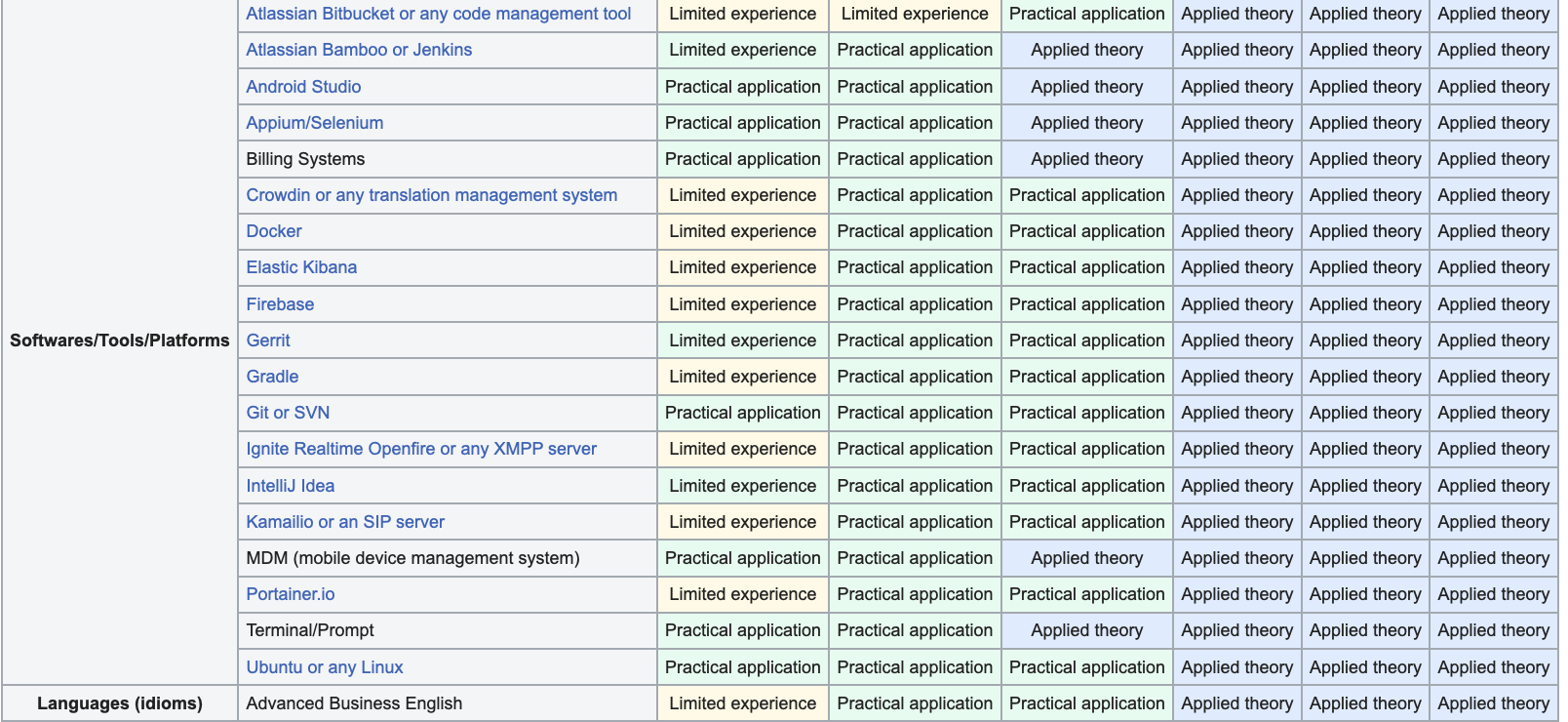
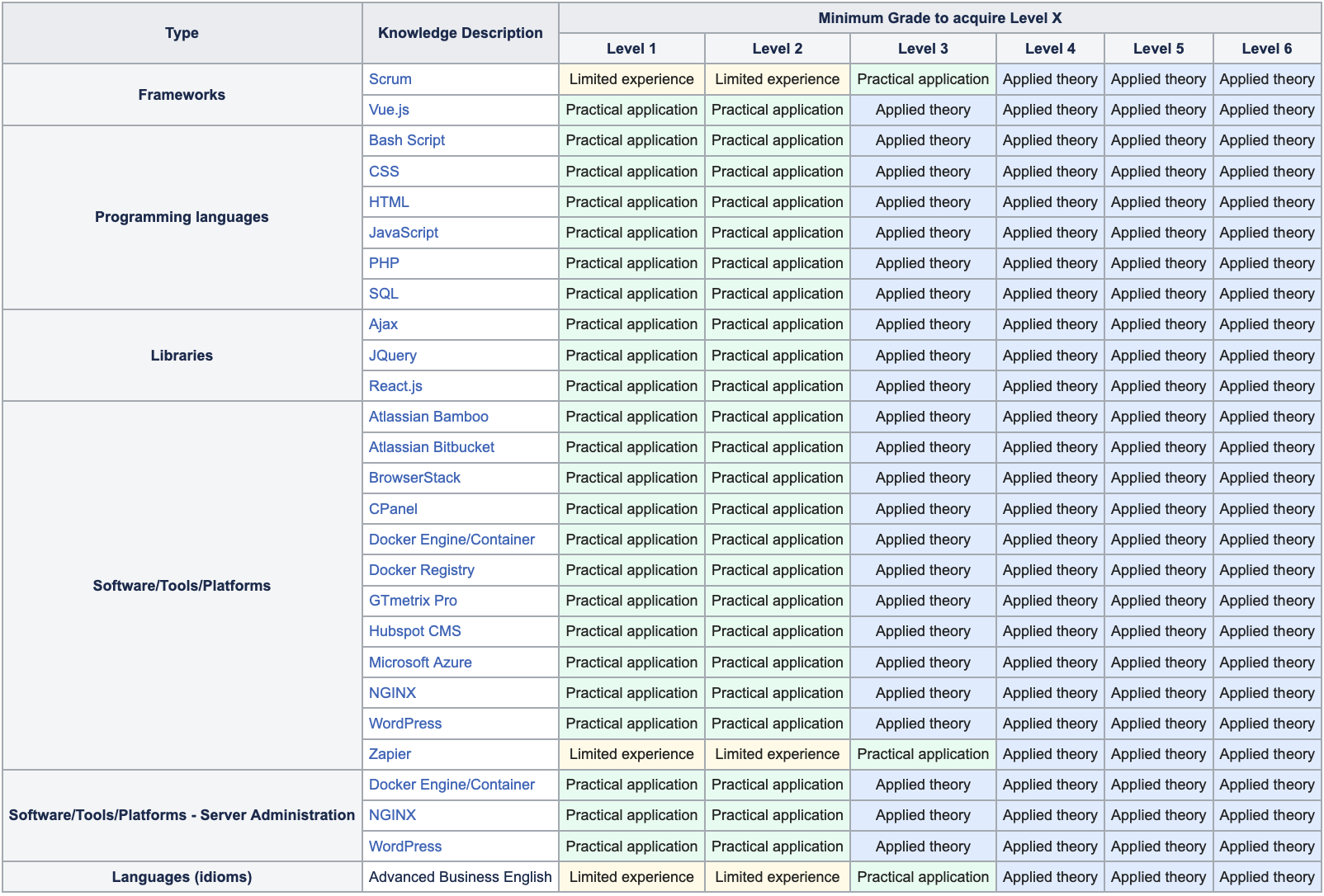
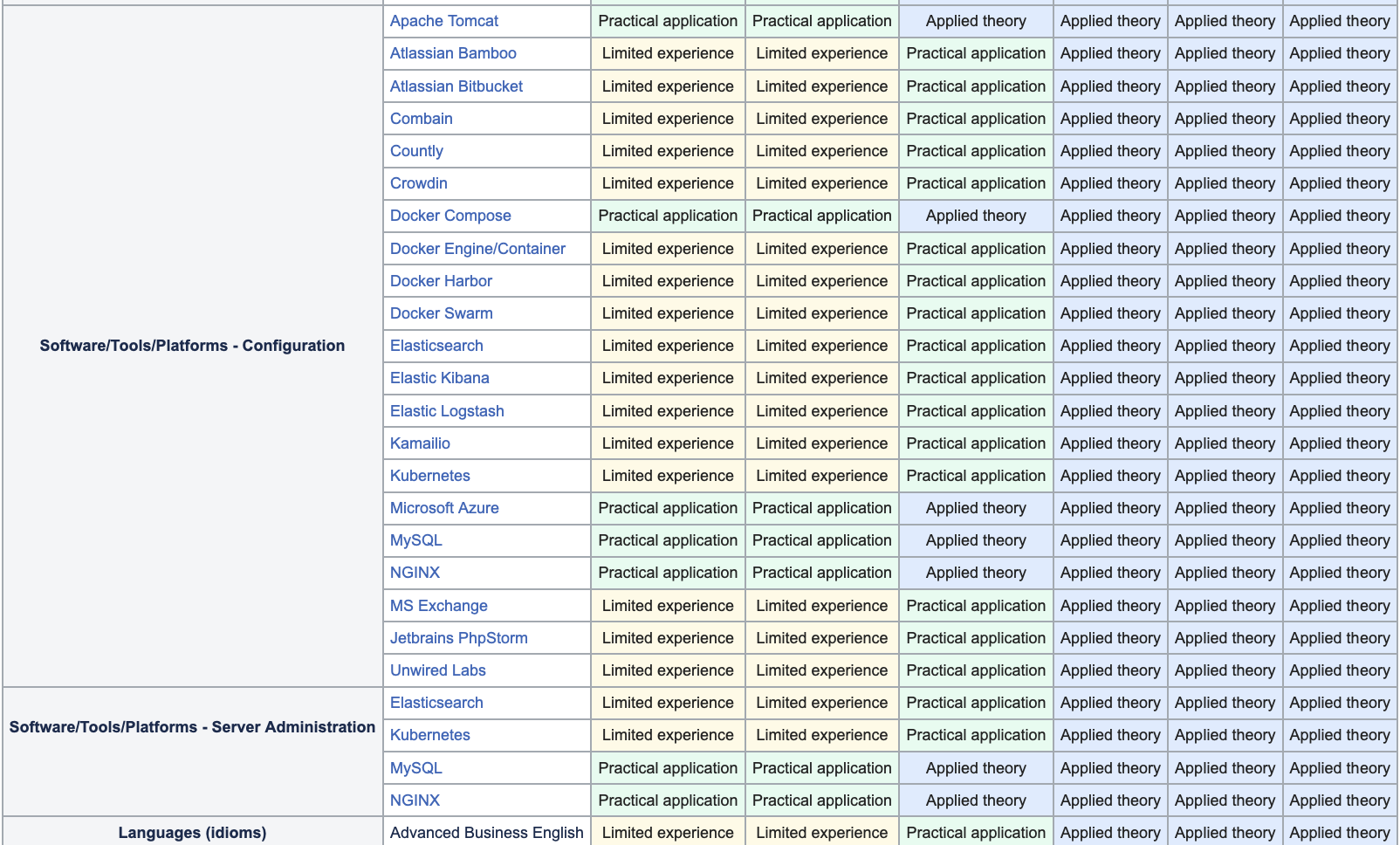
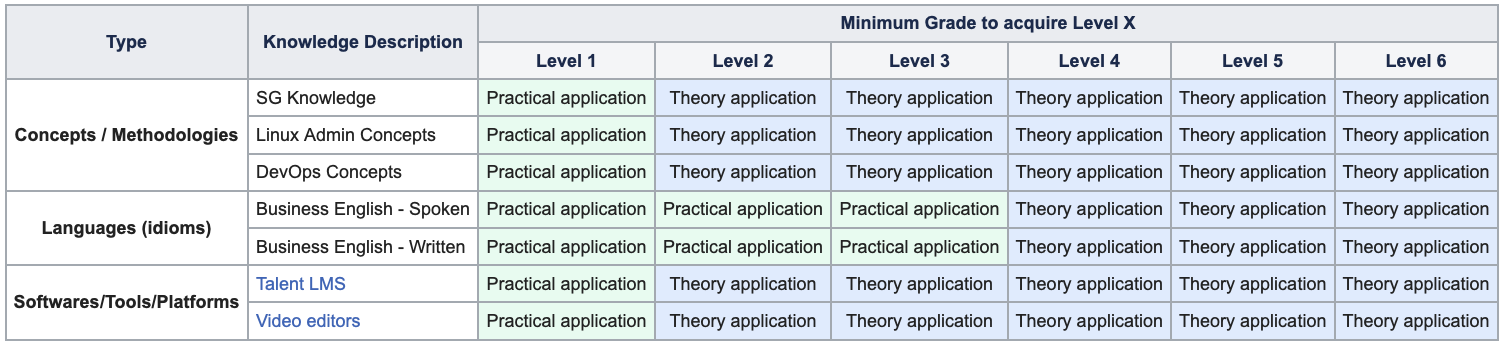
Also known as [**KAI of the framework**](/how-we-build-processes-and-a-great-product/knowledge-management/knowledge-accountability-index), this is about **understanding the usage and configuration of a diverse set of tools/software/platforms, languages, protocols, etc.** which affect your performance within the company. They are related to the scope of your position and employees should grow this knowledge and hard skills on their own, while the company will provide context on the application of the tool/software/platform within defined processes.

### [Realm](/how-we-build-processes-and-a-great-product/knowledge-management/realms) knowledge

We have categorized the concepts that are present in our business and operations into domains of knowledge or activity. When addressing business leadership, each management framework requires proficiency in one or more of such domains, which are called Realms.

### Organizational Knowledge

This is all about understanding the company’s products, the processes and tools/software/platforms related to their execution, the way all teams work, the concepts that are part of their scope, and how they contribute to the overall corporate strategy. It includes technical knowledge for non-technical people and business knowledge for technical people. For this category of knowledge, we provide pieces of training because this way we can ensure that everyone has the complete knowledge set to be a high-performer in our company.

**Problems we had with knowledge management:**

* Inefficient when serving only individuals: Information needed by many was often shared from individual to individual in conversation or email.
* Repetitious and time wasting: Often a few Subject Matter Experts are heavily relied upon to verbally provide information, and they spend their time repeating the same information rather than doing value-added work.
* Impermanent so ineffectual: Research shows it is difficult for people to retain information, especially when it is transferred verbally.
* No accountability or control: When no one was held accountable, the data shared could be inaccurate and out of date, and this was a problem that was difficult to fix.
* A self-fulfilling prophecy that recurs: The knowledge transfer process stopped when information was shared, but the knowledge gap still existed in the wider organization, leading to problem recurrence.

Where knowledge shouldn’t be:

* In inaccurate published content: Information may be published in manuals or on the intranet, and this may be outdated, inaccurate and hard to find, wasting time.
* In somebody's head: Information only held in someone's head is only of use to that person. Worse, they will be interrupted frequently with questions about it.
* In the cloud: Information may be recorded informally such as in emails, but this too is hard to find and often badly explained.

<figure><img src="https://476013847-files.gitbook.io/~/files/v0/b/gitbook-x-prod.appspot.com/o/spaces%2FCdGkCxKDvQdgeyQPlLua%2Fuploads%2FnB3FGptceQ2IfbzfvJNr%2FScreenshot%202024-05-31%20at%2012.56.57.png?alt=media&amp;token=bbf16114-f283-40b3-ba87-01592b6069c6" alt="" width="375"><figcaption></figcaption></figure>

<figure><img src="https://476013847-files.gitbook.io/~/files/v0/b/gitbook-x-prod.appspot.com/o/spaces%2FCdGkCxKDvQdgeyQPlLua%2Fuploads%2FzIfLGSozQFuzOSYSiLEx%2FScreenshot%202024-05-31%20at%2012.57.03.png?alt=media&amp;token=26dc9abc-01f8-426e-b45e-fbe7efb4a5d7" alt="" width="375"><figcaption></figcaption></figure>

Another thing we realized is that person has different ways of learning, advancing, and collaborating. We recognized this and decided to share knowledge in two formats: **reading and face-to-face courses with a practical application.** Therefore, we share knowledge through our internal wiki [**Confluence**](/how-we-build-processes-and-a-great-product/knowledge-management/confluence) **and through our** [**Learning Day**](/how-we-build-processes-and-a-great-product/knowledge-management/learning-day)**.**

<br>


# Knowledge Accountability Index

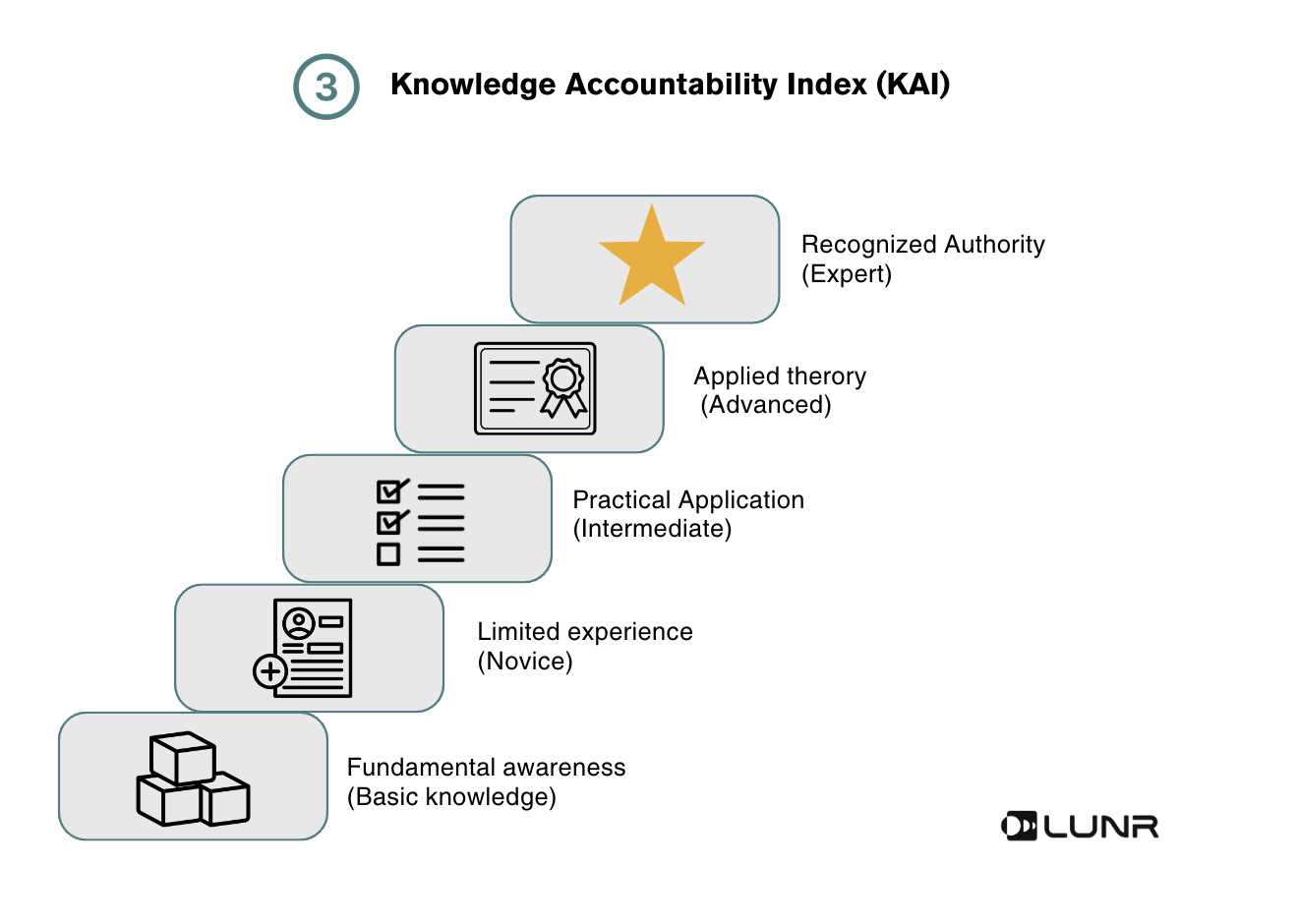
We believe **high-performance is all about accountability:** and that includes accountability in knowledge. Once information is systemized and available to all, it becomes measurable and this allows it to be considered within the employees’ performances. In order to manage the existing knowledge in the company and to promote such accountability, we created a **Knowledge Accountability Index a.k.a. KAI.**

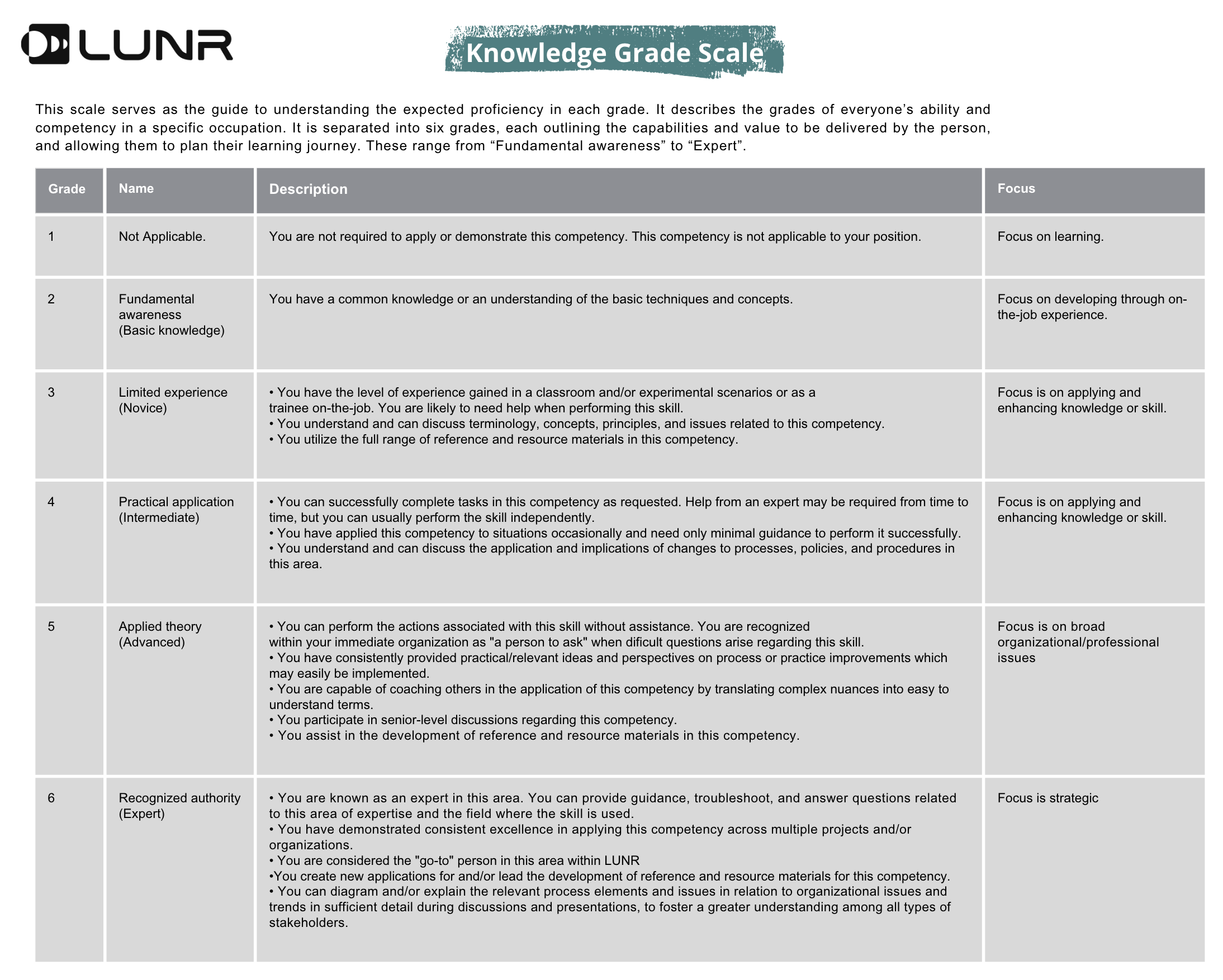
To help us measure competency in a skill, the i**ndex describes the grades of everyone’s ability and competency in a specific occupation.** It is **separated into six grades**, each outlining the capabilities and value to be delivered by the person, and allowing them to plan their learning journey. These range **from “Fundamental awareness” to “Expert”**. The index can be used by an individual to compare their current level of proficiency to top performers in the same occupation and it enables us to:

* Centralize effort to understand technology trends from a holistic view
* Define knowledge as a key component in high performance
* Anticipate and adapt to changes in external/internal environments to obtain/retain a competitive advantage in a quantifiable structure

It's clear that the effective management of knowledge aids competitive advantage. When people are accountable for knowledge it can be shared more efficiently and productively. We have put in place systems and good processes to achieve this so armed with knowledge, our employees are better able to innovate in their work.<br>

### Knowledge Grade Description

This scale serves as the guide to understanding the expected proficiency in each grade.
<figure><img src="https://476013847-files.gitbook.io/~/files/v0/b/gitbook-x-prod.appspot.com/o/spaces%2FCdGkCxKDvQdgeyQPlLua%2Fuploads%2Fp9qwtcGDmfvFFVC4fUW1%2FScreenshot%202024-05-31%20at%2013.03.58.png?alt=media&amp;token=0d083969-d7ff-4eb1-a996-1187b0c20c3e" alt=""><figcaption></figcaption></figure>

<figure><img src="https://476013847-files.gitbook.io/~/files/v0/b/gitbook-x-prod.appspot.com/o/spaces%2FCdGkCxKDvQdgeyQPlLua%2Fuploads%2FIH8AH2nrb1u1atqN5cbH%2FScreenshot%202024-05-31%20at%2013.05.44.png?alt=media&amp;token=aac23ce0-5a12-46a2-93f7-4dfe1c6120c8" alt=""><figcaption></figcaption></figure>


# Confluence

Our wiki acts as a single source of all knowledge for our organization which can be created, edited, and modified by any employee. Confluence functions as a central repository for managing and distributing all company knowledge and information. Here, all co-workers are responsible and accountable for storing internal documentation about company policies, processes, projects or products they are building, common workflows, procedure checklists, and more. We currently have Departments spaces composed of standard operation procedures, playbooks, how-to-guides and processes documentation, Teams spaces composed of operational artifacts and Divisions spaces hyperlinking all the content.


# Learning day

The Learning Day is our knowledge-driven initiative and it occurs on the last Tuesday of each month. It is a whole day dedicated to Learning. We start with breakfast at 9h00 filled with brain booster food and after that, we start the training according to the following formats:

* **Tech Challenges**: consist of a presentation with an instructor that will act as a facilitator for the employee to assimilate the knowledge. After the training, employees receive a Tech Challenge to prove that they are capable of completing tasks relating to what they just learned.
* **Tech Sessions**: consist of a collaboration activity or open format seminar. It can be given by an external trainer and it also comes with a task to be completed that varies from topic to topic.

<figure><img src="https://476013847-files.gitbook.io/~/files/v0/b/gitbook-x-prod.appspot.com/o/spaces%2FCdGkCxKDvQdgeyQPlLua%2Fuploads%2FEsrjiKt0VIcgej7YCsw2%2FScreenshot%202024-05-31%20at%2013.06.54.png?alt=media&amp;token=48b19fca-63a1-459a-b913-e5261c190417" alt=""><figcaption></figcaption></figure>

After the completion of a training session, you will receive a challenge to prove you are capable of completing tasks related to what you just learned. They are usually short exercises to test you.&#x20;


# Company Knowledge Centricity Level

The Company Knowledge Centricity Level is a measure of **how well knowledge is integrated, managed, and utilized within an organization.** It helps to understand the maturity of knowledge management practices and their impact on business performance.\
\
At LUNR, the Company Knowledge Centricity Level reflects **how integrated and essential knowledge is within our operations**. Currently, different departments are at Grade 2 and Grade 3, meaning we have a solid foundation but still have room for improvement. **Our goal is to reach Grade 5 by next year**, where knowledge is fully centralized, easily accessible, and efficiently shared across the entire organization. This ensures everyone can innovate and perform at their best, contributing to our mission of creating secure, ethical mobile technology.<br>

<figure><img src="https://476013847-files.gitbook.io/~/files/v0/b/gitbook-x-prod.appspot.com/o/spaces%2FCdGkCxKDvQdgeyQPlLua%2Fuploads%2FuvzzTN0WNpMXAmdzHVEM%2FScreenshot%202024-05-31%20at%2013.05.55.png?alt=media&amp;token=ce74709a-3d67-45ed-8981-588dc392a986" alt=""><figcaption></figcaption></figure>


# Realms

The Realms are part of LUNR [Knowledge Management](https://managementmodel.info/index.php?title=Knowledge_Management) strategy and englobe concepts, domains, formats, definitions, and areas of activities that cover all aspects of our business. To grow in LUNR, our employees need to show proficiency and find business opportunities based on one or more realms according to their management framework. Such knowledge is extremely important to be developed so people are capable of having meaningful discussions and effectively participating in the development of their teams, projects, and our product.

## Marketing Realm

<div><figure><img src="https://476013847-files.gitbook.io/~/files/v0/b/gitbook-x-prod.appspot.com/o/spaces%2FCdGkCxKDvQdgeyQPlLua%2Fuploads%2Faxqd8ublLIRca1oBhhoB%2FMarketing_Destinations_Realm.png?alt=media&amp;token=14eff437-487f-45b6-92fa-aaae1aef4a03" alt=""><figcaption></figcaption></figure> <figure><img src="https://476013847-files.gitbook.io/~/files/v0/b/gitbook-x-prod.appspot.com/o/spaces%2FCdGkCxKDvQdgeyQPlLua%2Fuploads%2FM3VEO88HBIhQ0gAi5hJd%2FMarketing_Strategy_and_Concepts.png?alt=media&amp;token=b225854b-a8fe-4230-afa1-62b10941f401" alt=""><figcaption></figcaption></figure></div>

## Business Development Realm

<figure><img src="https://476013847-files.gitbook.io/~/files/v0/b/gitbook-x-prod.appspot.com/o/spaces%2FCdGkCxKDvQdgeyQPlLua%2Fuploads%2FmvICTHnew8P36I9hDXwZ%2FBDev_Realm.png?alt=media&amp;token=73cf28f3-8c59-49dd-ad4c-8547a7f857e2" alt=""><figcaption></figcaption></figure>

## Customer Service Realm

<figure><img src="https://476013847-files.gitbook.io/~/files/v0/b/gitbook-x-prod.appspot.com/o/spaces%2FCdGkCxKDvQdgeyQPlLua%2Fuploads%2FF9TRGfFtBYyHaSjZ2P7S%2FCustomer_Service_TAM_Realm.png?alt=media&amp;token=417529ba-ef6e-4046-bd5d-19d774f33f13" alt=""><figcaption></figcaption></figure>

## Product Management Realm

<figure><img src="https://476013847-files.gitbook.io/~/files/v0/b/gitbook-x-prod.appspot.com/o/spaces%2FCdGkCxKDvQdgeyQPlLua%2Fuploads%2FzMUvgdnGY1FZG8PkIHJT%2FProduct_Mgt_Realm.png?alt=media&amp;token=14ea9e28-98ed-4416-b9e9-6adc8d6f69f9" alt=""><figcaption></figcaption></figure>

## Project Management Realm

<figure><img src="https://476013847-files.gitbook.io/~/files/v0/b/gitbook-x-prod.appspot.com/o/spaces%2FCdGkCxKDvQdgeyQPlLua%2Fuploads%2F8XWF3NWevcXpIfAu11id%2FPM_Realm.png?alt=media&amp;token=adfdf562-f23f-40cc-ad25-82b4756ee407" alt=""><figcaption></figcaption></figure>

## Software Engineering Realm

<figure><img src="https://476013847-files.gitbook.io/~/files/v0/b/gitbook-x-prod.appspot.com/o/spaces%2FCdGkCxKDvQdgeyQPlLua%2Fuploads%2FjtvSCJtMM1wvoLZzowqT%2FSoft_Eng_Realm.png?alt=media&amp;token=af92c277-3873-4cb6-83ad-7b4b3cb3a113" alt=""><figcaption></figcaption></figure>

## Product Owner Realm

<figure><img src="https://476013847-files.gitbook.io/~/files/v0/b/gitbook-x-prod.appspot.com/o/spaces%2FCdGkCxKDvQdgeyQPlLua%2Fuploads%2FYs65RPkqxXh2US5iMK4D%2FProduct_Mgt_Realm.png?alt=media&amp;token=53e88926-ff0f-45fe-bb31-fde8233ca51d" alt=""><figcaption></figcaption></figure>

## Information Security Realm

<figure><img src="https://476013847-files.gitbook.io/~/files/v0/b/gitbook-x-prod.appspot.com/o/spaces%2FCdGkCxKDvQdgeyQPlLua%2Fuploads%2FVXLjJg56HHpoECAUdN5a%2FInformation_Security_Realm.png?alt=media&amp;token=03150d50-2648-4740-bb3d-e2417ef71bd1" alt=""><figcaption></figcaption></figure>

## Manufacturing Realm

<figure><img src="https://476013847-files.gitbook.io/~/files/v0/b/gitbook-x-prod.appspot.com/o/spaces%2FCdGkCxKDvQdgeyQPlLua%2Fuploads%2FGwUUYIXRzhm2aqUJCrSy%2FManufacturing_Realm.png?alt=media&amp;token=ae76008e-7c90-4e6c-8cf9-98e042eecd45" alt=""><figcaption></figcaption></figure>

## HR Realm

<figure><img src="https://476013847-files.gitbook.io/~/files/v0/b/gitbook-x-prod.appspot.com/o/spaces%2FCdGkCxKDvQdgeyQPlLua%2Fuploads%2FbcvztDbtkuzPJTYbTpJp%2FHR_Realm.png?alt=media&amp;token=1ccc70ae-99ab-41fe-97be-79acfa145456" alt=""><figcaption></figcaption></figure>

## Supply Chain Realm

<figure><img src="https://476013847-files.gitbook.io/~/files/v0/b/gitbook-x-prod.appspot.com/o/spaces%2FCdGkCxKDvQdgeyQPlLua%2Fuploads%2F2Q5o2AOjntf9LQz5vY1z%2FHR_Realm.png?alt=media&amp;token=ba04a72a-50f0-4193-a0ec-34b1e8db3861" alt=""><figcaption></figcaption></figure>

## Finance Realm

<figure><img src="https://476013847-files.gitbook.io/~/files/v0/b/gitbook-x-prod.appspot.com/o/spaces%2FCdGkCxKDvQdgeyQPlLua%2Fuploads%2Fes7Q4cZwaUTJK4mSKyOE%2FFinance_Realm.png?alt=media&amp;token=daeaa28c-f2d8-482d-8e42-f26ec17c7428" alt=""><figcaption></figcaption></figure>

## Technical Support Realm

<figure><img src="https://476013847-files.gitbook.io/~/files/v0/b/gitbook-x-prod.appspot.com/o/spaces%2FCdGkCxKDvQdgeyQPlLua%2Fuploads%2FkmKtqHziA6eEI8UtsPQU%2FTechnical_Support_Realm.png?alt=media&amp;token=a9277094-966a-4a9b-8215-243df1e25865" alt=""><figcaption></figcaption></figure>


# Engineering culture

Our engineering culture enables us to create innovative mobile devices that people love while ensuring the highest standards of privacy and data protection. We seek to push the boundaries of mobile technology to achieve new and exciting advancements. We automate and continuously integrate to make our devices truly great.

Our team thrives on collaboration and open communication, ensuring that every member contributes to our success. We value continuous learning and encourage sharing knowledge through regular workshops and peer reviews. By doing so, we build a strong foundation for both individual and collective growth.


# Engineering culture

Engineering Culture values derive from Company culture and Agile Software Development values. We believe they complement each other in the right way and enable us to create innovative mobile devices that people love while ensuring the highest standards of privacy and data protection. We seek to push the boundaries of mobile technology to achieve new and exciting advancements. We automate and continuously integrate to make our products great.

\
In **Agile way of working,** we value:

* **Individuals and interactions** over processes and tools
* **Working software** over comprehensive documentation
* **Customer collaboration** over contract negotiation
* **Responding to change** over following a plan

That is, while there is value in the items on the right, we value the things on the left more.\
You can find more information about the twelve principles of the Agile Manifesto (written above) [here](http://agilemanifesto.org/principles.html).\
\
In Software Engineering there are two teams: **Quality Assurance and Software Development.** The Development Department is divided in two teams that need to deliver features every release cycle - Feature OS Team and Apps Team. We use the **Scrum Framework** for the Apps Team. It is a framework within which people can address complex adaptive problems, while productively and creatively delivering products of the highest possible value. The essence of Scrum is a small team of people - **Apps Team - Scrum**, and their associated **roles, events, artifacts, and rules**. The team is highly flexible, adaptive, and collaborative.\
Our talented engineers are at the cutting edge of driving our business forward with advancing technology. Building great software is as much about behavior as it is about coding. Our engineers are responsible for more than just coding. To create excellence requires a commitment to and ownership of the development processes. By committing to this Engineering Culture, we can perform better and achieve so much more together.

### Coding Standartds

* We follow the general Android coding style (default for Android Studio which is listed in the [Android website](http://developer.android.com/))
* We follow the Android Naming convention and naming conventions provided by Java/Kotlin coding standards.
* We format code and file structure using "ctrl + alt + L" everywhere so that the code remains consistent and easy to understand.
* Commit naming – the name must contain the task number, and it should briefly explain the implementation or problem it fixes.

### Code Reviews

* At least two other developers must review each commit before it is tested.
* If the scope of the review is too big, we estimate additional time.
* During the code review, all Unit tests should be passing. They are automatically run by Bamboo, and prevent in Bitbucket a pull request to be merged.
* Each review should focus on evaluating code quality. If you are reviewing a fixed bug, the solution should be the simplest one.
* If a bug requires refactoring or a change in design and architecture, it should be planned separately as an improvement.
* If feature implementation is reviewed, the reviewer should make sure he/she knows the implementation logic. Check it covers all the acceptance criteria.
* Code reviews are done at the start of each working day to avoid disrupting other daily activities. Items should spend the minimum possible time in the "In Review" stage.

### Architecture

* We aim for scalable, easy to explain and support, design of architecture without implying over-engineering.
* We follow SOLID principles and Clean Architecture patterns. We meet and present the new plan, and if it has any team dependency, the team is asked to join.
* Everyone is welcome to share an opinion regardless of seniority.

### Programming Language

* We prefer to use known and proven languages.
* We explore new options but only implement them if the benefit is confirmed and if maturity is high enough.

### Testing

* We follow TDD, so each new feature must be tested. Our goal is 100% test coverage of new features so each merge request goes through QA.
* Everyone is responsible for the quality, and this starts from the planning stage, goes through development, and ends up with testing.
* Each team member tests their work before handing it over. This way we can ensure no time is wasted on small defects caused by underlooking a ticket.

### Build vs. Buy

* We prefer to build most of our environment and tools.
* Buying sometimes requires a higher investment than just the price of the tool.
* A key concern is our customers' privacy, and we cannot rely on others to protect that.

### Security and Data Privacy

* User privacy is a core goal.
* We do not store private information or take information without first requesting it.
* When we need user data, we have to request permission first to the user and bring awareness to him/her of the need behind this request.


# Team culture

Scrum is an empirical process, "the art of the possible," and places great emphasis on mind-set and cultural shift to achieve business and organizational Agility.&#x20;

#### The Scrum Values

Scrum incorporates five core values that empower teams to work effectively:

1. **Commitment** - Team members individually commit to achieving team goals.
2. **Courage** - Everyone must have the courage to make tough decisions and take action.
3. **Focus** - All efforts should be directed toward the team's Sprint Goal.
4. **Openness** - Team members should be open about their work and any challenges they face.
5. **Respect** - Each person should respect their colleagues and their capabilities.

By embracing these values, teams create an environment of trust and efficiency that fosters success.

### The Three Pillars of empiricism

{% tabs %}
{% tab title="Transparency" %}
This means presenting the facts as is. All people involved are transparent in their day-to-day dealings with others. They all trust, respect, help each other. They also keep each other informed of good news as well as bad news. Observers should share a common understanding:

* All participants must share a common language referring to the process
* Those performing the work and those inspecting the resulting Increment must share a common definition of "Done."
  {% endtab %}

{% tab title="Inspection" %}
Scrum users must frequently inspect the work items and progress toward a Sprint Goal to detect undesirable variances. It is an action required by everyone on the Scrum team, not by an auditor or external party. Inspections are most beneficial when diligently performed by skilled people at the point of work but should not be so frequent that it gets in the way of the work.
{% endtab %}

{% tab title="Adaptation " %}
Adaptation is about continuous improvement - the ability to adapt based on the results of the inspection. Everyone in the team must ask this question regularly: Are we better off than yesterday? If any member determines aspects of a process and progress deviates outside acceptable limits, the team should adjust their process or work as soon as possible to minimize further deviation.
{% endtab %}
{% endtabs %}

\
**When the Scrum values commitment, courage, focus, openness, and respect are embodied and lived by the team, then transparency, inspection, and adaptation come to life and build trust for everyone.** People becoming proficient in living up to those values leads to a higher personal commitment to achieving the goals of the team. The members have to have the courage to do the right thing and work on tough problems as well as respect each other to be capable, independent people. Everyone focuses on the work of the Sprint and the goals of the team.


# Engineering Process and Roles

### The product owner

Product Owner is a role within Agile teams and in our company, belongs to the Project Management framework. He/she is r**esponsible for maximizing the value of the product**, which is a result of the work done by the Development Department. The Product Owner is **the sole person responsible for managing the Product Backlog**. The Scrum Master is a servant-leader for the Scrum Team. The Scrum Master helps those outside the Scrum Team understand which of their interactions with the Scrum Team are helpful and which aren't. The Scrum Master helps everyone change these interactions to maximize the value created by the Scrum Team. Even that Scrum Master is a different role, in our current implementation of the Scrum framework, the Product Owner serves it. In this setup, the **Product Owner scope is**:

* Ensure arranging the Product Backlog to maximize value.
* Find techniques for effective Product Backlog management.
* Understanding and practicing Agility.
* Ensuring everyone on the team has a context on the product Business goal and scope.
* Ensuring that the Product Backlog is visible, transparent, and clear to all, and shows what the Scrum Team will work on next.
* Ensuring the Development Department understands items in the Product Backlog to the level needed.
* He/She is a single entry point for any communication and work that needs to be done by the Development Department.
* Helping the team understand the need for clear and concise Product Backlog items.
* Understand product planning in an empirical environment.
* Facilitate the Scrum events as requested or needed.
* Coaching the Development Department in self-organization and cross-functionality.
* Coach the Development Department in the framework Scrum.
* Help the Development Department to create high-value products.
* Remove impediments to the Development Department's progress.

### The development Department

The Development Department **consists of professionals who do the work of delivering a potentially releasable Increment** - a portion of "Done" product items at the end of each Sprint. The teams in this department are structured and empowered by the organization to manage their work. The result is optimized overall efficiency and effectiveness. Here are their treats:&#x20;

* They are self-organizing.
* The teams are cross-functional, with all the skills needed to create a product Increment.
* Scrum recognizes no titles nor sub-teams for team members, regardless of the work performed or domains like testing, architecture, operations, or business analysis.
* Accountability and responsibility belong to the Development Department as a whole, despite specialized skills and areas of focus.
* Each team member owns his tickets and tracks their statuses during the whole process and progress as well as corresponding pull requests and branches.
* Each team member must ensure the reviewer and QA have enough information to test the corresponding ticket. It goes both ways; if you do not have context, ask the person to bring it to you.
* Each member is responsible for making sure all the dependencies on his/her ticket are taken care of, and everyone is notified as needed.
* Each team member can request a holiday before the upcoming Sprint, so the capacity of the team is known, there is time to find a replacement when needed and possible, and Sprint Planning can be executed properly without endangering the overall team productivity and efficiency.
* Technical specification documentation is part of development work (Self-documented code or product space's KB in Confluence).
* Functional specification documentation is a user guide made by the QA's (Academy for public features, Confluence for internal/sensitive features).
* Each team member logs the spent time working on a ticket daily.
* Each team member respects and acts with integrity and is not afraid to ask for help from his/her colleagues.

**In this chapter, we explored the roles and responsibilities within an Agile team, specifically focusing on the Product Owner and the Development Department.** The Product Owner is responsible for maximizing product value and managing the Product Backlog, while the Development Department focuses on delivering potentially releasable product increments. Both roles work collaboratively to ensure effective product development, with the Product Owner facilitating Scrum events and the Development Department embracing self-organization, cross-functionality, and accountability.


# Team Events and Processes

**We use the Scrum Framework,** and here you will find our events and meetings.&#x20;

Each Sprint is time-boxed to 2 weeks. Sprint Planning, Daily Scrum, Sprint Review, and Retrospective is mandatory for every member of the team. A team can only have one open Sprint.\
\
See all events in the next pages.

####


# Scrum Events

Scrum has **five events to create regularity** and to minimize the need for meetings not defined in Scrum. All events are time-boxed and have a maximum duration. Once a Sprint begins, its length is fixed and cannot be shortened or lengthened. All other events may end whenever they achieve their purpose, ensuring spending an appropriate amount of time without allowing waste in the process. The five events are :

1. The Sprint

2. Sprint Planning

3. Daily Scrum

4. Sprint Review

5. Sprint Retrospective

6. **The Sprint**

**The heart of Scrum is a Sprint**. It is a time-box of t**wo weeks** during which the teams create a **"Done," useable, and potentially releasable product Increment**. A new Sprint starts immediately after the conclusion of the previous Sprint. Sprints contain and consist of the Sprint Planning, Daily Scrums, the development work, the Sprint Review, and the Sprint Retrospective. During the Sprint, The Development team works on the Sprint Backlog Items. The Sprint Planning marks its beginning. **During the Sprint:**

* **No changes are mad**e that would endanger the Sprint Goal.
* **Quality goals do not decrease**.
* In case new information comes up and the team learns more under development, **the scope may be clarified or renegotiated** between the Product Owner and the Development Department.

**Sprints have to accomplish something.** Each Sprint has a goal of what to be built, a design, and a flexible plan that will guide building it, the work, and the resultant product increment.

2. **Sprint Planning**

Sprint Planning is **when the team plans what and how to perform as work**. It needs the collaborative work of the entire Scrum Team. Sprint Planning answers the following:

* What can the team deliver in the Increment, which would be the result of the upcoming Sprint?
* How would the team achieve to deliver the Increment that they plan for the Sprint?
* What can the team complete in this Sprint?

**The Development Department works to forecast the functionality** it can develop during the Sprint. **The Product Owner discusses the objective** which should achieve and the Product Backlog items. **The entire Scrum Team collaborates on understanding the work of the Sprint.** The input to this meeting is the Product Backlog, the latest product Increment, the projected capacity of the Development Department during the Sprint, and the past performance of the teams. The number of items selected from the Product Backlog for the Sprint is solely up to the Development Department. Only the Development Department can assess what it can accomplish over the upcoming Sprint. During Sprint Planning, the Scrum Team can also craft a Sprint Goal.

* How will the chosen work get done?

Having set the Sprint Goal and selected the Product Backlog items for the Sprint, the teams decide how it will build this functionality into a "Done" product Increment during the Sprint. **The Product Backlog items selected for this Sprint plus the plan for delivering them is called the Sprint Backlog.** Enough work is planned during Sprint Planning for the Development Department to forecast what it believes it can do in the upcoming Sprint. The Development Department self-organizes to undertake the work in the Sprint Backlog, both during Sprint Planning and as needed throughout the Sprint. The Product Owner can help to clarify the selected Product Backlog items and make trade-offs. By the end of the Sprint Planning, the Development Department should be able to explain to the Product Owner and Scrum Master how it intends to work as a self-organizing team to accomplish the Sprint Goal and create the anticipated Increment.

* Sprint Goal

**The Sprint Goal is the objective the team can meet within the Sprint through the implementation of the Product Backlog items.** It guides the teams on why it is building the Increment and which items would help to reach the goal. As the Development Department works, it keeps the Sprint Goal in mind. To satisfy the Sprint Goal, it implements functionality and technology. If the work turns out to be different than the Development Department expected, they collaborate with the Product Owner to negotiate the scope of Sprint Backlog within the Sprint.

3. **Daily Scrum**

**The Daily Scrum is a 15-minute time-boxed** event for the Development Department. The Daily Scrum happens every day of the Sprint at the same time and place. At it, t**he Development Department plans work for the next 24 hours.** It gives an overview of the progress towards completing the goal and has the intention to optimize the probability of the team to meet the Sprint goal. It has to answer the questions:

* What did I do until this Daily Scrum that helped the teams meet the Sprint Goal?
* What will I do until the next Daily Scrum to help the teams meet the Sprint Goal?
* Do I see any impediment that prevents the teams or me from meeting the Sprint Goal?

**Daily Scrums improve communications, eliminate other meetings, identify obstacles to development for removal, highlight and promote quick decision-making, and improve the Development Department's level of knowledge**. It is a key "inspect and adapt" meeting. The Daily Scrum is an internal meeting for the Development Department, and if others are present, the Scrum Master ensures that they do not disrupt the meeting.

4. **Sprint Review**

During the Sprint Review, **the Scrum Team and stakeholders collaborate about the work done in the Sprint.** Attendees collaborate on the next things that could be done to optimize value. It is an **informal meeting, not a status meeting,** and the presentation has the intention to elicit feedback and foster collaboration.

* Attendees include the Scrum Team and key stakeholders invited by the Product Owner.
* The Product Owner explains what Product Backlog items have been "Done" and what has not been "Done."
* The Development Department discusses what went well during the Sprint, what problems it ran into, and how those problems were solved.
* The Development Department demonstrates the work that it has "Done" and answers questions about the Increment.
* The Product Owner discusses the Product Backlog as it stands. He or she projects likely target and delivery dates based on progress to date (if needed).
* The entire group collaborates on what to do next so that the Sprint Review provides valuable input to subsequent Sprint Planning.
* A review of how the marketplace or potential use of the product might have changed is the most useful thing to do next.

The Product Backlog may also be adjusted based on the discussion on this meeting to meet new opportunities.

5. **Sprint Retrospective**

The Sprint Retrospective is an **opportunity for the Scrum Team to inspect itself and create a plan for improvements to act on during the next Sprint.** The purpose of the Sprint Retrospective is to:

* Inspect how the last Sprint went with regards to people, relationships, processes, and tools.
* Identify and order the major items that went well and potential improvements.
* Create a plan for implementing improvements to the way the Scrum Team does its work.

\
During the meeting, every member of the team should answer three questions:

* What did we do well?
* What went wrong?
* What can we improve?

<figure><img src="https://476013847-files.gitbook.io/~/files/v0/b/gitbook-x-prod.appspot.com/o/spaces%2FCdGkCxKDvQdgeyQPlLua%2Fuploads%2FYpaVcWRNiEbCb7tmqax5%2FScreenshot%202024-05-31%20at%2013.13.19.png?alt=media&amp;token=e5b31df3-d6d5-4ed7-8b56-2c7130f748fc" alt="" width="188"><figcaption></figcaption></figure>

By the end of the Sprint Retrospective, the Scrum Team should have identified improvements that it will implement in the next Sprint.


# Ongoing Meetings

### Product Refinement

Product Backlog refinement is an ongoing process in which the Product Owner and the Development Department collaborates on the details of Product Backlog items. During the meeting, items are reviewed and revised. The Scrum Team decides how and when refinement is held. Refinement usually consumes no more than 10% of the capacity of the Development Department. However, Product Backlog items can be updated at any time by the Product Owner. The goal of the refinement process is to have a clear understanding of every item so it can reasonably be "Done" within the Sprint time-box.

### Technical Debt session

A technical Debt session is a process that brings value to product quality. Those meetings happen when needed and requested by the Development Department. Their scope is to discuss technical quality-related topics and create a plan for handling the technical debt. At the end of the session, the team should have a clear idea of what is to be done and how it would happen. The Development Department creates diagrams related to the desired solution or if the scope needs further investigation and time - the Product Owner creates a ticket for needed diagrams and documentation for the plan. The ticket has a responsible person and prioritization to enter in development ASAP.

### Problem Review and Retrospective

This meeting happens after we have encountered critical obstacles. We see a continuous cycle of repeated mistakes or unproductive behavior. We discuss what happened and list all the events that caused the issue. We make improvement items that we can act on, related to process, communication, and collaboration. It is essential to keep the focus on the main goal: to find better ways for us to work together.\
We bring transparency for finalization on items through concepts which you will see in the next page.


# Concepts

### Definition of "Done"

Definition of Done guides the Development Department in knowing how many Product Backlog items it can select during a Sprint Planning. Each team creates its own DoD, and then the PO puts it in each Story. As Scrum Teams mature, their "DoD" will expand to include more strict criteria for higher quality. New definitions, as used, may uncover work to be done in previously "Done" increments.

### Product Backlog

The Product Backlog is an ordered list of everything that is known to be needed in the product. It is the single source of requirements for any changes to be made to the product. The Product Owner is responsible for the Product Backlog, including its content, availability, and ordering. Requirements never stop changing, so a Product Backlog is a living artifact.

### Sprint Backlog

The Sprint Backlog is the set of Product Backlog items selected for the Sprint, plus a plan for delivering the product Increment and realizing the Sprint Goal. The Sprint Backlog is a highly visible, real-time picture of the work that the Development Department plans to accomplish during the Sprint, and it belongs solely to the Development Department.

### Definition of “Ready”

Definition of Ready guides the Development Team in knowing if the item is ready to enter a Sprint Planning. The Development Team must grasp enough of Product Backlog item scope to be able to plan it into a Sprint and to frame some kind of commitment regarding its implementation so a Sprint Goal can be met. During Product Backlog refinement, detail, order, and estimates will be added or improved until the work on the backlog meets these criteria of "Ready". In effect, Product Backlog refinement helps to de-risk Sprint Planning.

These considerations are often summarized as the **"INVEST criteria"**

**I** (Independent). The PBI should be self-contained and it should be possible to bring it into progress without a dependency upon another BI or an external resource.

**N** (Negotiable). A good PBI should leave room for discussion regarding its optimal implementation.

**V** (Valuable). The value a PBI delivers to stakeholders should be clear.

**E** (Estimable). A PBI must have a size relative to other PBIs.

**S** (Small). PBIs should be small enough to estimate with reasonable accuracy and to plan into a time-box such as a Sprint.

**T** (Testable). Each PBI should have clear acceptance criteria that allow its satisfaction to be tested


# Performance

**Providing a concrete and clear development path that leads to a secure and trustworthy environment where innovation can thrive.** This is how we ensure our people's growth and development.\
\
We want employees to:

* <mark style="color:blue;">**Be productive (to deliver value quickly)**</mark>
* <mark style="color:blue;">**Be autonomous (to drive outcomes)**</mark>
* <mark style="color:blue;">**Be inspired and motivated (to create and thrive)**</mark>
* <mark style="color:blue;">**Be psychologically safe (to experiment and fail without feeling vulnerable)**</mark>
* <mark style="color:blue;">**Be constantly growing (to achieve mastery)**</mark>

\
That's why, we decided to create a development path that would align with culture, would work for employees from diverse backgrounds, at all levels of experience, and in many different (some unique) roles.

For IT knowledge-driven company, the brain of employees is the biggest asset. To maintain a High-Performance Culture we believe in taking decisive steps not to recruit or retain employees with average performance.

<figure><img src="https://476013847-files.gitbook.io/~/files/v0/b/gitbook-x-prod.appspot.com/o/spaces%2FCdGkCxKDvQdgeyQPlLua%2Fuploads%2FRJde8L8UKs7J5whluU3Y%2FScreenshot%202024-05-31%20at%2013.16.42.png?alt=media&amp;token=122b6a34-79ad-4d28-af41-085b9009d0b5" alt=""><figcaption></figcaption></figure>


# Paths

We designed **two growth paths** people can follow:

| [Individual Contributors Path](https://managementmodel.info/index.php?title=Individual_Contributors)                                                                | [Management Path](https://managementmodel.info/index.php?title=Management)                                                                                        |
| ------------------------------------------------------------------------------------------------------------------------------------------------------------------- | ----------------------------------------------------------------------------------------------------------------------------------------------------------------- |
| <ul><li>Do not necessarily want or have the right skills to manage people.</li><li>This path of growth is focused on the development of technical skills.</li></ul> | <ul><li>Develop the skills for advising and leading people.</li><li>Managers are also responsible for the teams’ and divisions' performance evaluations</li></ul> |

Whatever path you follow, you have a clear direction for development, career growth, and monetary success. Each path is composed of frameworks that cover every aspect of our business.

It is possible to jump from one framework to another if you meet the technical requirements for it and if there is an opening.

By default, all employees are hired as Individual Contributors unless specified otherwise. Whenever one employee reaches Level 3, he/she can show interest in following the Management Path. Whatever path you choose, you have a clear direction for development, career growth, and monetary success.

<figure><img src="https://476013847-files.gitbook.io/~/files/v0/b/gitbook-x-prod.appspot.com/o/spaces%2FCdGkCxKDvQdgeyQPlLua%2Fuploads%2FhlvfxvswAuD9cBmkLo5S%2FScreenshot%202024-05-31%20at%2013.18.25.png?alt=media&amp;token=7abdb9fa-5cd9-43d8-a93a-632444d58719" alt=""><figcaption></figcaption></figure>

In the Individual [Contributor's Framework](/how-we-ensure-peoples-growth/compensation/ic-frameworks) you will find the description, the salary and the realm of every IC path. In the [Management Frameworks ](/how-we-ensure-peoples-growth/compensation/mgt-frameworks)will find the description, the salary and the realm of every MGT path.

{% hint style="warning" %}

**The tables in next slides, utilized in both the IC path and the Management Path, are oversized. For enhanced clarity, feel free to download them from here.**&#x20;

{% endhint %}

{% file src="/files/oAJoZyZMkWc9BNqnPInx" %}


# Individual Contributors Path

In the Individual Contributors Path there are 6 levels in each framework and each level has 4 steps.

To move up from one level to the next is a huge milestone in terms of knowledge application, role complexity and overall scope. Steps serve as smaller indicators of growth in ownership and initiative.

<figure><img src="https://476013847-files.gitbook.io/~/files/v0/b/gitbook-x-prod.appspot.com/o/spaces%2FCdGkCxKDvQdgeyQPlLua%2Fuploads%2F3DNLceuCNEypAWBXwyaY%2FScreenshot%202024-05-31%20at%2013.19.52.png?alt=media&amp;token=33cde125-7fc2-4e37-8df1-554c6e11244d" alt="" width="281"><figcaption></figcaption></figure>

Each Level and Step for Individual Contributors is evaluated based on well-defined criteria as shown below:

<figure><img src="https://476013847-files.gitbook.io/~/files/v0/b/gitbook-x-prod.appspot.com/o/spaces%2FCdGkCxKDvQdgeyQPlLua%2Fuploads%2Fd8TDUj9amZgqnOLpHTW7%2FScreenshot%202024-05-31%20at%2013.20.29.png?alt=media&amp;token=8407eaf1-8bcc-4df0-b432-30e824a4de71" alt=""><figcaption></figcaption></figure>

This path was designed for those employees **who do not want to follow a career as a manager** but instead **plan to develop their technical skills** and use them to contribute to the goals and mission of the organization.

To move through the Individual Contributors Path, an **employee needs to meet the criteria outlined in the Level & Step Chart** below and score the minimum grade according to the [Knowledge Accountability Index (KAI) ](/how-we-build-processes-and-a-great-product/knowledge-management/knowledge-accountability-index)of their position.

Progress up the Levels expands not only the technical competencies and knowledge required but also the range of teams, departments, and divisions an employee works with. For example, employees in Levels 1 and 2 usually work on their own projects in their team(s). Level 3 employees would work on department-wide tasks, while Level 4 and 5 would do cross-department projects and Level 6 experts would work on company-wide projects.

### Individual Contributors Levels <a href="#epicmap-individualcontributorslevels" id="epicmap-individualcontributorslevels"></a>

Each Level and Step for Individual Contributors are evaluated based on well-defined criteria, as we already learnt. Here is more about each criteria.

<figure><img src="https://476013847-files.gitbook.io/~/files/v0/b/gitbook-x-prod.appspot.com/o/spaces%2FCdGkCxKDvQdgeyQPlLua%2Fuploads%2FTGJxIU1nlKIWH4G2Li9B%2FScreenshot%202024-05-31%20at%2013.35.14.png?alt=media&amp;token=ea2d3eb0-b178-4bdc-87ba-6e9a2c6191c9" alt=""><figcaption></figcaption></figure>

#### Knowledge <a href="#epicmap-knowledge" id="epicmap-knowledge"></a>

The ability to manage your own knowledge and learning is the foundation of improving your skills. This criteria examines employees’ ability to find, learn, and apply relevant knowledge, as well as use the **Knowledge Accountability Index (KAI)** and support the learning of others.

Assesment of the Application of the [KAI](/how-we-build-processes-and-a-great-product/knowledge-management/knowledge-accountability-index) and Focus for every 6 levels

<figure><img src="https://476013847-files.gitbook.io/~/files/v0/b/gitbook-x-prod.appspot.com/o/spaces%2FCdGkCxKDvQdgeyQPlLua%2Fuploads%2FXTjJtAMI7EO2jL2Hoh0C%2FScreenshot%202024-05-28%20at%2013.26.36.png?alt=media&amp;token=3bc7252d-db0f-4e0a-a0a8-fa80e2bcf21b" alt=""><figcaption></figcaption></figure>

#### Job Complexity

This criteria focuses on **how well employees manage their day-to-day tasks**. It tracks how well they are able to commit to the right amount of work, prioritize their tasks, find ways to improve processes, and deal with uncertainty and change. The scope of their work and the supervision they take and give also have an impact on their progress. The Job Complexity is redifined in [Responsability Assignment Matrixes.](/how-we-build-processes-and-a-great-product/operations-and-roles/our-responsibility-assignment-matrixes-raci-and-code-ks)

<figure><img src="https://476013847-files.gitbook.io/~/files/v0/b/gitbook-x-prod.appspot.com/o/spaces%2FCdGkCxKDvQdgeyQPlLua%2Fuploads%2FoZbi1rqSZoa3trXHc8Mn%2FScreenshot%202024-05-28%20at%2013.32.10.png?alt=media&amp;token=f9084f74-7795-48c3-9baf-acb1f1eba9ab" alt=""><figcaption></figcaption></figure>

#### Teamwork

The ability of our **teams to work together is crucial for achieving our goals**, and this IC category evaluates how well our employees communicate and collaborate. Being able to actively receive and deliver feedback is essential for the continued development of our teams, as well as the habit of sharing and documenting information and knowledge. Communicating clearly with a diverse audience and collaborating across teams and departments are also necessary for progressing through this IC path.

<figure><img src="https://476013847-files.gitbook.io/~/files/v0/b/gitbook-x-prod.appspot.com/o/spaces%2FCdGkCxKDvQdgeyQPlLua%2Fuploads%2F6nnN2NvZCCJ3Tc66HRFC%2FScreenshot%202024-05-28%20at%2013.31.08.png?alt=media&amp;token=19bb02f5-a015-42a9-bde4-6a11bed21276" alt=""><figcaption></figcaption></figure>

#### Informal Leadership

Encouraging participation and discussions and being a helpful team member is important for supporting the culture of innovation at the organization.

Even if you are not a manager, you are still expected to support your colleagues. **Only those professionals who are able to make important decisions and take ownership of them, start impactful discussions across teams and departments, and are encouraging mentors will progress through this IC category.**

<figure><img src="https://476013847-files.gitbook.io/~/files/v0/b/gitbook-x-prod.appspot.com/o/spaces%2FCdGkCxKDvQdgeyQPlLua%2Fuploads%2FJHgF2r9SyKHoF9umB5mH%2FScreenshot%202024-05-28%20at%2013.29.06.png?alt=media&amp;token=0dbf1ba5-da6c-46b5-88a4-3514073f9a06" alt=""><figcaption></figcaption></figure>

#### Strategy Involvement

Understanding how our company plans and makes decisions is essential for employees who want to be involved at a higher level in the organization. The [Strategy ](/how-we-make-decisions/strategy)Involvement path tracks how able they are to follow the strategy of the company and to promote it across teams and departments. The higher the level an employee is, the more they have an impact in setting the strategic direction of the company.

<figure><img src="https://476013847-files.gitbook.io/~/files/v0/b/gitbook-x-prod.appspot.com/o/spaces%2FCdGkCxKDvQdgeyQPlLua%2Fuploads%2FzhjUiUNa5ZB0kAMZ8M4T%2FScreenshot%202024-05-29%20at%2010.31.40.png?alt=media&amp;token=d6463e04-85c1-481b-a621-7ea2e185856a" alt=""><figcaption></figcaption></figure>


# Individual Contributors Levels - Software Engineering

Software is at the heart of the organization and **our software engineers are the innovators who help to push the industry forward**. Apart from the standard Individual Contributor Paths, **they are also evaluated based on additional technical criteria**, outlined in the Software Engineering Complexity path.

The criteria involve competencies like writing, testing, and debugging code, as well as promoting best practices in their own work and across teams on matters like monitoring, architecture, and security.

<figure><img src="https://476013847-files.gitbook.io/~/files/v0/b/gitbook-x-prod.appspot.com/o/spaces%2FCdGkCxKDvQdgeyQPlLua%2Fuploads%2FKhVkpogeLDtr5Tu8W5vw%2FScreenshot%202024-05-23%20at%2016.45.24.png?alt=media&amp;token=3757ecbf-67f9-406d-8763-ba34943b0ff1" alt=""><figcaption></figcaption></figure>


# Individual Contributors Steps

As we mentioned, the **Individual Contributor grid consists of Levels (1 to 6), and each Level is made of 4 Steps.** The Steps are separated into **Ownership**, which defines the current contribution of an employee in their role, and **Initiative**, which outlines what their intentions and goals should be, at their particular level.

<figure><img src="https://476013847-files.gitbook.io/~/files/v0/b/gitbook-x-prod.appspot.com/o/spaces%2FCdGkCxKDvQdgeyQPlLua%2Fuploads%2FLvDlKTB9jagkq515GZVa%2FScreenshot%202024-05-31%20at%2013.36.43.png?alt=media&amp;token=fb71f374-d755-4b77-95d7-e5e5657832e1" alt=""><figcaption></figcaption></figure>

**Ownership**

An ownership mindset is the willingness to think big and deliver better and in a manner that adds value to the business. The essence is taking accountability not just for your own deeds but for everyone in our operating system, enabling everyone to win.

**Initiative**

Initiative is the ability to be resourceful and work without always being told what to do. It requires resilience and determination. People who show initiative demonstrate they can think for themselves and act when necessary. It requires using your head and having the drive to achieve.

<figure><img src="https://476013847-files.gitbook.io/~/files/v0/b/gitbook-x-prod.appspot.com/o/spaces%2FCdGkCxKDvQdgeyQPlLua%2Fuploads%2FvQOUvSUo2SJ1hh1iVbDx%2FScreenshot%202024-05-29%20at%2010.29.12.png?alt=media&amp;token=df7e626f-9803-4f73-a09d-edfe32898379" alt=""><figcaption></figcaption></figure>


# Management Path

So, we have learned that LUNR has managers at four levels: L1, our pace setters; L2, our coaches; L3, our visionaries; and L4, our transformational leaders. Each level has four steps that a leader can grow into. We also have our [Tech leads](/how-we-make-decisions/leadership/tech-leads) who are our leaders in terms of operations.\
\
To progress within our organization, leaders have **two pathways for advancement:** \
A. **Level Up,** which aligns with the nature of their role, or\
B. **Step Up,** which reflects their performance as managers.&#x20;

In the Management Path, there are also four steps per level that you can grow into. To move up from one step to the other it’s evaluated the authority and involvement regarding:

We currently have four Levels for our Management Path. Each one of the levels is expected to have different leadership traits as we explored in the chapter [Leadership.](/how-we-make-decisions/leadership)

<figure><img src="https://476013847-files.gitbook.io/~/files/v0/b/gitbook-x-prod.appspot.com/o/spaces%2FCdGkCxKDvQdgeyQPlLua%2Fuploads%2FYgADdfCJPLJbxwaFSssn%2FScreenshot%202024-05-31%20at%2013.37.18.png?alt=media&amp;token=00776a42-3837-44c5-9bcb-06759e300089" alt="" width="291"><figcaption></figcaption></figure>

It's essential to foster a culture that encourages them to continuously strive for growth and aim higher, facilitating their transition from one Level or Step to the next.&#x20;

Regardless of their Level or Step, we believe **leaders have a crucial role in the operation of an orgnization.** Just as with other employees, they should be held accountable for their work and their performance, and only through excelling at their tasks can they rise up the Management Path. **The requirements are challenging, but only because excellent leadership is so important to the industry landscape.**&#x20;

* **Technical Leadership**
* **Business Leadership**
* **People Management Leadership**
* **Adaptive Leadership**

**Technical Leadership** refers to the ability to anticipate and find solutions for technical challenges. It's completely related to our Process Management and Team Management and strategies.

In this perspective we created two definitions: Completeness and Achievement.

Completeness refers to setting-up, improving and adapting processes in order to cover all aspects of our business. In terms of knowledge it's related to ensuring that all the set of knowledge in the company is mapped, defined, covered and with ceremonies defined for structured communication.

Achievement on the other hand is guaranteeing the teams are accountable for the company's processes and constantly improving and applying the needed technical knowledge and communicating effectively for us to have competitive advantage.

**Business Leadership -** this refers to managing our strategy, overcoming strategic challenges, and setting up context for subordinates and stakeholders. Here we defined two categories:

* Completeness

Completeness refers to the leader's involvement in creating and completing strategic maps, defining, monitoring, and reporting initiatives and KPIs.

* Achievement

Achievement is all about the teams achieving KPIs, strategic goals, and maps through successful initiatives execution. This includes Capability Assessment and Opportunity Finding.

*Capability Assessment (part of the Achievement category)*

It's defined by the likelihood of success and execution of strategy based on capability management and understanding. That refers to leaders' ability to excel in their core duties based on effectively assessing their team's and division's capability to manage campaigns, business plans, projects, initiatives, and achieve business goals. It's divided into two sub-categories:

* General Factors

Owning the technical knowledge needed for the role, understanding the team's and/or division domain and the feasibility of their team's and/or division's technical knowledge, and the needed technical knowledge at a company level.

* Internal Factors

The leaders' LUNR Knowledge in terms of who we are as a company and what we offer.

*Opportunity Finding (part of the Achievement category)*

To be capable of finding business opportunities and tackling our challenges we defined two sub-categories that our leaders should succeed: Experience and Exposure.

* Experience

The majority of people's learning and knowledge comes from on-the-job experiences that equip them with the opportunity to discover and develop job-related skills, address challenges, and learn from their mistakes. Through working in cross-department projects, contact with stakeholders, and complex tasks, leaders build the knowledge of how their role reflects on and is affected by the roles of others.

* Exposure

Refers to the ability of leaders to reinvent themselves when facing changes, market and industry knowledge, the leader's level of exposure to our challenges, and ability/ approach to solve them.

**People management (or sometimes called Career Management)** refers to the ability of the leader to place the people with the right set of skills and knowledge in the team and to help them grow.

In this perspective, completeness relates to having all the necessary positions in the company mapped so we can achieve our goals. It also includes if the performance evaluations and career pathing are done on-time and according to our Management Model.

Achievement refers to ensuring we have high-performers filling the needed positions in the teams and that they are constantly developing and growing.

\
A lot of times in our "Context, not Control" environment, as we mentioned, chaos tend to arise motivated by constant change. The **Adaptive Leadership refers** to the ability of our leaders to successfully conduct the teams during such moments in which the technical knowledge will not be the solution for the challenges.

These moments require the teams to adapt and usually involve a change of mindset and/or attitude, but that is easier said than done, since each person tend to react differently to changes.

In this scenario we considered 6 perspectives:

<table data-view="cards"><thead><tr><th></th><th></th><th></th></tr></thead><tbody><tr><td><p><strong>Get on the balcony</strong></p><p>Ability to view distant yourself from the situation and analyze the responses of participants.</p><p>It's a mental "balcony". When in the balcony, leaders can see patterns, minimize one's own emotional responses and react (or not!) in ways that will help the other team members to engage in the adaptive challenges.</p></td><td></td><td></td></tr><tr><td><p><strong>Identify adaptive challenges</strong></p><p>Ability to identify challenges that require people to learn new ways of doing things, re-think their attitudes, mindset, values, and norms, and adopt an experimental mind-set open for change.</p></td><td></td><td></td></tr><tr><td><p><strong>Regulate distress</strong></p><p>Ability to act as a facilitator for employees to see the need for change, while ensuring they do not become too overwhelmed by the change itself.</p></td><td></td><td></td></tr><tr><td><p><strong>Maintain disciplined attention</strong></p><p>Ability to identify and counteract any type of distraction that could prevent team members from dealing with the adaptive challenges.</p></td><td></td><td></td></tr><tr><td><p><strong>Get the work done</strong></p><p>Ability to place the work where it belongs being willing to be part of the challenge rather than directing its solution by providing answers from a position of a leader and ensuring the team is progressing in their work.</p></td><td></td><td></td></tr><tr><td><p><strong>Protect the voices from below</strong></p><p>Ability to weight and give voice to all people willing to experiment and learn. The leader incentives original voices that eventually got discouraged or silenced in the organization even if they are not as articulate as one would wish</p></td><td></td><td></td></tr></tbody></table>

\
You can find all Levels and Steps in the next pages.


# Level 1 - Our Pace setters

<figure><img src="https://476013847-files.gitbook.io/~/files/v0/b/gitbook-x-prod.appspot.com/o/spaces%2FCdGkCxKDvQdgeyQPlLua%2Fuploads%2F6TILJQPvkVDts1O06Eyj%2FScreenshot%202024-05-31%20at%2012.20.04.png?alt=media&amp;token=32a283ba-d069-49bc-afa0-ab5f7bc8c65a" alt="" width="174"><figcaption></figcaption></figure>

**In the images below (and in the next chapters) you will see how each step in every level is assesed.**&#x20;

***

### L1 Technical Leadership

<figure><img src="https://476013847-files.gitbook.io/~/files/v0/b/gitbook-x-prod.appspot.com/o/spaces%2FCdGkCxKDvQdgeyQPlLua%2Fuploads%2FsgtjIcR6jKEg6T71OWM8%2FScreenshot%202024-05-29%20at%209.24.23.png?alt=media&amp;token=b903562e-9f9b-4615-b648-b57a13aa2621" alt=""><figcaption></figcaption></figure>

***

### L1 Business Leadership

<figure><img src="https://476013847-files.gitbook.io/~/files/v0/b/gitbook-x-prod.appspot.com/o/spaces%2FCdGkCxKDvQdgeyQPlLua%2Fuploads%2FZNMQLLgohgxykr2N8gVl%2FScreenshot%202024-05-29%20at%209.28.51.png?alt=media&amp;token=80fb315e-ee54-4114-88da-57831c2a9684" alt=""><figcaption></figcaption></figure>

<table data-full-width="true"><thead><tr><th>Score</th><th width="449">Definition</th></tr></thead><tbody><tr><td>Limited</td><td>Has a basic understanding of their team's overall domain, framework's Realm and LUNR strategic plan.<br>Lacks understanding of his/her team's technical domain or does not possess the needed technical knowledge to succeed.</td></tr><tr><td>Intermediate</td><td>Has a complete understanding of framework's Realm and their team's domain, and how it contributes to the overall organization's strategy.<br>Has a complete understanding of their team's technical domain but lacks judgment on how to apply technical skills on projects and when delegating tasks.</td></tr><tr><td>Experienced</td><td>Has a thorough understanding of framework's Realm and their team's overall domain, how it's built in the strategic map and how it contributes to overall business strategy.<br>Has a thorough understanding of their team's technical domain and has a complete understanding of adjacent teams' technical domains. It’s capable of successfully delegate and evaluate tasks and cross-department projects.</td></tr><tr><td>Exceptional</td><td>Has a thorough understanding of the entire business, including all department's technical domains, and how they co-relate to each other.</td></tr></tbody></table>

**L1 Achievement: Capability Assessment Definition**

It’s defined by the likelihood of success and execution of strategy based on capability management and understanding. That refers to leaders’ ability to excel in their core duties based on effectively assessing their team's and department's capability to manage campaigns, business plans, projects, initiatives, and achieve business goals. It’s divided into two categories:

* General Factors<br>

Owning the technical knowledge needed for the role, understanding the team's and/or department domain and the feasibility of their team's and/or department's technical knowledge, and the needed technical knowledge at a company level.

<table data-full-width="true"><thead><tr><th>Score</th><th width="449">Definition</th></tr></thead><tbody><tr><td>1.Limited</td><td>Has a basic understanding of their team's overall domain, framework's Realm and LUNR strategic plan.<br>Lacks understanding of his/her team's technical domain or does not possess the needed technical knowledge to succeed.</td></tr><tr><td>2.Intermediate</td><td>Has a complete understanding of framework's Realm and their team's domain, and how it contributes to the overall organization's strategy.<br>Has a complete understanding of their team's technical domain but lacks judgment on how to apply technical skills on projects and when delegating tasks.</td></tr><tr><td>3.Experienced</td><td>Has a thorough understanding of framework's Realm and their team's overall domain, how it's built in the strategic map and how it contributes to overall business strategy.<br>Has a thorough understanding of their team's technical domain and has a complete understanding of adjacent teams' technical domains. It’s capable of successfully delegate and evaluate tasks and cross-department projects.</td></tr><tr><td>4.Exceptional</td><td>Has a thorough understanding of the entire business, including all department's technical domains, and how they co-relate to each other.</td></tr></tbody></table>

* Internal Factors <br>

The leaders' LUNR Knowledge in terms of who we are as a company and what we offer.

| Score          | Definition                                                                                                                                                                           |
| -------------- | ------------------------------------------------------------------------------------------------------------------------------------------------------------------------------------ |
| 1.Limited      | Has a basic organizational understanding of company’s business. Has a basic understanding of adjacent teams' business domains.                                                       |
| 2.Intermediate | Has a complete organizational understanding of company’s business. Strong knowledge of adjacent teams' business domains.                                                             |
| 3.Experienced  | Has a thorough organizational understanding of company’s business. Has a thorough understanding of adjacent teams' strategies and how they map to their team and interaction points. |
| 4.Exceptional  | Has a thorough understanding of the entire business including all departments and teams domains.                                                                                     |

**L1 Capability Assessment Scoring**<br>

<figure><img src="https://476013847-files.gitbook.io/~/files/v0/b/gitbook-x-prod.appspot.com/o/spaces%2FCdGkCxKDvQdgeyQPlLua%2Fuploads%2FgeV8wit9RNKXaEC9P1fl%2FScreenshot%202024-05-23%20at%2014.26.36.png?alt=media&amp;token=81e058b8-ebf8-43bb-b287-a6d7037aea75" alt=""><figcaption></figcaption></figure>

**L1 Achievement: Opportunity Finding Definition**<br>

<table><thead><tr><th width="132">Opportunity Category</th><th>Definition</th></tr></thead><tbody><tr><td>Experience</td><td>Knowledge that comes from on-the-job experiences and practical contact that equipped managers with the opportunity to discover and develop job-related skills, address challenges, and learn from their mistakes.</td></tr><tr><td>Exposure</td><td>Ability to expose themselves to our challenges, level of market knowledge, ability to find and structure solutions to the organization problems, and ability to reinvent him/herself when facing role changes.</td></tr></tbody></table>

**L1 Opportunity Finding Scoring**

<figure><img src="https://476013847-files.gitbook.io/~/files/v0/b/gitbook-x-prod.appspot.com/o/spaces%2FCdGkCxKDvQdgeyQPlLua%2Fuploads%2FryE2z5ky3TB9S2Dv46or%2FScreenshot%202024-05-29%20at%209.41.47.png?alt=media&amp;token=2d84edfe-7c6c-4d50-b322-ad5ee686ef5c" alt=""><figcaption></figcaption></figure>

**L1 Capability Assessment & Opportunity Finding Matrix**<br>

<figure><img src="https://476013847-files.gitbook.io/~/files/v0/b/gitbook-x-prod.appspot.com/o/spaces%2FCdGkCxKDvQdgeyQPlLua%2Fuploads%2FmErB0cSB0WsZYCEV42i9%2FOpportunity_capability.png?alt=media&amp;token=a7258c81-5d47-4e45-be43-89abf9a4dc3c" alt=""><figcaption></figcaption></figure>

***

### L1 People Management Leadership

<figure><img src="https://476013847-files.gitbook.io/~/files/v0/b/gitbook-x-prod.appspot.com/o/spaces%2FCdGkCxKDvQdgeyQPlLua%2Fuploads%2FWlip53N0s6xq6dnTDXMf%2FScreenshot%202024-05-29%20at%209.53.41.png?alt=media&amp;token=4c837c98-533f-47ee-88e4-1b8a810bca08" alt=""><figcaption></figcaption></figure>

***

### L1 Adaptive Leadership

<figure><img src="https://476013847-files.gitbook.io/~/files/v0/b/gitbook-x-prod.appspot.com/o/spaces%2FCdGkCxKDvQdgeyQPlLua%2Fuploads%2FezBfeekrMgScXqva9uk7%2FScreenshot%202024-05-29%20at%209.54.28.png?alt=media&amp;token=e143982e-1610-4590-81e4-2238ce3f0cf1" alt=""><figcaption></figcaption></figure>


# Level 2 - Our Coaches

<figure><img src="https://476013847-files.gitbook.io/~/files/v0/b/gitbook-x-prod.appspot.com/o/spaces%2FCdGkCxKDvQdgeyQPlLua%2Fuploads%2FLWs9PuYaRcXAgHI7Zh1Y%2FScreenshot%202024-05-31%20at%2012.20.17.png?alt=media&amp;token=19fc1f30-5781-4532-b460-9c14a5bbfca2" alt="" width="176"><figcaption></figcaption></figure>

### L2 Technical Leadership

<figure><img src="https://476013847-files.gitbook.io/~/files/v0/b/gitbook-x-prod.appspot.com/o/spaces%2FCdGkCxKDvQdgeyQPlLua%2Fuploads%2Fg8jTaWFasYhlYCsXMIJg%2FScreenshot%202024-05-29%20at%209.56.43.png?alt=media&amp;token=80513103-700e-438b-b639-6676e1a9e470" alt=""><figcaption></figcaption></figure>

***

### L2 Business Leadership

<figure><img src="https://476013847-files.gitbook.io/~/files/v0/b/gitbook-x-prod.appspot.com/o/spaces%2FCdGkCxKDvQdgeyQPlLua%2Fuploads%2FeYNRtngGqRZMKdGxwDr8%2FScreenshot%202024-05-29%20at%209.58.02.png?alt=media&amp;token=b85b99a2-c2ac-439a-9072-861bd892d4d6" alt=""><figcaption></figcaption></figure>

**L2 Achievement: Capability Assessment Definition**

It’s defined by the likelihood of success and execution of strategy based on capability management and understanding. That refers to leaders’ ability to excel in their core duties based on effectively assessing their team's and department's capability to manage campaigns, business plans, projects, initiatives, and achieve business goals. It’s divided into two categories:

* General Factors<br>

Owning the technical knowledge needed for the role, understanding the team's and/or department domain and the feasibility of their team's and/or department's technical knowledge, and the needed technical knowledge at a company level.

<table data-full-width="true"><thead><tr><th>Score</th><th width="449">Definition</th></tr></thead><tbody><tr><td>1.Limited</td><td>Has a basic understanding of their team's overall domain, framework's Realm and LUNR strategic plan.<br>Lacks understanding of his/her team's technical domain or does not possess the needed technical knowledge to succeed.</td></tr><tr><td>2.Intermediate</td><td>Has a complete understanding of framework's Realm and their team's domain, and how it contributes to the overall organization's strategy.<br>Has a complete understanding of their team's technical domain but lacks judgment on how to apply technical skills on projects and when delegating tasks.</td></tr><tr><td>3.Experienced</td><td>Has a thorough understanding of framework's Realm and their team's overall domain, how it's built in the strategic map and how it contributes to overall business strategy.<br>Has a thorough understanding of their team's technical domain and has a complete understanding of adjacent teams' technical domains. It’s capable of successfully delegate and evaluate tasks and cross-department projects.</td></tr><tr><td>4.Exceptional</td><td>Has a thorough understanding of the entire business, including all department's technical domains, and how they co-relate to each other.</td></tr></tbody></table>

* Internal Factors <br>

The leaders' LUNR Knowledge in terms of who we are as a company and what we offer.

| Score          | Definition                                                                                                                                                                           |
| -------------- | ------------------------------------------------------------------------------------------------------------------------------------------------------------------------------------ |
| 1.Limited      | Has a basic organizational understanding of company’s business. Has a basic understanding of adjacent teams' business domains.                                                       |
| 2.Intermediate | Has a complete organizational understanding of company’s business. Strong knowledge of adjacent teams' business domains.                                                             |
| 3.Experienced  | Has a thorough organizational understanding of company’s business. Has a thorough understanding of adjacent teams' strategies and how they map to their team and interaction points. |
| 4.Exceptional  | Has a thorough understanding of the entire business including all departments and teams domains.                                                                                     |

**L2 Capability Assessment Scoring**

<figure><img src="https://476013847-files.gitbook.io/~/files/v0/b/gitbook-x-prod.appspot.com/o/spaces%2FCdGkCxKDvQdgeyQPlLua%2Fuploads%2F7crmm9Mvvktev3Digsg4%2FScreenshot%202024-05-24%20at%2014.39.05.png?alt=media&amp;token=be03cce2-28a6-49f8-a6f7-f3b8fc5093d5" alt=""><figcaption></figcaption></figure>

**L2 Achievement: Opportunity Finding Definition**

<table><thead><tr><th width="132">Opportunity Category</th><th>Definition</th></tr></thead><tbody><tr><td>Experience</td><td>Knowledge that comes from on-the-job experiences and practical contact that equipped managers with the opportunity to discover and develop job-related skills, address challenges, and learn from their mistakes.</td></tr><tr><td>Exposure</td><td>Ability to expose themselves to our challenges, level of market knowledge, ability to find and structure solutions to the organization problems, and ability to reinvent him/herself when facing role changes.</td></tr></tbody></table>

**L2 Opportunity Finding Scoring**

<figure><img src="https://476013847-files.gitbook.io/~/files/v0/b/gitbook-x-prod.appspot.com/o/spaces%2FCdGkCxKDvQdgeyQPlLua%2Fuploads%2F2ZeaNoZPuH9yk73rvpUL%2FScreenshot%202024-05-29%20at%2010.03.15.png?alt=media&amp;token=c7fec4b2-6eb7-4e57-a94d-5b9ba36b2d6b" alt=""><figcaption></figcaption></figure>

**L2 Capability Assessment & Opportunity Finding Matrix**

<figure><img src="https://476013847-files.gitbook.io/~/files/v0/b/gitbook-x-prod.appspot.com/o/spaces%2FCdGkCxKDvQdgeyQPlLua%2Fuploads%2FmErB0cSB0WsZYCEV42i9%2FOpportunity_capability.png?alt=media&amp;token=a7258c81-5d47-4e45-be43-89abf9a4dc3c" alt=""><figcaption></figcaption></figure>

### L2 People Management Leadership

<figure><img src="https://476013847-files.gitbook.io/~/files/v0/b/gitbook-x-prod.appspot.com/o/spaces%2FCdGkCxKDvQdgeyQPlLua%2Fuploads%2FPSakKVoU6Yy5zAQhyCy9%2FScreenshot%202024-05-29%20at%2010.05.48.png?alt=media&amp;token=99dbfac8-5130-4e18-be47-70ba01f42d83" alt=""><figcaption></figcaption></figure>

### L2 Adaptive Leadership

<figure><img src="https://476013847-files.gitbook.io/~/files/v0/b/gitbook-x-prod.appspot.com/o/spaces%2FCdGkCxKDvQdgeyQPlLua%2Fuploads%2FU3gzp932xw8kWlFbcNl7%2FScreenshot%202024-05-29%20at%2010.06.46.png?alt=media&amp;token=7600f1ac-ef5e-4851-8cdd-5c3dc4ebffb2" alt=""><figcaption></figcaption></figure>


# Level 3 – Our visionaries and servant leaders

<figure><img src="https://476013847-files.gitbook.io/~/files/v0/b/gitbook-x-prod.appspot.com/o/spaces%2FCdGkCxKDvQdgeyQPlLua%2Fuploads%2FbGHkUhpQuvOZIIsYz0S7%2FScreenshot%202024-05-31%20at%2012.20.36.png?alt=media&amp;token=4e4c2252-68a3-4ec9-a8cc-b4364ba3738c" alt="" width="163"><figcaption></figcaption></figure>

### L3 Technical Leadership

<figure><img src="https://476013847-files.gitbook.io/~/files/v0/b/gitbook-x-prod.appspot.com/o/spaces%2FCdGkCxKDvQdgeyQPlLua%2Fuploads%2FlRHMBfOA7gFaqexBStBP%2FScreenshot%202024-05-29%20at%2010.08.12.png?alt=media&amp;token=acd06632-6d0a-4bc2-9d8f-8e1a780ee961" alt=""><figcaption></figcaption></figure>

### L3 Business Leadership

<figure><img src="https://476013847-files.gitbook.io/~/files/v0/b/gitbook-x-prod.appspot.com/o/spaces%2FCdGkCxKDvQdgeyQPlLua%2Fuploads%2FKdGNi1DmEruz6mu1EfJQ%2FScreenshot%202024-05-29%20at%2010.09.18.png?alt=media&amp;token=b9d1aa7b-b7ac-45ab-88cf-f0bf6f1d87f8" alt=""><figcaption></figcaption></figure>

**L3 Achievement: Capability Assessment Definition**

It’s defined by the likelihood of success and execution of strategy based on capability management and understanding. That refers to leaders’ ability to excel in their core duties based on effectively assessing their team's and division's capability to manage campaigns, business plans, projects, initiatives, and achieve business goals. It’s divided into two categories:

* General Factors<br>

Owning the technical knowledge needed for the role, understanding the team's and/or division domain and the feasibility of their team's and/or division's technical knowledge, and the needed technical knowledge at a company level.

<table data-full-width="true"><thead><tr><th>Score</th><th width="449">Definition</th></tr></thead><tbody><tr><td>1.Limited</td><td>Has a basic understanding of their team's overall domain, framework's Realm and LUNR strategic plan.<br>Lacks understanding of his/her team's technical domain or does not possess the needed technical knowledge to succeed.</td></tr><tr><td>2.Intermediate</td><td>Has a complete understanding of framework's Realm and their team's domain, and how it contributes to the overall organization's strategy.<br>Has a complete understanding of their team's technical domain but lacks judgment on how to apply technical skills on projects and when delegating tasks.</td></tr><tr><td>3.Experienced</td><td>Has a thorough understanding of framework's Realm and their team's overall domain, how it's built in the strategic map and how it contributes to overall business strategy.<br>Has a thorough understanding of their team's technical domain and has a complete understanding of adjacent teams' technical domains. It’s capable of successfully delegate and evaluate tasks and cross-department projects.</td></tr><tr><td>4.Exceptional</td><td>Has a thorough understanding of the entire business, including all department's technical domains, and how they co-relate to each other.</td></tr></tbody></table>

* Internal Factors <br>

The leaders' LUNR knowledge in terms of who we are as a company and what we offer.

| Score          | Definition                                                                                                                                                                           |
| -------------- | ------------------------------------------------------------------------------------------------------------------------------------------------------------------------------------ |
| 1.Limited      | Has a basic organizational understanding of company’s business. Has a basic understanding of adjacent teams' business domains.                                                       |
| 2.Intermediate | Has a complete organizational understanding of company’s business. Strong knowledge of adjacent teams' business domains.                                                             |
| 3.Experienced  | Has a thorough organizational understanding of company’s business. Has a thorough understanding of adjacent teams' strategies and how they map to their team and interaction points. |
| 4.Exceptional  | Has a thorough understanding of the entire business including all departments and teams domains.                                                                                     |

**L3 Capability Assessment Scoring**

<figure><img src="https://476013847-files.gitbook.io/~/files/v0/b/gitbook-x-prod.appspot.com/o/spaces%2FCdGkCxKDvQdgeyQPlLua%2Fuploads%2FY37WR7cW1g4csBCwh227%2FScreenshot%202024-05-24%20at%2014.45.45.png?alt=media&amp;token=13c6777c-babc-49bc-9742-368bc8b9f8f4" alt=""><figcaption></figcaption></figure>

**L3 Achievement: Opportunity Finding Definition**

<table><thead><tr><th width="132">Opportunity Category</th><th>Definition</th></tr></thead><tbody><tr><td>Experience</td><td>Knowledge that comes from on-the-job experiences and practical contact that equipped managers with the opportunity to discover and develop job-related skills, address challenges, and learn from their mistakes.</td></tr><tr><td>Exposure</td><td>Ability to expose themselves to our challenges, level of market knowledge, ability to find and structure solutions to the organization problems, and ability to reinvent him/herself when facing role changes.</td></tr></tbody></table>

**L3 Opportunity Finding Scoring**

<figure><img src="https://476013847-files.gitbook.io/~/files/v0/b/gitbook-x-prod.appspot.com/o/spaces%2FCdGkCxKDvQdgeyQPlLua%2Fuploads%2FUma6vFB5utezMa2vUS6v%2FScreenshot%202024-05-29%20at%2010.13.00.png?alt=media&amp;token=046da998-8241-42d3-bb6f-445a7b13f3ae" alt=""><figcaption></figcaption></figure>

**L3 Capability Assessment & Opportunity Finding Matrix**

<figure><img src="https://476013847-files.gitbook.io/~/files/v0/b/gitbook-x-prod.appspot.com/o/spaces%2FCdGkCxKDvQdgeyQPlLua%2Fuploads%2FmErB0cSB0WsZYCEV42i9%2FOpportunity_capability.png?alt=media&amp;token=a7258c81-5d47-4e45-be43-89abf9a4dc3c" alt=""><figcaption></figcaption></figure>

### L3 People Management Leadership

<figure><img src="https://476013847-files.gitbook.io/~/files/v0/b/gitbook-x-prod.appspot.com/o/spaces%2FCdGkCxKDvQdgeyQPlLua%2Fuploads%2FiMkOFIuRPq5CWa8NyDqs%2FScreenshot%202024-05-29%20at%2010.16.02.png?alt=media&amp;token=0f868f69-6781-4b74-bf7a-29e0309cae9a" alt=""><figcaption></figcaption></figure>

### L3 Adaptive Leadership

<figure><img src="https://476013847-files.gitbook.io/~/files/v0/b/gitbook-x-prod.appspot.com/o/spaces%2FCdGkCxKDvQdgeyQPlLua%2Fuploads%2FgnLWiDMg035AGzROZwSJ%2FScreenshot%202024-05-29%20at%2010.16.14.png?alt=media&amp;token=0303daea-48ee-4b69-9dff-464140f22b97" alt=""><figcaption></figcaption></figure>


# Level 4 – Our transformational leaders

<figure><img src="https://476013847-files.gitbook.io/~/files/v0/b/gitbook-x-prod.appspot.com/o/spaces%2FCdGkCxKDvQdgeyQPlLua%2Fuploads%2FbHGeBwPKL5Soaneak0gB%2FScreenshot%202024-05-31%20at%2012.20.53.png?alt=media&amp;token=31589fdb-abbd-4e0b-b82a-e8c07df4da60" alt="" width="150"><figcaption></figcaption></figure>

### L4 Technical Leadership

<figure><img src="https://476013847-files.gitbook.io/~/files/v0/b/gitbook-x-prod.appspot.com/o/spaces%2FCdGkCxKDvQdgeyQPlLua%2Fuploads%2FQ72kWlbZ3sBdvSyhi66i%2FScreenshot%202024-05-29%20at%2010.17.35.png?alt=media&amp;token=d2f2f36a-1079-4589-855a-79ffdea3f1c1" alt=""><figcaption></figcaption></figure>

### L4 Business Leadership

<figure><img src="https://476013847-files.gitbook.io/~/files/v0/b/gitbook-x-prod.appspot.com/o/spaces%2FCdGkCxKDvQdgeyQPlLua%2Fuploads%2Fs4ZoK6S5y5ZWgYhRnhy4%2FScreenshot%202024-05-29%20at%2010.18.39.png?alt=media&amp;token=4908a0e8-503e-449e-bc6f-d5ae40d15485" alt=""><figcaption></figcaption></figure>

**L4 Achievement: Capability Assessment Definition**

It’s defined by the likelihood of success and execution of strategy based on capability management and understanding. That refers to leaders’ ability to excel in their core duties based on effectively assessing their team's and division's capability to manage campaigns, business plans, projects, initiatives, and achieve business goals. It’s divided into two categories:

* General Factors<br>

Owning the technical knowledge needed for the role, understanding the team's and/or division domain and the feasibility of their team's and/or division's technical knowledge, and the needed technical knowledge at a company level.

<table data-full-width="true"><thead><tr><th>Score</th><th width="449">Definition</th></tr></thead><tbody><tr><td>1.Limited</td><td>Has a basic understanding of their team's overall domain, framework's Realm and LUNR strategic plan.<br>Lacks understanding of his/her team's technical domain or does not possess the needed technical knowledge to succeed.</td></tr><tr><td>2.Intermediate</td><td>Has a complete understanding of framework's Realm and their team's domain, and how it contributes to the overall organization's strategy.<br>Has a complete understanding of their team's technical domain but lacks judgment on how to apply technical skills on projects and when delegating tasks.</td></tr><tr><td>3.Experienced</td><td>Has a thorough understanding of framework's Realm and their team's overall domain, how it's built in the strategic map and how it contributes to overall business strategy.<br>Has a thorough understanding of their team's technical domain and has a complete understanding of adjacent teams' technical domains. It’s capable of successfully delegate and evaluate tasks and cross-department projects.</td></tr><tr><td>4.Exceptional</td><td>Has a thorough understanding of the entire business, including all department's technical domains, and how they co-relate to each other.</td></tr></tbody></table>

* Internal Factors <br>

The leaders' LUNR in terms of who we are as a company and what we offer.

| Score          | Definition                                                                                                                                                                           |
| -------------- | ------------------------------------------------------------------------------------------------------------------------------------------------------------------------------------ |
| 1.Limited      | Has a basic organizational understanding of company’s business. Has a basic understanding of adjacent teams' business domains.                                                       |
| 2.Intermediate | Has a complete organizational understanding of company’s business. Strong knowledge of adjacent teams' business domains.                                                             |
| 3.Experienced  | Has a thorough organizational understanding of company’s business. Has a thorough understanding of adjacent teams' strategies and how they map to their team and interaction points. |
| 4.Exceptional  | Has a thorough understanding of the entire business including all departments and teams domains.                                                                                     |

**L4 Capability Assessment Scoring**

<figure><img src="https://476013847-files.gitbook.io/~/files/v0/b/gitbook-x-prod.appspot.com/o/spaces%2FCdGkCxKDvQdgeyQPlLua%2Fuploads%2F7JivmY0jKdlwOX3uIa5t%2FScreenshot%202024-05-24%20at%2014.53.46.png?alt=media&amp;token=853da60e-a319-42dc-9bd6-3605a0df0197" alt=""><figcaption></figcaption></figure>

**L4 Achievement: Opportunity Finding Definition**

<table><thead><tr><th width="132">Opportunity Category</th><th>Definition</th></tr></thead><tbody><tr><td>Experience</td><td>Knowledge that comes from on-the-job experiences and practical contact that equipped managers with the opportunity to discover and develop job-related skills, address challenges, and learn from their mistakes.</td></tr><tr><td>Exposure</td><td>Ability to expose themselves to our challenges, level of market knowledge, ability to find and structure solutions to the organization problems, and ability to reinvent him/herself when facing role changes.</td></tr></tbody></table>

**L4 Opportunity Finding Scoring**

<figure><img src="https://476013847-files.gitbook.io/~/files/v0/b/gitbook-x-prod.appspot.com/o/spaces%2FCdGkCxKDvQdgeyQPlLua%2Fuploads%2FZxN1ghL1CajIwL9E6nxy%2FScreenshot%202024-05-29%20at%2010.20.11.png?alt=media&amp;token=1266e8ef-051d-412e-8f9f-1b7d98ab46d2" alt=""><figcaption></figcaption></figure>

**L4 Capability Assessment & Opportunity Finding Matrix**

<figure><img src="https://476013847-files.gitbook.io/~/files/v0/b/gitbook-x-prod.appspot.com/o/spaces%2FCdGkCxKDvQdgeyQPlLua%2Fuploads%2FmErB0cSB0WsZYCEV42i9%2FOpportunity_capability.png?alt=media&amp;token=a7258c81-5d47-4e45-be43-89abf9a4dc3c" alt=""><figcaption></figcaption></figure>

### L4 People Management Leadership

<figure><img src="https://476013847-files.gitbook.io/~/files/v0/b/gitbook-x-prod.appspot.com/o/spaces%2FCdGkCxKDvQdgeyQPlLua%2Fuploads%2FRRB86HigSW5NtORd5REp%2FScreenshot%202024-05-29%20at%2010.21.52.png?alt=media&amp;token=44b08c28-b617-4f13-a32e-666e7378d5e0" alt=""><figcaption></figcaption></figure>

### L4 Adaptive Leadership

<figure><img src="https://476013847-files.gitbook.io/~/files/v0/b/gitbook-x-prod.appspot.com/o/spaces%2FCdGkCxKDvQdgeyQPlLua%2Fuploads%2FYZe6UbAsGfexgCd6QMwm%2FScreenshot%202024-05-29%20at%2010.22.48.png?alt=media&amp;token=e406649a-b8a1-449f-a5df-03f5eaf2972a" alt=""><figcaption></figcaption></figure>


# Key concepts

### Core Duties

* Level 1 managers are responsible for coordinating processes and stakeholders which means their main differentiator is Technical Leadership.
* Level 2 managers are responsible for their division's performance and people's growth so even though they have to focus on Career Leadership, their main differentiator is Business Leadership through experience and exposure.&#x20;
  * Level 2 Step 1 and Step 2 managers are still involved in the operation and execution of their department's processes while Level 2 Step 3 and Step 4 are responsible for process management on a higher level of report, design, automation, and monitoring.
* Level 3 managers are responsible for coaching and ensuring people's growth in more than one division/team which requires proficiency in Business Leadership but the way of achieving this high-performance mindset is through Adaptive Leadership and it's the main differentiator for the level.
* Level 4 managers focus on the organization's performance, growth, and alignment which means their main focus and differentiator is related to Organizational transformation.

### Levels Rules - Hiring and Promotion <a href="#epicmap-levelsrules-hiringandpromotion" id="epicmap-levelsrules-hiringandpromotion"></a>

* To be hired or promoted as a Manager Level 3 and 4 you must have proven experience in the external factors capability category.
* You cannot be hired or promoted at a higher level than Level 2 Step 2 if you don't have proven experience in opportunity finding related to our business and/or industry. For Level & Step Reviews we will consider the experience acquired in our company and projects.
* You cannot be hired at a higher level than Level 2 Step 2 if you were not previously exposed to our market and/or type of technical and business and adaptive challenges.
* For Business Leadership, if you score the Incomplete or Initial rating in Experience, it's mandatory to score Managed or higher in Exposure.


# Performance evaluation

Evaluations are done on-demand. If you feel you are ready to [Level Up or Step Up,](/how-we-make-decisions/leadership/leaders-performance) you can request a Level & Step Review from your manager at any time you want. After the evaluation is completed, both the employee and manager will create a [K-POC](/how-we-ensure-peoples-growth/performance/k-poc) in our system. K-POC stands for **Knowledge and Personal Objective Cycle** and it explains the improvements you need to make before the next evaluation. The K-POC does not have an explicit timeline so once you complete your K-POC, you can request another review.\
\
**Performance Evaluation Framework**

<figure><img src="https://476013847-files.gitbook.io/~/files/v0/b/gitbook-x-prod.appspot.com/o/spaces%2FCdGkCxKDvQdgeyQPlLua%2Fuploads%2FZ2RQOFHzUC19kvS27mGU%2FScreenshot%202024-05-23%20at%2016.13.36.png?alt=media&amp;token=f8949760-bf09-4cbb-b230-d8e2a8884d72" alt=""><figcaption></figcaption></figure>

### Performance Evaluation Framework Visualization

<figure><img src="https://476013847-files.gitbook.io/~/files/v0/b/gitbook-x-prod.appspot.com/o/spaces%2FCdGkCxKDvQdgeyQPlLua%2Fuploads%2FPYnwLMQq5Wue1b7aRUGO%2FScreenshot%202024-05-31%20at%208.09.30.png?alt=media&amp;token=ef0dfecc-cc55-45eb-9b02-4968fa002742" alt=""><figcaption></figcaption></figure>


# 360 Evaluation Matrix

The 360 Evaluation Matrix in LUNR is a c**omprehensive feedback tool** that involves gathering performance data from various sources, including peers, subordinates, supervisors, and self-assessment&#x73;**.** This **holistic approach** **ensures a well-rounded view** of an employee's capabilities, strengths, and areas for improvement, enhancing the accuracy and effectiveness of performance evaluations.

{% file src="/files/imipe7oks1cJHu7NcgYD" %}


# K-POC

**K-POC (Knowledge and Personal Objective Cycle) is integral to LUNR performance** evaluation as it aligns individual development goals with organizational objectives. By focusing on knowledge acquisition and personal growth, **K-POC ensures that team members enhance their skills in areas critical to LUNR's performance metrics**, thereby driving overall productivity and success.

{% embed url="<https://www.canva.com/design/DAGGtQedfeI/iw6bP6RBMj-aIwxOs5E82w/view?utm_campaign=designshare&utm_content=DAGGtQedfeI&utm_medium=link&utm_source=editor>" %}

{% file src="/files/abYytHCsjQKdbQdD2SVR" %}


# CAP

Even though we strive to gather dedicated and reliable people, we realize **sometimes people can lose their focus on our mission**.

To help re-establish the link between our goals, we have implemented the **Corrective Action Plan – or CAP**. It is a procedure that highlights areas in which an employee needs to improve and asks them to come up with an action plan for this. This way we give our people a chance to realign with our culture and take corrective action before we take further measures.

<figure><img src="https://476013847-files.gitbook.io/~/files/v0/b/gitbook-x-prod.appspot.com/o/spaces%2FCdGkCxKDvQdgeyQPlLua%2Fuploads%2FJgVtQydDsMlxrRWqwIuf%2FScreenshot%202024-05-29%20at%2018.20.16.png?alt=media&amp;token=0aee51ea-df63-4952-b8bc-2bbf1c01167a" alt=""><figcaption></figcaption></figure>

{% file src="/files/hNQvPqAVyXZe60E7aQ1I" %}

The current digital landscape is ripe with errors that can be exploited and can put users’ data at risk. We imagine a world in which the digital privacy of individuals is in their own hands, and we have a plan to build that future. We cannot do it alone - we need the right people to support us on this journey of growth and innovation. LUNR is a demanding workplace, but also one that will allow you to express your greatness, work the way you perform best, and push you to your limits.


# Management Model Golden Rules

Our Management Model has some Golden Rules to ensure high-performance of our people.

### On Progression or Stagnation in the Framework

Level and Step Reviews can be requested at any time, but we require that employees undergo at least one evaluation per year. Any less than that is unacceptable

* For Individual Contributors: If you start at LUNR as a Level 1 or 2, you will have one year to Level UP.
* For Individual Contributors: If you start at LUNR as a Level 3, 4, 5 or 6, you will have one year to at least Step UP.
* For Managers: If you start at LUNR as a Step 1 or 2, you will have one year to Step UP.
* If you start at LUNR in the Level A Path, you will have one year to grow and become a Level 1 on your chosen framework, including proficiency in the KAI of the framework.
* If you are an average performer (defined as having 2 failed [K-POCs ](/how-we-ensure-peoples-growth/performance/k-poc)in a row) we will let you go.

### On the assigned Level upon hiring:

* You can apply for positions that are a maximum of one Level UP from your assigned Level.
* If you were hired for the Management Path, you can only score Level A during your probation period, unless you were hired for the Level A Path specifically.
* If you do not meet the expectations of the Level you were assigned upon hiring, there are two possible outcomes:<br>
  * We make you an offer at the salary of your Level, and you will get a K-POC with clear instructions on how to Level UP in the months ahead.
  * You can refuse, and we will let you go.<br>

### On Salary increase based on the market

* If your Framework had an increase based on the market, in your next evaluation, we will re-adjust your salary according to the new Salary Grid. We expect you to step up one in this scenario.

### On changing Paths

When changing the path, there are 3 criteria to be followed:<br>

* Job has to be big enough: meaning, is there the need of a person with your seniority for the role at that moment?
* You have to be a superstar in your current role
* You have to be an ambassador of our Management Model

<br>

### On changing Frameworks/Roles - triggered by the employee

When you wish to change frameworks, there are some criteria to be followed:<br>

* Job has to be big enough: meaning, is there the need of a person with your seniority for the role at that moment?
* You have to be a superstar in your current role
* You have to be an ambassador of our Management Model
* You will be assigned a K-POC related to the new framework, and you need to accomplish it before officially changing frameworks.

### On changing Frameworks/Roles - triggered by the company

If there's a change in some department or division and the company needs to relocate employees under new frameworks or roles, there are some criteria to be followed:

* The company will offer a new contract with a new probation for the employee
* The company will only make the change official once it's agreed with the employee
* The employee will be assigned a K-POC related to the new framework or role and needs to accomplish it during probation

### On creating the K-POCs

* If the improvement is RACI/CODE-KS related, the management will provide detailed instructions on how to execute/document/follow the relevant process so the employee can work on the objective
* If the improvement is KAI related, the employees can propose any objective they want, as long as in the end, they are able to execute a practical task based on the item of the KAI
* If the improvement is on mindset/attitude level (Level & Step Chart), the employees should come up with any strategy as they feel effective to Level Up - Management will point out what the gap is and the deadline so the employee can work on their personal plan - if the employee reached the expected improvement or not, it will be up to manager's evaluation supported by situations and cases officially reported in our systems (Feedback session of Small Improvements, for example)

{% hint style="warning" %}
**Growth is not linear nor streamlined, therefore our competency matrix is not a checklist, it’s a guideline, and smaller deviations are to be expected.**
{% endhint %}


# Compensation

**Being paid well builds a High-Performance culture in which our team members feel valued for their great work.**\
\
Companies should strive to reward their people with the highest salary for any particular position. Why is it so important? It’s simple – **we believe when employees are paid well they are able to provide top performance.**

Salary is important for every worker – we all have personal needs and expenses, and making enough to cover them is a main consideration when applying for work. We understand that, and we want to minimize the anxieties candidates have when applying to IT roles. By paying top of the market, we guarantee the compensation they get for their work will be highly competitive, and aspects such as skills and a fitting mindset will have the biggest weight in their decision. We strongly believe that one outstanding person gets more done and is a better value than two mediocre people, so we prefer to not engage in bidding wars and jump straight to putting the best offer on the table. No need for unproductive salary negotiations here.

**Offering top compensation also attracts top performers**. We want the best and brightest talent to help us achieve our company goals, and we are ready to reward them for their hard work with us. It’s a great way for people to feel valued for their skills and stay motivated.

Lastly, we understand topics of salaries and bonuses are common in every workplace. Oftentimes, they may trigger discussions and arguments which steer attention away from the common goal, which has a negative effect on performance and team morale. **Being transparent about compensation and allowing people to find out how much their colleagues are paid will put everyone on the same page and minimize the harmful effects of toxic office behavior by ensuring all employees are treated fairly.**

Paying top of the market is not just an empty claim - it’s an active process of adjusting our compensation so it reflects the current market value of a position. We achieve this by monitoring both the labor markets in Sofia and abroad, as we are an international company with international clients, and we strive for fair compensation.

Compentsation Review

* At LUNR, we have a dynamic approach to compensation and regularly monitor the market, especially before hiring someone new.
* If we detect the market value of a given position has increased, every employee in this position gets a raise.
* Employees can trust that their pay will be automatically adjusted to keep up with increases in the top-line market rate.

Compensation Over Time

* We remain at top of the market by benchmarking our compensation against competitors and consulting with recruiting agencies.
* Market forces, namely changing supply and demand for specific skills, may lead to higher relative increases in pay for some people.
* Depends in part on inflation and economy.

We compensate based on personal success

* ﻿﻿We know that rewarding the best will deliver success for LUNR\
  We compensate at the top of the market, regardless of whether LUNR's experiences succeeds or struggles.
* ﻿﻿We reward our high performers for their outstanding work and commitment to our winning team.

**When hiring a new colleague, we check the current value of their position.** If we find an increase from our current range, we accordingly raise the salaries of all our employees within that position once they step up. This guarantees the continued competitiveness of our salaries, even for employees who’ve been with us for years.

**Constant growth is in the DNA of our organization**, and we want the same for our people. The dynamic nature of our industry must be matched by our people. This pace is not for everyone, and we understand some employees choose to follow a different path. As we say, if you don’t grow, you have to go and that's also why all our processes are well documented in our knowledge database, so new people can quickly get on board, and knowledge doesn’t leave when an individual does.

Some companies choose to be obscure about their compensation systems, hoping to get away with offering lower payments. We think this is immature and ineffective, and it hurts employee morale and motivation. This is why **we are proudly transparent in our management and our salary rules.**

As mentioned above, companies need to ensure that new employees are compensated at the top of the market. But once part of the organization, they rely not only on the market value of their position to determine their level of compensation. They are also compensated based on personal success and achievements. **We believe that employees should know just how much their skills and experience are worth.** This is why we developed the Management model, which provides a clear development path for any employee.

Want to understand your salary calculation, or make a career progression path? Go for it! We have created a salary grid, as well as a formula for how we calculate salaries, which gives you the power to check your compensation and contest us if you find any mismatch.

The formula is:
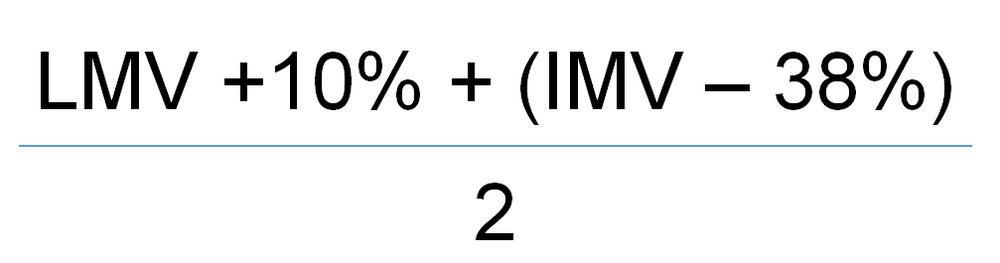
<figure><img src="https://476013847-files.gitbook.io/~/files/v0/b/gitbook-x-prod.appspot.com/o/spaces%2FCdGkCxKDvQdgeyQPlLua%2Fuploads%2FDwtuTCoT2Ye4RaLHlzGS%2F1000px-ICForm.png?alt=media&amp;token=5be18a13-9b84-4502-9533-950bfbb6c1c9" alt=""><figcaption></figcaption></figure>

In which:

* LMV - Local Market Value (Zaplatomer and Recruiting Agencies)
* 10% increase over the highest salary announced in Zaplatomer
* IMV - International Market Value for a low-cost city ([PayScale.com](http://payscale.com/); [Glassdoor.com](http://glassdoor.com/))
* 38% - taxes deduction for USD salary

This formula corresponds to Level 2 Step 1 in our grid. Once you start on a particular level with a base NET salary (like Level 2 above), you can find clear guidelines for moving up to the next level. Each move up/down in Levels comes with a compensation increase/decrease of 1000 BGN, and each Step applies an increase/decrease of 150 BGN.

The formula for  management positions would be:

<figure><img src="https://476013847-files.gitbook.io/~/files/v0/b/gitbook-x-prod.appspot.com/o/spaces%2FCdGkCxKDvQdgeyQPlLua%2Fuploads%2FSzxEKbtndDMbFSvdI7sE%2FMgtForm.png?alt=media&amp;token=b060ffc6-7dda-4d1d-aa50-b73096b9212f" alt=""><figcaption></figcaption></figure>

In which:

* HAS- Highest Announced Salary for the position in a US Salary Information Website ([PayScale.com](http://payscale.com/);[Glassdoor.com](http://glassdoor.com/))
* Deduction of 38% which is related to taxes for USD salary
* Adding a 75% multiplier for the cost of living in Sofia

This formula corresponds to Step 3 of each Level for the Management Path.

As you can see, companies should reward its passionate people with clear and fair compensation. **A high-performance culture is key to the goal of providing industry-leading solutions to digital security, and we motivate and empower employees by putting them in charge of their career growth path and ensuring their personal development.**

In the next chapters you will find the frameworks for every Individual contributor and Manager.


# IC Frameworks

Here you will find the frameworks for every one of our Individual contributors according to their domain of work.


# Android Development

The heart of the organization is our team of Android Developers. They consistently push the boundaries of encrypted communications in order to maximize LUNR's apps and deliver the most secure mobile solutions.

The developers are in charge of handling the entire software lifecycle, from requirements analysis through prototype creation, wireframe conversion to high-quality code, and feature implementation.

Growing within this framework entails cooperating with other developers and producing high-quality apps.

## Progression

In order to progress in our development path and Level Up or Step Up, our Android Developers must:

* Meet the criteria of the Level & Step Chart for the [Individual Contributors Path](#user-content-fn-1)[^1]
* Meet the [KAI ](/how-we-build-processes-and-a-great-product/knowledge-management/knowledge-accountability-index)grade of the framework related to each level
* Demonstrate proficiency in LUNR knowledge

### Level A

The Level A path is destined for employees who still do not possess the skills or proficiency in the whole set of criteria required of Individual Contributors. If during the hiring process we detected that you had the potential to quickly become Level 1, we made you an offer for Level A so you can expect to be provided with coaching, structured tasks with technical challenges, and the opportunity to learn and grow so you can be part of the Management Model as an Individual Contributor.

#### Golden Rules

To Level Up to become part of the Individual Contributor's Path, the Level A employees must:

* Meet the criteria of the[ Individual Contributors](/how-we-ensure-peoples-growth/performance/paths/individual-contributors-path) Level & Step Grid in one year.
* Demonstrate proficiency in the [KAI](/how-we-build-processes-and-a-great-product/knowledge-management) of the Android Development framework according to the levels.

| Level A Framework   | Description                                                                                                                                                                                                                                                                                                                                                                                                                                                                                                                                                                                                                      |
| ------------------- | -------------------------------------------------------------------------------------------------------------------------------------------------------------------------------------------------------------------------------------------------------------------------------------------------------------------------------------------------------------------------------------------------------------------------------------------------------------------------------------------------------------------------------------------------------------------------------------------------------------------------------- |
| Android Development | <p>Must have:<br></p><ul><li>Experience with Java or Kotlin, Android Studio, and Git</li></ul><p>Good to have:</p><ul><li>Experience with XML</li><li>Experience with RESTful APIs and Android components</li><li>Knowledge of Scrum</li><li>Experience with Android Developer Tools and Android SDK</li><li>Experience with libraries: rxJava/rxAndroid, Retrofit, Glide, Dagger 2, EventBus, Butterknife, Espresso, Mokito</li><li>Knowledge of Design patterns: MVP, MVVM</li><li>Knowledge of software development practices: TDD, Continuous integration, Code review</li><li>Experience with Jira and Confluence</li></ul> |

### Salary Grid

All mentioned salary ranges represent the monthly income in Bulgarian Lev after taxes and deductions.

| Android Development |               |
| ------------------- | ------------- |
| A Path              | 2.500 - 3.500 |

\
Android Development

<table><thead><tr><th width="133"></th><th></th><th></th><th></th><th></th></tr></thead><tbody><tr><td>Level</td><td></td><td></td><td></td><td></td></tr><tr><td>Individual Contributor Path</td><td>Step</td><td></td><td></td><td></td></tr><tr><td>1</td><td>1</td><td>2</td><td>3</td><td>4</td></tr><tr><td>1</td><td>6.000</td><td>6.150</td><td>6.300</td><td>6.450</td></tr><tr><td>2</td><td>7.000</td><td>7.150</td><td>7.300</td><td>7.450</td></tr><tr><td>3</td><td>8.000</td><td>8.150</td><td>8.300</td><td>8.450</td></tr><tr><td>4</td><td>9.000</td><td>9.150</td><td>9.300</td><td>9.450</td></tr><tr><td>5</td><td>10.000</td><td>10.150</td><td>10.300</td><td>10.450</td></tr><tr><td>6</td><td>11.000</td><td>11.150</td><td>11.300</td><td>11.450</td></tr></tbody></table>

## [KAI ](/how-we-build-processes-and-a-great-product/knowledge-management/knowledge-accountability-index)of the framework

<figure><img src="https://476013847-files.gitbook.io/~/files/v0/b/gitbook-x-prod.appspot.com/o/spaces%2FCdGkCxKDvQdgeyQPlLua%2Fuploads%2FjRgrXu1xMu3khwlGWa8a%2FScreenshot%202024-05-23%20at%2017.14.24.png?alt=media&amp;token=535ed8e7-061b-4dc9-a061-3564bc8b9fec" alt=""><figcaption></figcaption></figure>

<figure><img src="https://476013847-files.gitbook.io/~/files/v0/b/gitbook-x-prod.appspot.com/o/spaces%2FCdGkCxKDvQdgeyQPlLua%2Fuploads%2Fl0Lq07IV3d5ugBMgmUtl%2FScreenshot%202024-05-23%20at%2017.14.59.png?alt=media&amp;token=f95b12ef-1cdb-4554-be88-6cae0fb7b0db" alt=""><figcaption></figcaption></figure>

[^1]:


# Android OS Development

Our Android Developers are the engine of the company. They optimize LUNR’s products and services to deliver the most secure mobile solutions by constantly challenging the standards of encrypted communications.

The developers are responsible for managing the complete software lifecycle – from analyzing requirements to creating prototypes, transforming wireframes into high-quality code, and implementing new features. They also ensure the top quality of our solutions by developing and executing unit tests, troubleshooting issues, removing impediments, and improving the overall performance of Secure OS. Growing in this framework means working alongside other developers and committing to collaborative problem solving to deliver a sophisticated design and a high-quality product.

We envision each of our employees as stakeholders, so developers are responsible for driving the collaboration with other teammates and agile teams, acting as subject-matter experts to less experienced Software Engineers, and adding user value to the solution.

## Progression

In order to progress in our development path and Level Up or Step Up, our Android Developers must:

* Meet the criteria of the Level & Step Chart for the [Individual Contributors Path](#user-content-fn-1)[^1]
* Meet the [KAI ](/how-we-build-processes-and-a-great-product/knowledge-management/knowledge-accountability-index)grade of the framework related to each level
* Demonstrate proficiency in LUNR knowledge

## Salary Grid

All mentioned salary ranges represent the monthly income in Bulgarian Lev after taxes and deductions.<br>

| Android Development         |        |        |        |        |
| --------------------------- | ------ | ------ | ------ | ------ |
| Level                       |        |        |        |        |
| Individual Contributor Path | Step   |        |        |        |
| 1                           | 1      | 2      | 3      | 4      |
| 1                           | 7.000  | 7.150  | 7.300  | 7.450  |
| 2                           | 8.000  | 8.150  | 8.300  | 8.450  |
| 3                           | 9.000  | 9.150  | 9.300  | 9.450  |
| 4                           | 10.000 | 10.150 | 10.300 | 10.450 |
| 5                           | 11.000 | 10.150 | 11.300 | 11.450 |
| 6                           | 12.000 | 12.150 | 12.300 | 12.450 |

### [KAI](/how-we-build-processes-and-a-great-product/knowledge-management/knowledge-accountability-index) of the framework

Extensive Knowledge
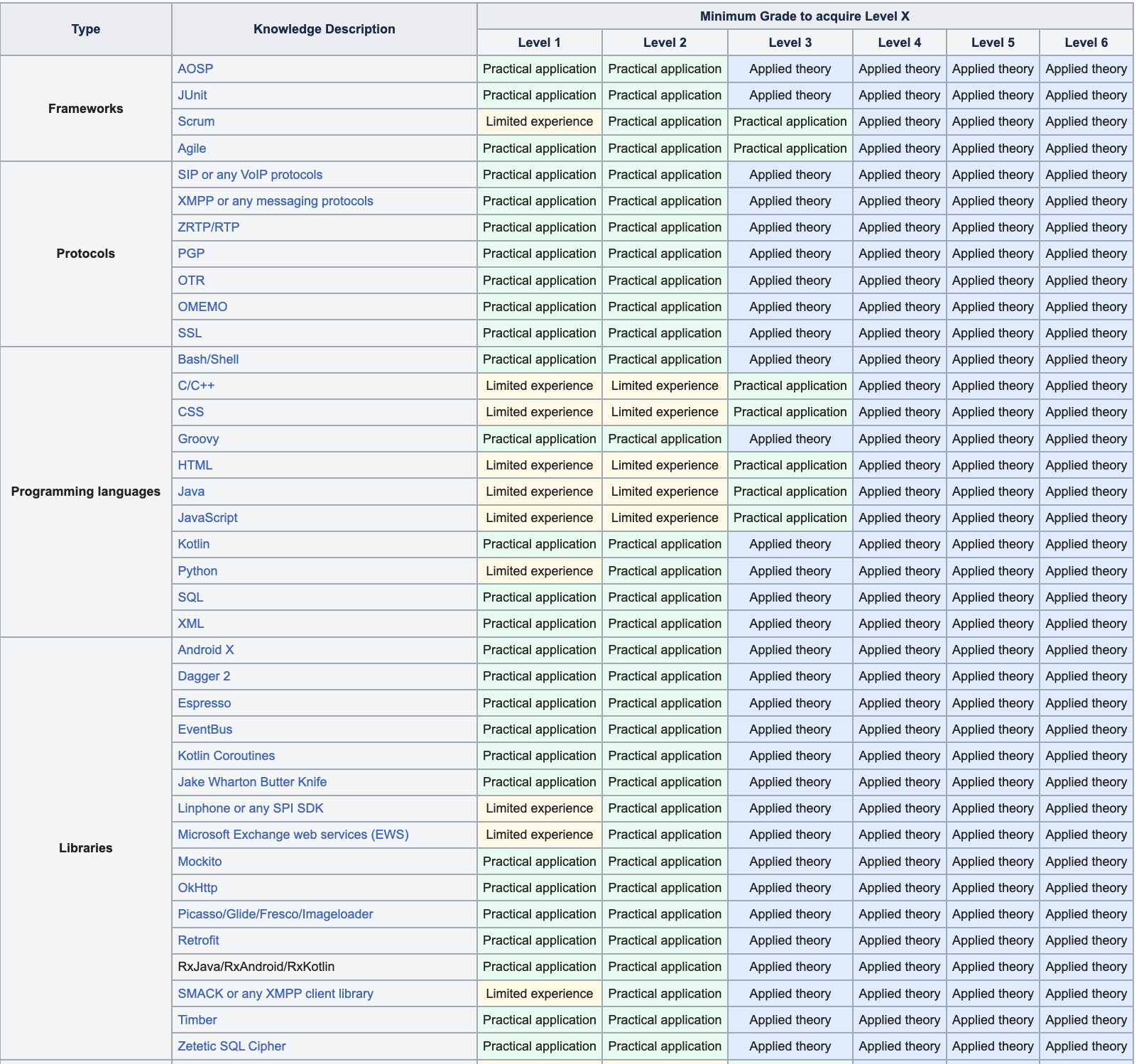
<figure><img src="https://476013847-files.gitbook.io/~/files/v0/b/gitbook-x-prod.appspot.com/o/spaces%2FCdGkCxKDvQdgeyQPlLua%2Fuploads%2FAiaI7klsBk42O98I3mdR%2FScreenshot%202024-05-23%20at%2017.20.06.png?alt=media&amp;token=d5cac701-afc2-4809-bd30-2aa9de3b5e13" alt=""><figcaption></figcaption></figure>

<figure><img src="https://476013847-files.gitbook.io/~/files/v0/b/gitbook-x-prod.appspot.com/o/spaces%2FCdGkCxKDvQdgeyQPlLua%2Fuploads%2FLo7f08LtOHtA6qbRCjJb%2FScreenshot%202024-05-23%20at%2017.21.25.png?alt=media&amp;token=486850d3-6250-4a3a-9f46-581af81b4186" alt=""><figcaption></figcaption></figure>

[^1]:


# Assets security

Security is one of the core concepts present in our company. Therefore, it's under the responsibility of the employees allocated in the Assets Security framework to monitor our premises for any thefts and fraud activities, develop in-depth knowledge of our operations and security systems, and implement safekeeping programs for our premises. Growing in this framework means ensuring the highest level of protection to our office, equipment, and amenities.

## Progression

In order to progress in our development path and Level Up or Step Up, our Assets Security team must:

* Meet the criteria of the Level & Step Chart for the [Individual Contributors Path](/how-we-ensure-peoples-growth/performance/paths/individual-contributors-path). Note that this framework has two levels of growth as an exception.
* Meet the [KAI ](/how-we-build-processes-and-a-great-product/knowledge-management/knowledge-accountability-index)grade of the framework related to each level
* Demonstrate a basic understanding of LUNR knowledge<br>

## Salary Grid

All mentioned salary ranges represent the monthly income in Bulgarian Lev after taxes and deductions.

| Assets Security                   | Step  |       |       |       |   |
| --------------------------------- | ----- | ----- | ----- | ----- | - |
| Level/Individual Contributor Path | 1     | 2     | 3     | 4     | 5 |
| 1                                 | 1.350 | 1.500 | 1.650 | 1.800 |   |
| 2                                 | 2.350 | 2.500 | 2.650 | 2.800 |   |


# Business Development

The Business Developers contribute to the expansion of our encrypted mobile solutions all over the world, bringing closer our mission to allow users to have full control over the privacy of their data and communications.

Their focus is to increase the company’s profitability through business expansion, and development ensuring Secure Group leadership in the mobile security market. On a day-to-day basis, they approach quality leads in the niche market for anti-surveillance solutions with a clear value proposition, manage channels, present product demos, and improve customer experience by actively helping new clients enter the market of encrypted communications.

As our Business Developers grow in this framework, they aim to expand their knowledge of the market, acquiring the full context that allows them to ensure the best opportunities and deals for the company.

## Progression

In order to progress in our development path and Level Up or Step Up, our Business developers must:

* Meet the criteria of the Level & Step Chart for the [Individual Contributors Path](#user-content-fn-1)[^1]
* Meet the [KAI ](/how-we-build-processes-and-a-great-product/knowledge-management/knowledge-accountability-index)grade of the framework related to each level
* Demonstrate proficiency in LUNR knowledge

## Salary Grid

All mentioned salary ranges represent the monthly income in Bulgarian Lev after taxes and deductions.

| Business Development        | Step  |       |       |       |
| --------------------------- | ----- | ----- | ----- | ----- |
| Level                       |       |       |       |       |
| Individual Contributor Path | 1     | 2     | 3     | 4     |
| 1                           | 2.200 | 2.350 | 2.500 | 2.650 |
| 2                           | 3.200 | 3.350 | 3.500 | 3.650 |
| 3                           | 4.200 | 4.350 | 4.500 | 4.650 |

The role includes a commission that grows progressively with the level increase.

### KAI of the Framework

Extensive knowledge

<figure><img src="https://476013847-files.gitbook.io/~/files/v0/b/gitbook-x-prod.appspot.com/o/spaces%2FCdGkCxKDvQdgeyQPlLua%2Fuploads%2FMPY08qkDM3kHdcmYte79%2FScreenshot%202024-05-23%20at%2017.28.38.png?alt=media&amp;token=a2c3cbd0-0be5-4539-852a-d3f055a7828f" alt=""><figcaption></figcaption></figure>

[^1]:


# Digital marketing

Letting people know about what we do is vital in achieving our goals. By crafting the most innovative, creative, and customized materials, our digital marketing team spreads the word on what we do, what we offer, and how we do it. They not only excel in meaningful communication, but they also coordinate a variety of tools and platforms, making sure our online accounts are effectively managed through costumed tailored strategies to reinforce our marketing efforts and make us and our partners stand out.

We have dedicated digital marketers for employer branding, our products, and our organization. That's why it's essential that they are constantly monitoring our competitors, new technologies, and industry trends, so they can develop the best digital marketing strategies for our different audiences.

## Progression

In order to progress in our development path and Level Up or Step Up, our Marketers must:

* Meet the criteria of the Level & Step Chart for the [Individual Contributors Path](#user-content-fn-1)[^1]
* Meet the [KAI ](/how-we-build-processes-and-a-great-product/knowledge-management/knowledge-accountability-index)grade of the framework related to each level
* Demonstrate proficiency in LUNR knowledge

## Salary Grid

All mentioned salary ranges represent the monthly income in Bulgarian Lev after taxes and deductions.

| Digital Marketing           | Step  |       |       |       |
| --------------------------- | ----- | ----- | ----- | ----- |
| Level                       |       |       |       |       |
| Individual Contributor Path | 1     | 2     | 3     | 4     |
| 1                           | 2.000 | 2.150 | 2.300 | 2.450 |
| 2                           | 3.000 | 3.150 | 3.300 | 3.450 |
| 3                           | 4.000 | 4.150 | 4.300 | 4.450 |
| 4                           | 5.000 | 5.150 | 5.300 | 5.450 |
| 5                           | 6.000 | 6.150 | 6.300 | 6.450 |
| 6                           | 7.000 | 7.150 | 7.300 | 7.450 |

## [KAI ](/how-we-build-processes-and-a-great-product/knowledge-management/knowledge-accountability-index)of the framework

Extensive knowledge
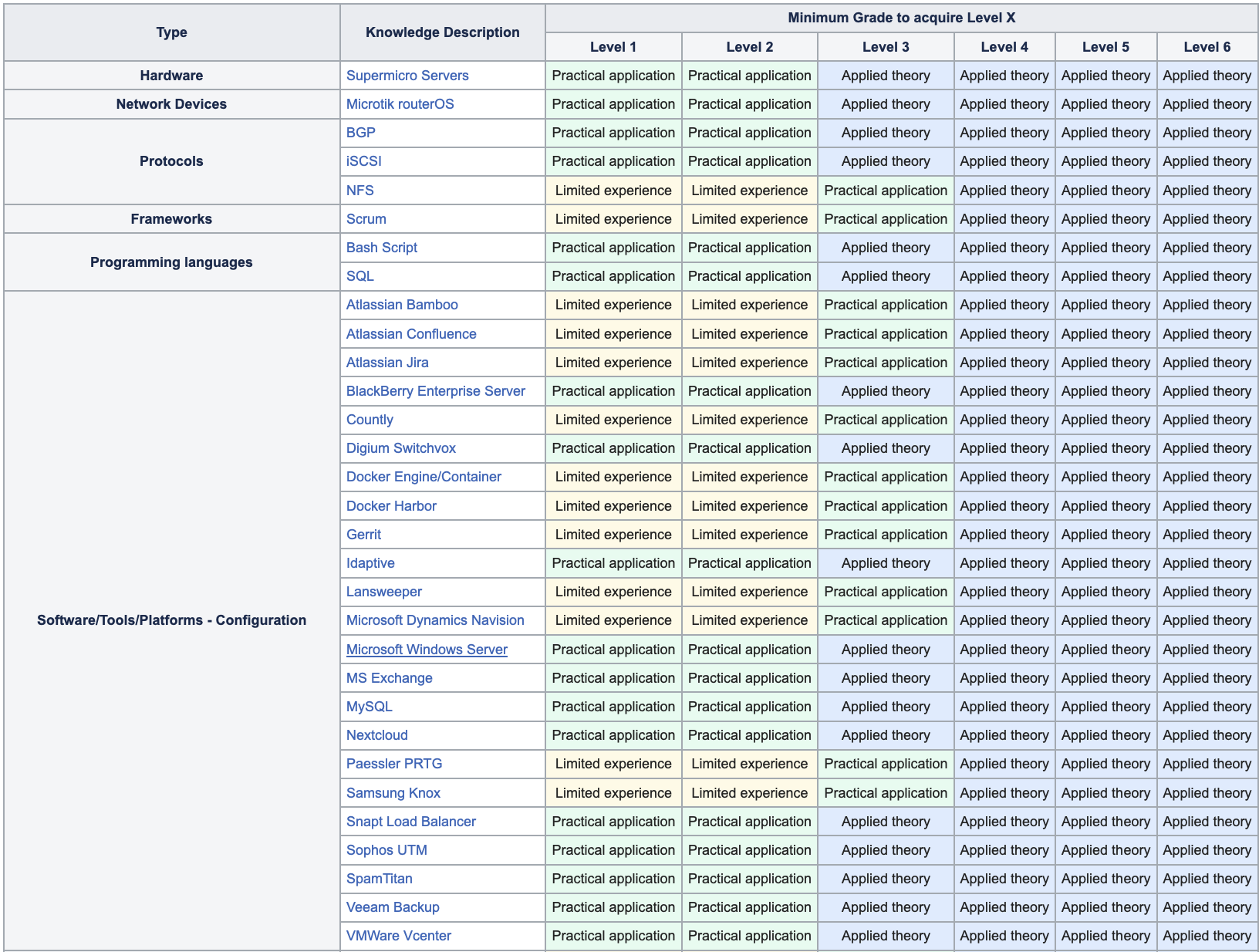
<figure><img src="https://476013847-files.gitbook.io/~/files/v0/b/gitbook-x-prod.appspot.com/o/spaces%2FCdGkCxKDvQdgeyQPlLua%2Fuploads%2FCkUs0vV4dhByw1TVNQ1Z%2FScreenshot%202024-05-23%20at%2017.35.42.png?alt=media&amp;token=a793da06-aa30-40f4-810a-7f40feb6f64d" alt=""><figcaption></figcaption></figure>

<figure><img src="https://476013847-files.gitbook.io/~/files/v0/b/gitbook-x-prod.appspot.com/o/spaces%2FCdGkCxKDvQdgeyQPlLua%2Fuploads%2FFd49WRidjQHQH2Ngt8Ry%2FScreenshot%202024-05-23%20at%2017.36.14.png?alt=media&amp;token=3b7c757a-1736-400c-aeb6-f5fd5a6ff98a" alt=""><figcaption></figcaption></figure>

[^1]:


# Front-end web development

Our front-end web developers are responsible for implementing web applications using different tools, and ensuring that they are clear to use and to navigate allowing our users to have a pleasant and efficient experience when interacting with the site. With an extreme focus on security, they understand the importance of website usability so, in their day-to-day, they strive to change, automate, and perform tests in order to optimize the websites' performance and improve our online presence.

Through continuous integration and deployment, domain and, access management, the key to fast growth in this framework is to develop websites that excel in:

* Accessibility
* Stability
* Security
* SEO Optimisation
* Speedy Development

## Progression

In order to progress in our development path and Level Up or Step Up, our front-end web developers must:

* Meet the criteria of the Level & Step Chart for the [Individual Contributors Path](#user-content-fn-1)[^1]
* Meet the [KAI ](/how-we-build-processes-and-a-great-product/knowledge-management/knowledge-accountability-index)grade of the framework related to each level
* Demonstrate proficiency in LUNR knowledge

## Salary Grid

All mentioned salary ranges represent the monthly income in Bulgarian Lev after taxes and deductions.

| Front-End Web Development   | Step  |       |       |       |
| --------------------------- | ----- | ----- | ----- | ----- |
| Level                       |       |       |       |       |
| Individual Contributor Path | 1     | 2     | 3     | 4     |
| 1                           | 3.000 | 3.150 | 3.300 | 3.450 |
| 2                           | 4.000 | 4.150 | 4.300 | 4.450 |
| 3                           | 5.000 | 5.150 | 5.300 | 5.450 |
| 4                           | 6.000 | 6.150 | 6.300 | 6.450 |
| 5                           | 7.000 | 7.150 | 7.300 | 7.450 |
| 6                           | 8.000 | 8.150 | 8.300 | 8.450 |

### [KAI](/how-we-build-processes-and-a-great-product/knowledge-management/knowledge-accountability-index) Framework

Extensive knowledge

<figure><img src="https://476013847-files.gitbook.io/~/files/v0/b/gitbook-x-prod.appspot.com/o/spaces%2FCdGkCxKDvQdgeyQPlLua%2Fuploads%2FXLw1DkP102jNxuE05gjA%2FScreenshot%202024-05-23%20at%2017.42.46.png?alt=media&amp;token=ab003e02-7fe9-46aa-ac4a-f9103880a6ca" alt=""><figcaption></figcaption></figure>

[^1]:


# Full Stack Web Development

The main responsibility of our Full Stack Web Developers is to include plan, build, test, and maintain our Web projects. At the same time, their work is based on customer orientation: either when designing new applications or when suggesting improvements to existing projects. This work-relationship can be very complex and requires a broad view of the market, business management processes, marketing, and other skills.

Our developers need to master several technologies on different layers. On the business layer side - the PHP 7+ language and the Symfony framework are the starting points. Of course, to master them it's required to know programming patterns in order to minimize time and effort and maximize results. In the data layer, knowledge of the SQL language and some of the most commonly used databases on the web, such as MySQL, PostgreSQL, is indispensable. In the presentation layer, we have HTML and JavaScript as required technologies in order to progress in this framework. Finally, in the DevOps layer, Docker or related knowledge and experience are must-haves.

## Progression

In order to progress in our development path and Level Up or Step Up, our full stack devs developers must:

* Meet the criteria of the Level & Step Chart for the [Individual Contributors Path](#user-content-fn-1)[^1]
* Meet the [KAI ](/how-we-build-processes-and-a-great-product/knowledge-management/knowledge-accountability-index)grade of the framework related to each level
* Demonstrate proficiency in LUNR knowledge

## Salary Grid

All mentioned salary ranges represent the monthly income in Bulgarian Lev after taxes and deductions.

| Full Stack Web Development  | Step   |        |        |        |
| --------------------------- | ------ | ------ | ------ | ------ |
| Level                       |        |        |        |        |
| Individual Contributor Path | 1      | 2      | 3      | 4      |
| 1                           | 5.000  | 5.150  | 5.300  | 5.450  |
| 2                           | 6.000  | 6.150  | 6.300  | 6.450  |
| 3                           | 7.000  | 7.150  | 7.300  | 7.450  |
| 4                           | 8.000  | 8.150  | 8.300  | 8.450  |
| 5                           | 9.000  | 9.150  | 9.300  | 9.450  |
| 6                           | 10.000 | 10.150 | 10.300 | 10.450 |

### [KAI](/how-we-build-processes-and-a-great-product/knowledge-management/knowledge-accountability-index) of the framework

Extensive knowledge

<figure><img src="https://476013847-files.gitbook.io/~/files/v0/b/gitbook-x-prod.appspot.com/o/spaces%2FCdGkCxKDvQdgeyQPlLua%2Fuploads%2F5GsklZdH1XUbPimQAZ2H%2FScreenshot%202024-05-23%20at%2017.46.23.png?alt=media&amp;token=b6488535-d117-483b-8e9b-d1c6805018dd" alt=""><figcaption></figcaption></figure>

<figure><img src="https://476013847-files.gitbook.io/~/files/v0/b/gitbook-x-prod.appspot.com/o/spaces%2FCdGkCxKDvQdgeyQPlLua%2Fuploads%2FVbpGx78bqBF5sDxi4KwK%2FScreenshot%202024-05-23%20at%2017.46.50.png?alt=media&amp;token=3ae45969-3073-4c23-9dee-14d322a38ec3" alt=""><figcaption></figcaption></figure>

[^1]:


# Facility cleaning

The Facility Cleaning framework's main goal is to ensure the comfort of our office. It's their responsibility to clean, stock, and supply designated facility areas.

## Progression

In order to progress in our development path and Level Up or Step Up, our Facility Cleaning team must:

* Meet the criteria of the Level & Step Chart for the [Individual Contributors Path](/how-we-ensure-peoples-growth/performance/paths/individual-contributors-path). Note that this framework has one level of growth as an exception. After reaching the maximum level and if the criteria for change are met, employees can be allocated in a different framework.
* Meet the[ KAI ](/how-we-build-processes-and-a-great-product/knowledge-management/knowledge-accountability-index)grade of the framework related to each level.

## Salary Grid

All mentioned salary ranges represent the monthly income in Bulgarian Lev after taxes and deductions.

| Facility Cleaning                 | Step  |       |       |       |
| --------------------------------- | ----- | ----- | ----- | ----- |
| Level/Individual Contributor Path | 1     | 2     | 3     | 4     |
| 1                                 | 850   | 1.000 | 1.150 | 1.300 |
| 2                                 | 1.850 | 2.000 | 2.150 | 2.300 |

<br>


# Information security

LUNR is rapidly expanding. Our teams are in continuous motion, and we’re constantly welcoming new people to join our company. The Information Security team needs to keep up with this fast-changing environment and ensure that our company's data is protected by ensuring that all parties have the right access to work safely.

It's also under the responsibility of the Information Security team to manage the security of our network and servers, monitor activities, establish compliant procedures, and guarantee the protection of our datacenter.

Advancing in this framework consists of being on the lookout for new threats and finding new ways of safeguarding our company through effective management of processes, methodologies, costs, and policies assuring LUNR's ability to function and grow as an ethical, compliant, and transparent organization.

## Progression

In order to progress in our development path and Level Up or Step Up, our security guys developers must:

* Meet the criteria of the Level & Step Chart for the [Individual Contributors Path](#user-content-fn-1)[^1]
* Meet the [KAI ](/how-we-build-processes-and-a-great-product/knowledge-management/knowledge-accountability-index)grade of the framework related to each level
* Demonstrate proficiency in LUNR knowledge

### Salary Grid

All mentioned salary ranges represent the monthly income in Bulgarian Lev after taxes and deductions.

| Information Security        | Step  |       |       |       |
| --------------------------- | ----- | ----- | ----- | ----- |
| Level                       |       |       |       |       |
| Individual Contributor Path | 1     | 2     | 3     | 4     |
| 1                           | 4.160 | 4.310 | 4.466 | 4.610 |
| 2                           | 5.160 | 5.310 | 5.466 | 5.610 |
| 3                           | 6.160 | 6.310 | 6.466 | 6.610 |
| 4                           | 7.160 | 7.310 | 7.466 | 7.610 |
| 5                           | 8.160 | 8.310 | 8.466 | 8.610 |
| 6                           | 9.160 | 9.310 | 9.466 | 9.610 |

### [KAI ](/how-we-build-processes-and-a-great-product/knowledge-management/knowledge-accountability-index)of the framework

Extensive knowledge

<figure><img src="https://476013847-files.gitbook.io/~/files/v0/b/gitbook-x-prod.appspot.com/o/spaces%2FCdGkCxKDvQdgeyQPlLua%2Fuploads%2FpS5k5qYnqhyDmrhSaiye%2FScreenshot%202024-05-23%20at%2017.51.56.png?alt=media&amp;token=3a5fe6cb-c21c-4c64-abb1-0c623e394761" alt=""><figcaption></figcaption></figure>

<figure><img src="https://476013847-files.gitbook.io/~/files/v0/b/gitbook-x-prod.appspot.com/o/spaces%2FCdGkCxKDvQdgeyQPlLua%2Fuploads%2Fg67YqIKxmTCOSkCiWCqn%2FScreenshot%202024-05-23%20at%2017.52.29.png?alt=media&amp;token=43a48c30-73e4-40bc-898b-a388a5a62f37" alt=""><figcaption></figcaption></figure>

[^1]:


# Marketing automation

The Marketing Automation team works to increase our company's profitability through business expansion and development by creating, implementing and reinforcing best practices and procedures to improve lead nurturing efforts and inbound lead management processes. They are also responsible for conveying B2B inbound tactics and follow industry trends to attract key stakeholders with a recognized international significance for our cybersecurity niche market.

Growth in this framework relates to understanding the market's buyer personas, business channel, and management and building a fully operational automation infrastructure to target the most qualified leads for our business.

## Progression

In order to progress in our development path and Level Up or Step Up, our Marketing automation team  must:

* Meet the criteria of the Level & Step Chart for the [Individual Contributors Path](#user-content-fn-1)[^1]
* Meet the [KAI ](/how-we-build-processes-and-a-great-product/knowledge-management/knowledge-accountability-index)grade of the framework related to each level
* Demonstrate proficiency in LUNR knowledge

## Salary Grid

All mentioned salary ranges represent the monthly income in Bulgarian Lev after taxes and deductions.

| Marketing Automation        | Step  |       |       |       |
| --------------------------- | ----- | ----- | ----- | ----- |
| Level                       |       |       |       |       |
| Individual Contributor Path | 1     | 2     | 3     | 4     |
| 1                           | 2.800 | 2.950 | 3.200 | 3.350 |
| 2                           | 3.800 | 3.950 | 4.200 | 4.350 |
| 3                           | 4.800 | 4.950 | 5.200 | 5.350 |
| 4                           | 5.800 | 5.950 | 6.200 | 6.350 |
| 5                           | 6.800 | 6.950 | 7.200 | 7.350 |
| 6                           | 7.800 | 7.950 | 8.200 | 8.350 |

### [KAI](/how-we-build-processes-and-a-great-product/knowledge-management/knowledge-accountability-index) of the framework

Extensive knowledge

<figure><img src="https://476013847-files.gitbook.io/~/files/v0/b/gitbook-x-prod.appspot.com/o/spaces%2FCdGkCxKDvQdgeyQPlLua%2Fuploads%2FfZmSRPx4f98up1Em9xF3%2FScreenshot%202024-05-23%20at%2017.57.42.png?alt=media&amp;token=0f944d29-5dc8-4d4b-ba55-01a530af1948" alt=""><figcaption></figcaption></figure>

[^1]:


# QA automation

The QA Automation engineers are responsible for producing a powerful set of test cases and internal testing tools to support the development of our operating system. They help us increase the efficiency of our quality testing by developing scripts that automate test cases for key product features.

Our QAs design and implement such tests, debug and define corrective actions to ensure the highest product quality. They are also key players to ensure collaboration with other members of the engineering team to find the best methods for solving problems and securing the quality and usability of our products.

Developing in this framework means closely monitoring the software development process to identify what are its automation possibilities to ultimately ensure our testing capacity works at its full potential and to ensure the quality of our solutions.

## Progression

In order to progress in our development path and Level Up or Step Up, our QA automation team  must:

* Meet the criteria of the Level & Step Chart for the [Individual Contributors Path](#user-content-fn-1)[^1]
* Meet the [KAI ](/how-we-build-processes-and-a-great-product/knowledge-management/knowledge-accountability-index)grade of the framework related to each level
* Demonstrate proficiency in LUNR knowledge

## Salary Grid

All mentioned salary ranges represent the monthly income in Bulgarian Lev after taxes and deductions.

| QA Automation               | Step  |       |       |       |
| --------------------------- | ----- | ----- | ----- | ----- |
| Level                       |       |       |       |       |
| Individual Contributor Path | 1     | 2     | 3     | 4     |
| 1                           | 4.500 | 4.650 | 4.800 | 4.950 |
| 2                           | 5.500 | 5.650 | 5.800 | 5.950 |
| 3                           | 6.500 | 6.650 | 6.800 | 6.950 |
| 4                           | 7.500 | 7.650 | 7.800 | 7.950 |
| 5                           | 8.500 | 8.650 | 8.800 | 8.950 |
| 6                           | 9.500 | 9.650 | 9.800 | 9.950 |

### [KAI](/how-we-build-processes-and-a-great-product/knowledge-management/knowledge-accountability-index) of the framework

Extensive knowledge

<figure><img src="https://476013847-files.gitbook.io/~/files/v0/b/gitbook-x-prod.appspot.com/o/spaces%2FCdGkCxKDvQdgeyQPlLua%2Fuploads%2FgdVYLYhMj7DBZbclYG8s%2FScreenshot%202024-05-23%20at%2018.01.07.png?alt=media&amp;token=28ddf843-8ad8-40d6-9e0e-937f0b3e9895" alt=""><figcaption></figcaption></figure>

<figure><img src="https://476013847-files.gitbook.io/~/files/v0/b/gitbook-x-prod.appspot.com/o/spaces%2FCdGkCxKDvQdgeyQPlLua%2Fuploads%2FvZDCU385ClTZrRaorCUv%2FScreenshot%202024-05-23%20at%2018.01.32.png?alt=media&amp;token=94c3b30c-4f81-4ea4-9142-d05d03984bae" alt=""><figcaption></figcaption></figure>

[^1]:


# Quality assurance

The Quality Assurance Engineers contribute to ensuring the quality of our product by providing testing on all stages of the development lifecycle. They perform manual testing by writing, performing, and updating test suites as well as defining the acceptance criteria for our products' features.

Developing in this framework is not only about effectively testing but, beyond that, it means advocating for the quality of LUNR’s products and ensuring they are up to the standards of our partners' expectations.

## Progression

In order to progress in our development path and Level Up or Step Up, our QA  team  must:

* Meet the criteria of the Level & Step Chart for the [Individual Contributors Path](#user-content-fn-1)[^1]
* Meet the [KAI ](/how-we-build-processes-and-a-great-product/knowledge-management/knowledge-accountability-index)grade of the framework related to each level
* Demonstrate proficiency in LUNR knowledge

## Salary Grid

All mentioned salary ranges represent the monthly income in Bulgarian Lev after taxes and deductions.

| Quality Assurance           | Step  |       |       |       |
| --------------------------- | ----- | ----- | ----- | ----- |
| Level                       |       |       |       |       |
| Individual Contributor Path | 1     | 2     | 3     | 4     |
| 1                           | 2.300 | 2.450 | 2.600 | 2.750 |
| 2                           | 3.300 | 3.450 | 3.600 | 3.750 |
| 3                           | 4.300 | 4.450 | 4.600 | 4.750 |
| 4                           | 5.300 | 5.450 | 5.600 | 5.750 |
| 5                           | 6.300 | 6.450 | 6.600 | 6.750 |
| 6                           | 7.300 | 7.450 | 7.600 | 7.750 |

### [KAI](/how-we-build-processes-and-a-great-product/knowledge-management/knowledge-accountability-index) of the framework

Extensive knowledge

<figure><img src="https://476013847-files.gitbook.io/~/files/v0/b/gitbook-x-prod.appspot.com/o/spaces%2FCdGkCxKDvQdgeyQPlLua%2Fuploads%2FQAGfGHiGfIQFHSFmhIxM%2FScreenshot%202024-05-23%20at%2018.03.59.png?alt=media&amp;token=53bda763-8903-47b9-ba95-c4f0bfb75a72" alt=""><figcaption></figcaption></figure>

[^1]:


# Recruiting Operations

The Recruiting Operations team in LUNRensures we hire the best of the best. They assess, hire and retain skilled employees to fill our technical positions.

## Progression

In order to progress in our development path and Level Up or Step Up, our recruiters  must:

* Meet the criteria of the Level & Step Chart for the [Individual Contributors Path](#user-content-fn-1)[^1]
* Meet the [KAI ](/how-we-build-processes-and-a-great-product/knowledge-management/knowledge-accountability-index)grade of the framework related to each level
* Demonstrate proficiency in LUNR knowledge

## Salary Grid

All mentioned salary ranges represent the monthly income in Bulgarian Lev after taxes and deductions.

| Tech Recruitment            | Step  |       |       |       |
| --------------------------- | ----- | ----- | ----- | ----- |
| Level                       |       |       |       |       |
| Individual Contributor Path | 1     | 2     | 3     | 4     |
| 1                           | 1.500 | 1.650 | 1.800 | 1.950 |
| 2                           | 2.500 | 2.650 | 2.800 | 2.950 |
| 3                           | 3.500 | 3.650 | 3.800 | 3.950 |
| 4                           | 4.500 | 4.650 | 4.800 | 4.950 |
| 5                           | 5.500 | 5.650 | 5.800 | 5.950 |
| 6                           | 6.500 | 6.650 | 6.800 | 6.950 |

### [KAI ](/how-we-build-processes-and-a-great-product/knowledge-management/knowledge-accountability-index)of the framework

Extensive knowledge

<figure><img src="https://476013847-files.gitbook.io/~/files/v0/b/gitbook-x-prod.appspot.com/o/spaces%2FCdGkCxKDvQdgeyQPlLua%2Fuploads%2FjxuGSu2uRZr1MY0C2LmC%2FScreenshot%202024-05-23%20at%2018.06.38.png?alt=media&amp;token=8b59bbd2-fb12-48a3-9292-a7627e073ce6" alt=""><figcaption></figcaption></figure>

[^1]:


# Technical Training

Knowledge is at the core of our business. As we explored in the [Knowledge Management ](/how-we-build-processes-and-a-great-product/knowledge-management)chapter, it is key that our teams have access to relevant and updated information so they don’t face any gaps in their skills when trying to achieve their goals. Because of that, we started our LUNR Academy, and the role of our Technical Trainers is not only to manage the knowledge hub but to expand the project and bring it to the next level. Our final goal is to spread the knowledge and create the first Cybersecurity Academy in Bulgaria.&#x20;

The technical trainers are responsible for planning training and workshops directed to LUNR’s internal and external stakeholders related to the Information Security Realm. It's under their responsibility to make sure our new hires are onboarded smoothly and fast, our employees expand their knowledge, and our partners are supported with all information they need. To grow in this framework, it's essential to dig deep into understanding our products and services and to excel at communicating these concepts clearly and in an engaging tone to different audiences.

## Progression

In order to progress in our development path and Level Up or Step Up, our Technical training  must:

* Meet the criteria of the Level & Step Chart for the [Individual Contributors Path](#user-content-fn-1)[^1]
* Meet the [KAI ](/how-we-build-processes-and-a-great-product/knowledge-management/knowledge-accountability-index)grade of the framework related to each level
* Demonstrate proficiency in LUNR knowledge

## Salary Grid

All mentioned salary ranges represent the monthly income in Bulgarian Lev after taxes and deductions.

| Tech Training               | Step   |        |        |        |
| --------------------------- | ------ | ------ | ------ | ------ |
| Level                       |        |        |        |        |
| Individual Contributor Path | 1      | 2      | 3      | 4      |
| 1                           | 5.000  | 5.150  | 5.300  | 5.450  |
| 2                           | 6.000  | 6.150  | 6.300  | 6.450  |
| 3                           | 7.000  | 7.150  | 7.300  | 7.450  |
| 4                           | 8.000  | 8.150  | 8.300  | 8.450  |
| 5                           | 9.000  | 9.150  | 9.300  | 9.450  |
| 6                           | 10.000 | 10.150 | 10.300 | 10.450 |

### [KAI ](/how-we-build-processes-and-a-great-product/knowledge-management/knowledge-accountability-index)of the framework

Extensive knowledge

<figure><img src="https://476013847-files.gitbook.io/~/files/v0/b/gitbook-x-prod.appspot.com/o/spaces%2FCdGkCxKDvQdgeyQPlLua%2Fuploads%2FQa1pPSwtlK5TqFmEwK0H%2FScreenshot%202024-05-23%20at%2018.10.26.png?alt=media&amp;token=252ba025-8bc8-44da-9e37-7241ea709efb" alt=""><figcaption></figcaption></figure>

[^1]:


# Technical recruitment

The Technical Recruiters in LUNR help us grow our IT teams, by promoting our employer brand and Management Model, reducing our time-to-hire, and ensuring we attract the best professionals on the market. Ultimately, their main goal is to build a strong tech talent pipeline.

## Progression

In order to progress in our development path and Level Up or Step Up, our Technical training  must:

* Meet the criteria of the Level & Step Chart for the [Individual Contributors Path](#user-content-fn-1)[^1]
* Meet the [KAI ](/how-we-build-processes-and-a-great-product/knowledge-management/knowledge-accountability-index)grade of the framework related to each level
* Demonstrate proficiency in LUNR knowledge

## Salary Grid

All mentioned salary ranges represent the monthly income in Bulgarian Lev after taxes and deductions.

| Tech Recruitment            | Step  |       |       |       |
| --------------------------- | ----- | ----- | ----- | ----- |
| Level                       |       |       |       |       |
| Individual Contributor Path | 1     | 2     | 3     | 4     |
| 1                           | 1.800 | 1.950 | 2.100 | 2.250 |
| 2                           | 2.800 | 2.950 | 3.100 | 3.250 |
| 3                           | 3.800 | 3.950 | 4.100 | 4.250 |
| 4                           | 4.800 | 4.950 | 5.100 | 5.250 |
| 5                           | 5.800 | 5.950 | 6.100 | 6.250 |
| 6                           | 6.800 | 6.950 | 7.100 | 7.250 |

### [KAI ](/how-we-build-processes-and-a-great-product/knowledge-management/knowledge-accountability-index)of the framework

Extensive knowledge<br>

<figure><img src="https://476013847-files.gitbook.io/~/files/v0/b/gitbook-x-prod.appspot.com/o/spaces%2FCdGkCxKDvQdgeyQPlLua%2Fuploads%2FjGf87NkIQpBL4O4nke8k%2FScreenshot%202024-05-23%20at%2018.13.08.png?alt=media&amp;token=dded5c3f-189e-46f9-b807-6cec133347f6" alt=""><figcaption></figcaption></figure>

[^1]:


# WordPress Developers

Our WordPress Developers are responsible for designing, developing, and maintaining WordPress-based websites. The primary focus is on creating custom themes, implementing plugins, and ensuring the functionality and performance of our websites and partners' websites.

The key to fast growth in this framework is by integrating third-party APIs and services for enhanced functionality and data synchronization while optimizing websites for speed, performance, and search engine optimization (SEO) best practices.

## Progression

In order to progress in our development path and Level Up or Step Up, our WordPress Developers must:

* Meet the criteria of the Level & Step Chart for the [Individual Contributors Path](#user-content-fn-1)[^1]
* Meet the [KAI ](/how-we-build-processes-and-a-great-product/knowledge-management/knowledge-accountability-index)grade of the framework related to each level
* Demonstrate proficiency in LUNR knowledge

## Salary Grid

All mentioned salary ranges represent the monthly income in Bulgarian Lev after taxes and deductions.

| Wordpress Development       | Step  |       |       |       |
| --------------------------- | ----- | ----- | ----- | ----- |
| Level                       |       |       |       |       |
| Individual Contributor Path | 1     | 2     | 3     | 4     |
| 1                           | 3.100 | 3.250 | 3.400 | 3.550 |
| 2                           | 4.100 | 4.250 | 4.400 | 4.550 |
| 3                           | 5.100 | 5.250 | 5.400 | 5.550 |
| 4                           | 6.100 | 6.250 | 6.400 | 6.550 |
| 5                           | 7.100 | 7.250 | 7.400 | 7.550 |
| 6                           | 8.100 | 8.250 | 8.400 | 8.550 |

### [KAI ](/how-we-build-processes-and-a-great-product/knowledge-management/knowledge-accountability-index)of the framework

Extensive knowledge

<figure><img src="https://476013847-files.gitbook.io/~/files/v0/b/gitbook-x-prod.appspot.com/o/spaces%2FCdGkCxKDvQdgeyQPlLua%2Fuploads%2F7RNM4UhUYCfPGQJewueF%2FScreenshot%202024-05-23%20at%2018.18.39.png?alt=media&amp;token=22ed3dad-83a3-4719-b835-cd97e1f71a16" alt=""><figcaption></figcaption></figure>

[^1]:


# UX/UI

The UX/UI Designers (abbreviation for User Experience/User Interface) are responsible, as the name implies, for ensuring that the design of the application meets all users' needs, ensuring their satisfaction by interacting with our company, platforms, or partner's brands.

UX/UI Designers are mainly responsible for developing user navigation maps, usability tests, creation, development, and implementation of innovative and attractive solutions, prototyping, user and process flow, and linking the communicative interaction to the Design concepts. Once the tests have been carried out, along with our partner's feedback, they also optimize the created solutions, performing the documentation of all processes. To ensure growth in this framework, the UX/UI Designers are required to make enhancement studies, create navigability standards for performance optimization focusing on security, create engagement, and guarantee customer satisfaction.

## Progression

In order to progress in our development path and Level Up or Step Up, our designers must:

* Meet the criteria of the Level & Step Chart for the [Individual Contributors Path](#user-content-fn-1)[^1]
* Meet the [KAI ](/how-we-build-processes-and-a-great-product/knowledge-management/knowledge-accountability-index)grade of the framework related to each level
* Demonstrate proficiency in LUNR knowledge

## Salary Grid

All mentioned salary ranges represent the monthly income in Bulgarian Lev after taxes and deductions.

| UX/UI Design                | Step  |       |       |       |
| --------------------------- | ----- | ----- | ----- | ----- |
| Level                       |       |       |       |       |
| Individual Contributor Path | 1     | 2     | 3     | 4     |
| 1                           | 3.600 | 3.750 | 3.800 | 3.950 |
| 2                           | 4.600 | 4.750 | 4.800 | 4.950 |
| 3                           | 5.600 | 5.750 | 5.800 | 5.950 |
| 4                           | 6.600 | 6.750 | 6.800 | 6.950 |
| 5                           | 7.600 | 7.750 | 7.800 | 7.950 |
| 6                           | 8.600 | 8.750 | 8.800 | 8.950 |

### [KAI ](/how-we-build-processes-and-a-great-product/knowledge-management/knowledge-accountability-index)of the framework

Extensive knowledge<br>

<figure><img src="https://476013847-files.gitbook.io/~/files/v0/b/gitbook-x-prod.appspot.com/o/spaces%2FCdGkCxKDvQdgeyQPlLua%2Fuploads%2FPOiIXeoANAUwzmHyB0zE%2FScreenshot%202024-05-23%20at%2018.16.03.png?alt=media&amp;token=e255cbd2-5056-4477-aaea-766f360b6f53" alt=""><figcaption></figcaption></figure>

[^1]:


# MGT Frameworks

Here you will find the frameworks for all of our managers, according to their domain.&#x20;


# Application support management

Application Support Managers ensure effective front-end and back-end functionality of applications. To make sure errors are avoided, they perform root cause analysis, triage, and testing.

They are also responsible for investigating bottlenecks, resolving application performance issues, debugging, writing scripts, and investigating and performing changes. Growing in this framework requires a deep understanding of the software and test development lifecycle.

## Progression

In order to progress in our development path and Level Up or Step Up, our Application Support Managers must:

* Meet the criteria of the Level & Step Chart for [Management Path](/how-we-ensure-peoples-growth/performance/paths/management-path)
* Demonstrate proficiency in the Customer Service Realm and Software Engineering Realm

## Salary Grid

All mentioned salary ranges represent the monthly income in Bulgarian Lev after taxes and deductions.

| Application Support Management | Step   |        |        |        |
| ------------------------------ | ------ | ------ | ------ | ------ |
| Level                          | 1      | 2      | 3      | 4      |
| 1                              | 3.464  | 3.764  | 4.564  | 5.464  |
| 2                              | 6.147  | 6.447  | 7.247  | 8.147  |
| 3                              | 8.594  | 8.894  | 9.694  | 10.594 |
| 4                              | 11.247 | 11.547 | 12.347 | 13.247 |

## Realm

<figure><img src="https://476013847-files.gitbook.io/~/files/v0/b/gitbook-x-prod.appspot.com/o/spaces%2FCdGkCxKDvQdgeyQPlLua%2Fuploads%2FjtvSCJtMM1wvoLZzowqT%2FSoft_Eng_Realm.png?alt=media&amp;token=af92c277-3873-4cb6-83ad-7b4b3cb3a113" alt=""><figcaption></figcaption></figure>


# Accounting\&Finance Management

Our Accounting & Finance Managers are here to ensure that the financial, tributary, economic, and patrimonial situation of Secure Group is effectively managed. They are methodic and organized when dealing with all sorts of documents, such as statements of income, accounts payable, and receivable tax guides. Another important aspect of this framework is the need to understand, organize, and ensure flexibility of all financial processes from our entities and report outcomes to the managers so we can constantly optimize our budget workflow. An extensive understanding of our business and how we manage financial transactions with partners, customers, and suppliers from all over the world is also essential to the success of this framework. Fast growth means not only succeeding in managing our finances but supporting our business in making cost-effective decisions related to our strategic goals.

## Progression

In order to progress in our development path and Level Up or Step Up, our Accounting & Finance Managers must:

* Meet the criteria of the Level & Step Chart for the [Management Path](https://managementmodel.info/index.php?title=Management)
* Demonstrate proficiency in the Finance and Project Management Realms

<br>

## Salary Grid

All mentioned salary ranges represent the monthly income in Bulgarian Lev after taxes and deductions.

| Finance Management | Step   |        |        |        |
| ------------------ | ------ | ------ | ------ | ------ |
| Level              | 1      | 2      | 3      | 4      |
| 1                  | 2.500  | 2.800  | 3.600  | 4.500  |
| 2                  | 6.220  | 6.520  | 7.320  | 8.220  |
| 3                  | 9.350  | 9.650  | 10.450 | 11.350 |
| 4                  | 12.090 | 12.390 | 13.190 | 14.090 |

## Realm

<figure><img src="https://476013847-files.gitbook.io/~/files/v0/b/gitbook-x-prod.appspot.com/o/spaces%2FCdGkCxKDvQdgeyQPlLua%2Fuploads%2Fes7Q4cZwaUTJK4mSKyOE%2FFinance_Realm.png?alt=media&amp;token=daeaa28c-f2d8-482d-8e42-f26ec17c7428" alt=""><figcaption></figcaption></figure>


# HR Operations Management

The HR Ops managers in LUNR are responsible for the whole Employee Lifecycle. From finding, screening, and shortlisting candidates for various roles in the IC and Management Path to making sure their onboarding and offboarding in the company are effective and pleasant. They network online and offline with potential candidates promoting our employer branding, reducing our time-to-hire, and ensuring we attract and keep the best of the best professionals.

## Progression

In order to progress in our development path and Level Up or Step Up, our HR Ops Managers must:

* Meet the criteria of the Level & Step Chart for the [Management Path](/how-we-ensure-peoples-growth/performance/paths/management-path)
* Demonstrate proficiency in the HR and Project Management Realm

## Salary Grid

All mentioned salary ranges represent the monthly income in Bulgarian Lev after taxes and deductions.

| HR Ops Management | Step  |       |        |        |
| ----------------- | ----- | ----- | ------ | ------ |
| Level             | 1     | 2     | 3      | 4      |
| 1                 | 2.207 | 2.507 | 3.307  | 4.207  |
| 2                 | 3.363 | 3.663 | 4.463  | 5.363  |
| 3                 | 7.174 | 7.474 | 8.274  | 9.174  |
| 4                 | 9.060 | 9.360 | 10.160 | 11.060 |

## Realm

<figure><img src="https://476013847-files.gitbook.io/~/files/v0/b/gitbook-x-prod.appspot.com/o/spaces%2FCdGkCxKDvQdgeyQPlLua%2Fuploads%2F2Q5o2AOjntf9LQz5vY1z%2FHR_Realm.png?alt=media&amp;token=ba04a72a-50f0-4193-a0ec-34b1e8db3861" alt=""><figcaption></figcaption></figure>


# Information Security Management

The Information security managers' main responsibility is to develop, implement, and monitor a strategic, comprehensive enterprise information security and IT risk management program to ensure that the integrity, confidentiality, and availability of information are owned, controlled, and processed by our organization. They are in charge of security systems, such as firewalls, data protection controls, encryption, vulnerability scanning, and so on. They also manage the team that oversees the proper deployment, configuration, and functioning of these systems helping different teams around the organization understand risks and data privacy issues. It's part of their responsibility scope to monitor all operations and infrastructure in order to keep an eye on our organization’s digital security footprint, monitor internal and external policy compliance, and monitor regulatory compliance.

Their growth path includes implementing new technologies, auditing policies, and controls continuously, and ensuring cybersecurity stays on the organizational radar.

## Progression

In order to progress in our development path and Level Up, our Information Security team must:

* Meet the criteria of the Level Chart for the[ Management Path](/how-we-ensure-peoples-growth/performance/paths/management-path)
* Demonstrate proficiency in the Information Security Realm

<br>

## Salary Grid

All mentioned salary ranges represent the monthly income in Bulgarian Lev after taxes and deductions.

| Information Security Management | Step   |        |        |        |
| ------------------------------- | ------ | ------ | ------ | ------ |
| Level                           | 1      | 2      | 3      | 4      |
| 1                               | 3.176  | 3.476  | 4.276  | 5.176  |
| 2                               | 6.300  | 6.600  | 7.400  | 8.300  |
| 3                               | 9.706  | 10.006 | 10.806 | 11.706 |
| 4                               | 12.295 | 12.595 | 13.395 | 14.295 |

## Realm

<figure><img src="https://476013847-files.gitbook.io/~/files/v0/b/gitbook-x-prod.appspot.com/o/spaces%2FCdGkCxKDvQdgeyQPlLua%2Fuploads%2FVXLjJg56HHpoECAUdN5a%2FInformation_Security_Realm.png?alt=media&amp;token=03150d50-2648-4740-bb3d-e2417ef71bd1" alt=""><figcaption></figcaption></figure>


# Marketing Management

Generate leads, drive up tangible results for LUNR partners, and increase their brand awareness through relevant, highly effective, cost-optimized marketing approaches is the main responsibility of our Marketing managers. It's vital not only that they use white hat marketing practices but also have the right approach to them, researching and orienting our strategy and efforts towards driving real lasting results based on customer data and latest technologies.

To ensure growth, they need extensive knowledge of marketing strategies and all aspects of our business to act as trusted advisors to our partners and to translate their expertise into increased brand awareness and profitability.

## Progression

In order to progress in our development path and Level Up or Step Up, our Marketing Managers must:

* Meet the criteria of the Level & Step Chart for [Management Path](/how-we-ensure-peoples-growth/performance/paths/management-path)
* Demonstrate proficiency in the Marketing Realm

<br>

## Salary Grid

All mentioned salary ranges represent the monthly income in Bulgarian Lev after taxes and deductions.

| Marketing Management | Step   |        |        |        |
| -------------------- | ------ | ------ | ------ | ------ |
| Level                | 1      | 2      | 3      | 4      |
| 1                    | 2.847  | 3.147  | 33.947 | 4.897  |
| 2                    | 5.565  | 5.865  | 6.665  | 7.565  |
| 3                    | 8.606  | 8.906  | 9.706  | 10.606 |
| 4                    | 10.802 | 11.102 | 11.902 | 12.802 |

## Realm

<figure><img src="https://476013847-files.gitbook.io/~/files/v0/b/gitbook-x-prod.appspot.com/o/spaces%2FCdGkCxKDvQdgeyQPlLua%2Fuploads%2Faxqd8ublLIRca1oBhhoB%2FMarketing_Destinations_Realm.png?alt=media&amp;token=14eff437-487f-45b6-92fa-aaae1aef4a03" alt=""><figcaption></figcaption></figure>

<figure><img src="https://476013847-files.gitbook.io/~/files/v0/b/gitbook-x-prod.appspot.com/o/spaces%2FCdGkCxKDvQdgeyQPlLua%2Fuploads%2FWheFJ6R8C62Efoxo83Vd%2FMarketing_Strategy_and_Concepts-2.png?alt=media&amp;token=c8323b35-45b8-4d03-9b34-a79e68f239cf" alt=""><figcaption></figcaption></figure>


# NOC\&Support management

NOC Support Managers are responsible for ensuring an effective 24/7 day-to-day operation of our platforms including support of Linux systems. They act as the service engineer on assigned open tickets and work in collaboration with technical support staff and management, to resolve customer-affecting technical issues in a timely manner in order to maintain maximum satisfaction.

Growing in this framework requires the ability to understand complex systems and interactions, drive incidents to closure, identify tasks that require automation, and ability to build a knowledge base.

## Progression

In order to progress in our development path and Level Up or Step Up, our NOC Support Managers must:

* Meet the criteria of the Level & Step Chart for [Management Path](/how-we-ensure-peoples-growth/performance/paths/management-path)
* Demonstrate proficiency in the Technical Support Realm and Information Security Realm

<br>

## Salary Grid

All mentioned salary ranges represent the monthly income in Bulgarian Lev after taxes and deductions.

| NOC Support Management | Step   |        |        |        |
| ---------------------- | ------ | ------ | ------ | ------ |
| Level                  | 1      | 2      | 3      | 4      |
| 1                      | 3.992  | 4.292  | 5.092  | 5.992  |
| 2                      | 6.710  | 7.010  | 7.810  | 8.710  |
| 3                      | 9.080  | 9.380  | 10.180 | 11.080 |
| 4                      | 12.247 | 12.547 | 13.347 | 14.247 |

## Realm

<figure><img src="https://476013847-files.gitbook.io/~/files/v0/b/gitbook-x-prod.appspot.com/o/spaces%2FCdGkCxKDvQdgeyQPlLua%2Fuploads%2FF9TRGfFtBYyHaSjZ2P7S%2FCustomer_Service_TAM_Realm.png?alt=media&amp;token=417529ba-ef6e-4046-bd5d-19d774f33f13" alt=""><figcaption></figcaption></figure>

<br>


# Operations management (logistics)

Operations managers focused on the business layer support operational leadership in a variety of divisions and teams — from Finance to IT, Business Development, and Partner Success. They develop, implement, and maintain quality assurance protocols and ensure operational activities remain on time and within a defined budget.

To grow in this framework it's essential that such managers partner with cross-functional teams in improving the processes, tools, and systems bringing effectiveness and innovation to our operations.

## Progression

In order to progress in our development path and Level Up or Step Up, our Operations team must:

* Meet the criteria of the Level & Step Chart for the [Management Path](/how-we-ensure-peoples-growth/performance/paths/management-path). Note that this framework has one level of growth as an exception. After reaching the maximum level and if the criteria for change are met, employees can be allocated in a different framework.
* Demonstrate proficiency in the Supply Chain, and Business Development Realms

<br>

## Salary Grid

All mentioned salary ranges represent the monthly income in Bulgarian Lev after taxes and deductions.

| Operations Management | Step  |       |       |       |
| --------------------- | ----- | ----- | ----- | ----- |
| Level                 | 1     | 2     | 3     | 4     |
| 1                     | 2.200 | 2.500 | 3.300 | 4.200 |
| 2                     | 3.000 | 3.300 | 4.100 | 5.000 |

## Realm

<figure><img src="https://476013847-files.gitbook.io/~/files/v0/b/gitbook-x-prod.appspot.com/o/spaces%2FCdGkCxKDvQdgeyQPlLua%2Fuploads%2FmvICTHnew8P36I9hDXwZ%2FBDev_Realm.png?alt=media&amp;token=73cf28f3-8c59-49dd-ad4c-8547a7f857e2" alt=""><figcaption></figcaption></figure>

<figure><img src="https://476013847-files.gitbook.io/~/files/v0/b/gitbook-x-prod.appspot.com/o/spaces%2FCdGkCxKDvQdgeyQPlLua%2Fuploads%2FNTPXDO4089SV5ttHPQI1%2FSC_Realm-2.png?alt=media&amp;token=d7cb2ff7-0d73-4e55-b290-c6327a33df7d" alt=""><figcaption></figcaption></figure>


# Operations management (administration)

Operations managers that are focused on the administration layer of our business are responsible for purchasing materials, planing inventories, and overseeing some of our products' logistics processes. In addition, they are required to develop and implement policies and procedures for our office regarding the onboarding of newcomers, suppliers management, and facility maintenance.

Growing in this framework means creating processes that help our teams to operate productively, ensuring cost-effective contracts, and guaranteeing our office is run in a smooth and secure manner.

## Progression

In order to progress in our development path and Level Up or Step Up, our Operations team must:

* Meet the criteria of the Level & Step Chart for the [Management Path](/how-we-ensure-peoples-growth/performance/paths/management-path)
* Demonstrate proficiency in the Supply Chain, Project Management, Finance and Manufacturing Realms

<br>

## Salary Grid

All mentioned salary ranges represent the monthly income in Bulgarian Lev after taxes and deductions.

| Operations Management | Step   |        |        |        |
| --------------------- | ------ | ------ | ------ | ------ |
| Level                 | 1      | 2      | 3      | 4      |
| 1                     | 3.300  | 3.600  | 4.400  | 5.300  |
| 2                     | 7.700  | 8.000  | 8.800  | 9.700  |
| 3                     | 10.700 | 11.000 | 11.800 | 12.700 |
| 4                     | 13.700 | 14.000 | 14.800 | 15.700 |

## Realm

<figure><img src="https://476013847-files.gitbook.io/~/files/v0/b/gitbook-x-prod.appspot.com/o/spaces%2FCdGkCxKDvQdgeyQPlLua%2Fuploads%2Fes7Q4cZwaUTJK4mSKyOE%2FFinance_Realm.png?alt=media&amp;token=daeaa28c-f2d8-482d-8e42-f26ec17c7428" alt=""><figcaption></figcaption></figure>

<figure><img src="https://476013847-files.gitbook.io/~/files/v0/b/gitbook-x-prod.appspot.com/o/spaces%2FCdGkCxKDvQdgeyQPlLua%2Fuploads%2FNTPXDO4089SV5ttHPQI1%2FSC_Realm-2.png?alt=media&amp;token=d7cb2ff7-0d73-4e55-b290-c6327a33df7d" alt=""><figcaption></figcaption></figure>

<figure><img src="https://476013847-files.gitbook.io/~/files/v0/b/gitbook-x-prod.appspot.com/o/spaces%2FCdGkCxKDvQdgeyQPlLua%2Fuploads%2F8XWF3NWevcXpIfAu11id%2FPM_Realm.png?alt=media&amp;token=adfdf562-f23f-40cc-ad25-82b4756ee407" alt=""><figcaption></figcaption></figure>

<figure><img src="https://476013847-files.gitbook.io/~/files/v0/b/gitbook-x-prod.appspot.com/o/spaces%2FCdGkCxKDvQdgeyQPlLua%2Fuploads%2F1uCKjE3ViFlAcdkaIN0U%2FManufacturing_Realm.png?alt=media&amp;token=2d518868-b5c3-41f3-b5d4-fd319d2c4bfa" alt=""><figcaption></figcaption></figure>


# Product owner

The Product Owners are accountable for managing our product lifecycle, from evaluating and prioritizing requirements to aligning with Engineering teams to make sure features are delivered, and everything related to the go-to-market process is properly supported. They also make sure that the product roadmap, task prioritization, and backlog are efficiently managed.

In order to progress in Secure Group, it's essential that all the work done by them ensure alignment between our product vision, customer's needs, and business goals. To achieve that, they are also responsible for setting and monitoring product success metrics.

Product Owners need to have a strong orientation for market trend analysis and the capability to translate them into product goals. Besides that, they need to ensure go-to-market readiness of new features and provide customer-side insights for our UX/UI processes.

## Progression

In order to progress in our development path and Level Up or Step Up, our Product Owners must:

* Meet the criteria of the Level & Step Chart for the [Management Path](/how-we-ensure-peoples-growth/performance/paths/management-path)
* Demonstrate proficiency in the Product Owner Realm

<br>

## Salary Grid

All mentioned salary ranges represent the monthly income in Bulgarian Lev after taxes and deductions.

| Product Owner | Step   |        |        |        |
| ------------- | ------ | ------ | ------ | ------ |
| Level         | 1      | 2      | 3      | 4      |
| 1             | 2.800  | 3.100  | 3.900  | 4.800  |
| 2             | 3.300  | 4.600  | 5.400  | 6.300  |
| 3             | 8.500  | 8.800  | 9.600  | 10.500 |
| 4             | 11.500 | 11.800 | 12.600 | 13.500 |

## Realm

<figure><img src="https://476013847-files.gitbook.io/~/files/v0/b/gitbook-x-prod.appspot.com/o/spaces%2FCdGkCxKDvQdgeyQPlLua%2Fuploads%2FL4JsWXgK44QrDuuBUSaf%2FPO_Realm-2.png?alt=media&amp;token=fcb6fd0b-64b8-4969-acbc-ace01efb6947" alt=""><figcaption></figcaption></figure>


# Product Engineering Management

The main focus of our Product engineers is development and product-facing to align product requirements with market demands. That is the reason why they need a strong technical background with hands-on engineering experience. Under the scope of their responsibility, there's also the development of our product definition and position, applications, differentiators, and pricing.

Ensuring growth in this framework translates into creating an innovative product by developing the roadmap to guide it from conception through design and into wide release. Product managers bridge the gap among the different departments involved in successfully bringing our product to market, including R\&D, Software Engineering, Marketing, Business Development, and Partner Success.

## Progression

In order to progress in our development path and Level Up or Step Up, our Product Engineers must:

* Meet the criteria of the Level & Step Chart for [Management Path](/how-we-ensure-peoples-growth/performance/paths/management-path)
* Demonstrate proficiency in the Software Engineering, Project Management and Product Management Realms

<br>

## Salary Grid

All mentioned salary ranges represent the monthly income in Bulgarian Lev after taxes and deductions.

| Product Engineering Management | Step   |        |        |        |
| ------------------------------ | ------ | ------ | ------ | ------ |
| Level                          | 1      | 2      | 3      | 4      |
| 1                              | 5.130  | 5.430  | 6.230  | 7.130  |
| 2                              | 7.540  | 7.840  | 8.640  | 9.540  |
| 3                              | 10.065 | 10.365 | 11.165 | 12.065 |
| 4                              | 12.466 | 12.766 | 13.566 | 14.466 |

## Realm

<figure><img src="https://476013847-files.gitbook.io/~/files/v0/b/gitbook-x-prod.appspot.com/o/spaces%2FCdGkCxKDvQdgeyQPlLua%2Fuploads%2FjtvSCJtMM1wvoLZzowqT%2FSoft_Eng_Realm.png?alt=media&amp;token=af92c277-3873-4cb6-83ad-7b4b3cb3a113" alt=""><figcaption></figcaption></figure>


# Product Marketing Management

Product Marketing managers are responsible for positioning our product, communicating our value to the market, and ensuring our growth through the engagement of target audiences. They receive new product information and updates from the Product managers and define sales channels, promotion strategies, sales guides, budgets, key value propositions, and messages.

It's essential to have a deep influence and knowledge on product development from an end-user perspective and overall market behavior understanding in order to grow in this framework.

## Progression

In order to progress in our development path and Level Up or Step Up, our Product Managers must:

* Meet the criteria of the Level & Step Chart for [Management Path](/how-we-ensure-peoples-growth/performance/paths/management-path)
* Demonstrate proficiency in the Marketing and Product Realms

<br>

## Salary Grid

All mentioned salary ranges represent the monthly income in Bulgarian Lev after taxes and deductions.

| Product Marketing Management | Step   |        |        |        |
| ---------------------------- | ------ | ------ | ------ | ------ |
| Level                        | 1      | 2      | 3      | 4      |
| 1                            | 4.430  | 4.730  | 5.530  | 6.430  |
| 2                            | 8.540  | 8.840  | 9.640  | 10.540 |
| 3                            | 11.065 | 11.365 | 12.165 | 13.065 |
| 4                            | 13.466 | 13.766 | 14.566 | 15.466 |

## Realm

<figure><img src="https://476013847-files.gitbook.io/~/files/v0/b/gitbook-x-prod.appspot.com/o/spaces%2FCdGkCxKDvQdgeyQPlLua%2Fuploads%2FWheFJ6R8C62Efoxo83Vd%2FMarketing_Strategy_and_Concepts-2.png?alt=media&amp;token=c8323b35-45b8-4d03-9b34-a79e68f239cf" alt=""><figcaption></figcaption></figure>

<figure><img src="https://476013847-files.gitbook.io/~/files/v0/b/gitbook-x-prod.appspot.com/o/spaces%2FCdGkCxKDvQdgeyQPlLua%2Fuploads%2Faxqd8ublLIRca1oBhhoB%2FMarketing_Destinations_Realm.png?alt=media&amp;token=14eff437-487f-45b6-92fa-aaae1aef4a03" alt=""><figcaption></figcaption></figure>


# Project Management (Business)

Business Project Managers define and organize a variety of processes that are essential to ensure the high quality of our products, events or operations. They are responsible for ensuring we have the finest and most cost-effective suppliers, they manage stakeholders and possess strong industry knowledge within their area of focus. Their main focus is adding value to our product and events through flawless planning and execution.

## Progression

In order to progress in our development path and Level Up or Step Up, our Business Project Managers team must:

* Meet the criteria of the Level & Step Chart for the [Management Path](/how-we-ensure-peoples-growth/performance/paths/management-path)
* Demonstrate proficiency in the Project Management Realm

## Salary Grid

All mentioned salary ranges represent the monthly income in Bulgarian Lev after taxes and deductions.

| Project Management | Step   |        |        |        |
| ------------------ | ------ | ------ | ------ | ------ |
| Level              | 1      | 2      | 3      | 4      |
| 1                  | 2.200  | 2.500  | 3.300  | 4.200  |
| 2                  | 4.345  | 4.645  | 5.445  | 6.345  |
| 3                  | 7.500  | 7.800  | 8.600  | 9.500  |
| 4                  | 11.580 | 11.880 | 12.680 | 13.580 |

## Realm

\ <br>

<figure><img src="https://476013847-files.gitbook.io/~/files/v0/b/gitbook-x-prod.appspot.com/o/spaces%2FCdGkCxKDvQdgeyQPlLua%2Fuploads%2F8XWF3NWevcXpIfAu11id%2FPM_Realm.png?alt=media&amp;token=adfdf562-f23f-40cc-ad25-82b4756ee407" alt=""><figcaption></figcaption></figure>


# Project Management (Software)

Our Software Project Managers (also called Product Owners if they are part of an Agile team) provide the consistency needed in software projects from start to finish. The Software Project Managers coordinate internal resources, assist in the definition of project scope and objectives, involve all relevant stakeholders, and ensure technical feasibility, write technical specs and track project performance. To grow in this framework means succeeding in a mixture of technical, agile and scrum knowledge to oversee both the product and the engineers performing the work.

<br>

## Progression

In order to progress in our development path and Level Up or Step Up, our Project Managers must:

* Meet the criteria of the Level & Step Chart for the [Management Path](/how-we-ensure-peoples-growth/performance/paths/management-path)
* Demonstrate proficiency in the Project Management Realm

## Salary Grid

All mentioned salary ranges represent the monthly income in Bulgarian Lev after taxes and deductions.

| Project Management (Software) | Step   |        |        |        |
| ----------------------------- | ------ | ------ | ------ | ------ |
| Level                         | 1      | 2      | 3      | 4      |
| 1                             | 2.200  | 2.500  | 3.300  | 4.200  |
| 2                             | 4.345  | 4.645  | 5.445  | 6.345  |
| 3                             | 7.500  | 7.800  | 8.600  | 9.500  |
| 4                             | 11.580 | 11.880 | 12.680 | 13.580 |

## Realm

<figure><img src="https://476013847-files.gitbook.io/~/files/v0/b/gitbook-x-prod.appspot.com/o/spaces%2FCdGkCxKDvQdgeyQPlLua%2Fuploads%2F8XWF3NWevcXpIfAu11id%2FPM_Realm.png?alt=media&amp;token=adfdf562-f23f-40cc-ad25-82b4756ee407" alt=""><figcaption></figcaption></figure>


# Sales Management

Sales managers design and implement strategic sales plans that expand our company’s customer base and ensures our strong market presence. They also oversee the activities and performance of business developers and set individual target goals with the team. To ensure expansion, the Sales managers are required to coordinate with marketing on lead generation.

The biggest challenge these managers face is understanding our ideal partners and how they relate to our product so to grow in this framework it's essential to possess outstanding customer understanding, negotiation skills, and a hustling mentality.

## Progression

In order to progress in our development path and Level Up or Step Up, our Sales Managers must:

* Meet the criteria of the Level & Step Chart for the [Management Path](/how-we-ensure-peoples-growth/performance/paths/management-path)
* Demonstrate proficiency in the Business Development Realm

<br>

## Salary Grid

All mentioned salary ranges represent the monthly income in Bulgarian Lev after taxes and deductions.

| Sales Management | Step   |        |        |        |
| ---------------- | ------ | ------ | ------ | ------ |
| Level            | 1      | 2      | 3      | 4      |
| 1                | 1.812  | 2.112  | 2.912  | 3.812  |
| 2                | 4.345  | 4.645  | 5.445  | 6.345  |
| 3                | 7.533  | 7.833  | 8.633  | 9.533  |
| 4                | 11.583 | 11.883 | 12.683 | 13.583 |

The compensation for the role includes a performance-based bonus

## Realm

<figure><img src="https://476013847-files.gitbook.io/~/files/v0/b/gitbook-x-prod.appspot.com/o/spaces%2FCdGkCxKDvQdgeyQPlLua%2Fuploads%2FmvICTHnew8P36I9hDXwZ%2FBDev_Realm.png?alt=media&amp;token=73cf28f3-8c59-49dd-ad4c-8547a7f857e2" alt=""><figcaption></figcaption></figure>


# Software Engineering Management

Software Engineering managers oversee the design and implementation of our product. Their responsibilities include directing the work of engineers to ensure the quality of our product, writing code, code reviews, hunting down bugs, pairing with teammates, and developing best practices materials for the developers and QAs. Besides helping the team to solve technical problems they also delegate tickets, create work schedules, and translate technical content to non-technical stakeholders.

Growing in this framework includes developing a thorough knowledge of software architecture design, making important technical decisions based on product change requests, analyzing technical problems and opportunities to improve our product quality by getting all the way into the code, and making technical recommendations to improve the development quality based on deep-dive findings. It's also essential to have a deep influence and knowledge on product development from an end-user perspective and overall market behavior understanding.

## Progression

In order to progress in our development path and Level Up or Step Up, our Software Engineering Managers must:

* Meet the criteria of the Level & Step Chart for [Management Path](/how-we-ensure-peoples-growth/performance/paths/management-path)
* Demonstrate proficiency in the Software Engineering Realm<br>

## Salary Grid

All mentioned salary ranges represent the monthly income in Bulgarian Lev after taxes and deductions.

| Soft. Engineering Management | Step   |        |        |        |
| ---------------------------- | ------ | ------ | ------ | ------ |
| level                        | 1      | 2      | 3      | 4      |
| 1                            | 5.430  | 5.730  | 6.530  | 7.430  |
| 2                            | 7.540  | 7.840  | 8.640  | 9.540  |
| 3                            | 10.065 | 10.365 | 11.165 | 12.065 |
| 4                            | 12.466 | 12.766 | 13.566 | 14.466 |

## Realm

<figure><img src="https://476013847-files.gitbook.io/~/files/v0/b/gitbook-x-prod.appspot.com/o/spaces%2FCdGkCxKDvQdgeyQPlLua%2Fuploads%2FjtvSCJtMM1wvoLZzowqT%2FSoft_Eng_Realm.png?alt=media&amp;token=af92c277-3873-4cb6-83ad-7b4b3cb3a113" alt=""><figcaption></figcaption></figure>


# Strategic Business Development Management

Strategic Business Development managers' main focus is to research, identify, analyze, and develop new business opportunities. For that, they need an in-depth understanding of our customers' requirements, industry, market, and company's capabilities to create, pitch, and approve business cases. They research emerging trends, own full projects, and are in charge of scaling them up with their teams.&#x20;

The career growth path of such managers includes opening new Secure Group branches and becoming themselves our strategic partners.

<br>

## Progression

In order to progress in our development path and Level Up or Step Up, our Strategic Business Development Managers must:

* Meet the criteria of the Level & Step Chart for the [Management Path](/how-we-ensure-peoples-growth/performance/paths/management-path)
* Demonstrate proficiency in all Realms

<br>

## Salary Grid

All mentioned salary ranges represent the monthly income in Bulgarian Lev after taxes and deductions.

| Strategic Bus. Dev. Management | Step   |        |        |        |
| ------------------------------ | ------ | ------ | ------ | ------ |
| Level                          | 1      | 2      | 3      | 4      |
| 1                              | 2.615  | 2.915  | 3.715  | 4.615  |
| 2                              | 5.630  | 5.930  | 6.730  | 7.630  |
| 3                              | 8.606  | 8.906  | 9.706  | 10.606 |
| 4                              | 11.130 | 11.430 | 12.230 | 13.130 |

## Realm

<figure><img src="https://476013847-files.gitbook.io/~/files/v0/b/gitbook-x-prod.appspot.com/o/spaces%2FCdGkCxKDvQdgeyQPlLua%2Fuploads%2FWheFJ6R8C62Efoxo83Vd%2FMarketing_Strategy_and_Concepts-2.png?alt=media&amp;token=c8323b35-45b8-4d03-9b34-a79e68f239cf" alt=""><figcaption></figcaption></figure>

<figure><img src="https://476013847-files.gitbook.io/~/files/v0/b/gitbook-x-prod.appspot.com/o/spaces%2FCdGkCxKDvQdgeyQPlLua%2Fuploads%2Faxqd8ublLIRca1oBhhoB%2FMarketing_Destinations_Realm.png?alt=media&amp;token=14eff437-487f-45b6-92fa-aaae1aef4a03" alt=""><figcaption></figcaption></figure>

<figure><img src="https://476013847-files.gitbook.io/~/files/v0/b/gitbook-x-prod.appspot.com/o/spaces%2FCdGkCxKDvQdgeyQPlLua%2Fuploads%2FmvICTHnew8P36I9hDXwZ%2FBDev_Realm.png?alt=media&amp;token=73cf28f3-8c59-49dd-ad4c-8547a7f857e2" alt=""><figcaption></figcaption></figure>

<figure><img src="https://476013847-files.gitbook.io/~/files/v0/b/gitbook-x-prod.appspot.com/o/spaces%2FCdGkCxKDvQdgeyQPlLua%2Fuploads%2Fu2L3b4wpH5kHBjc63aaU%2FCustomer_Service_TAM_Realm.png?alt=media&amp;token=663ad94c-72e2-4be5-a987-fcdeefd45eb5" alt=""><figcaption></figcaption></figure>

<figure><img src="https://476013847-files.gitbook.io/~/files/v0/b/gitbook-x-prod.appspot.com/o/spaces%2FCdGkCxKDvQdgeyQPlLua%2Fuploads%2FFpgUa8v4Gl3h8cNv65B4%2FProduct_Mgt_Realm-2.png?alt=media&amp;token=c4163174-a30a-4dd6-ab8a-f6abcda8673e" alt=""><figcaption></figcaption></figure>

<figure><img src="https://476013847-files.gitbook.io/~/files/v0/b/gitbook-x-prod.appspot.com/o/spaces%2FCdGkCxKDvQdgeyQPlLua%2Fuploads%2F8XWF3NWevcXpIfAu11id%2FPM_Realm.png?alt=media&amp;token=adfdf562-f23f-40cc-ad25-82b4756ee407" alt=""><figcaption></figcaption></figure>

<figure><img src="https://476013847-files.gitbook.io/~/files/v0/b/gitbook-x-prod.appspot.com/o/spaces%2FCdGkCxKDvQdgeyQPlLua%2Fuploads%2FjtvSCJtMM1wvoLZzowqT%2FSoft_Eng_Realm.png?alt=media&amp;token=af92c277-3873-4cb6-83ad-7b4b3cb3a113" alt=""><figcaption></figcaption></figure>

<figure><img src="https://476013847-files.gitbook.io/~/files/v0/b/gitbook-x-prod.appspot.com/o/spaces%2FCdGkCxKDvQdgeyQPlLua%2Fuploads%2FVXLjJg56HHpoECAUdN5a%2FInformation_Security_Realm.png?alt=media&amp;token=03150d50-2648-4740-bb3d-e2417ef71bd1" alt=""><figcaption></figcaption></figure>

<figure><img src="https://476013847-files.gitbook.io/~/files/v0/b/gitbook-x-prod.appspot.com/o/spaces%2FCdGkCxKDvQdgeyQPlLua%2Fuploads%2F1uCKjE3ViFlAcdkaIN0U%2FManufacturing_Realm.png?alt=media&amp;token=2d518868-b5c3-41f3-b5d4-fd319d2c4bfa" alt=""><figcaption></figcaption></figure>

<figure><img src="https://476013847-files.gitbook.io/~/files/v0/b/gitbook-x-prod.appspot.com/o/spaces%2FCdGkCxKDvQdgeyQPlLua%2Fuploads%2F2Q5o2AOjntf9LQz5vY1z%2FHR_Realm.png?alt=media&amp;token=ba04a72a-50f0-4193-a0ec-34b1e8db3861" alt=""><figcaption></figcaption></figure>

<figure><img src="https://476013847-files.gitbook.io/~/files/v0/b/gitbook-x-prod.appspot.com/o/spaces%2FCdGkCxKDvQdgeyQPlLua%2Fuploads%2Fes7Q4cZwaUTJK4mSKyOE%2FFinance_Realm.png?alt=media&amp;token=daeaa28c-f2d8-482d-8e42-f26ec17c7428" alt=""><figcaption></figcaption></figure>


# Strategic Human Resources Management

The HR managers in LUNR are responsible for updating and ensuring that the Management Model is followed at every level and considering all processes that we have in place in our company. They focus on divisions' career progression and are involved in decisions regarding frameworks and their impact, internal mobility, and employer branding. Their biggest challenge is to ensure a high-performing culture considering our unique roles, the fast-changing ambiguous environment, turnover, and retention.

## Progression

In order to progress in our development path and Level Up or Step Up, our HR Managers must:

* Meet the criteria of the Level & Step Chart for the [Management Path](/how-we-ensure-peoples-growth/performance/paths/management-path)
* Demonstrate proficiency in the HR and Project Management Realms

<br>

## Salary Grid

All mentioned salary ranges represent the monthly income in Bulgarian Lev after taxes and deductions.

| Strategic HR Management | Step   |        |        |        |
| ----------------------- | ------ | ------ | ------ | ------ |
| Level                   | 1      | 2      | 3      | 4      |
| 1                       | 1.950  | 2.250  | 3.050  | 3.950  |
| 2                       | 4.950  | 5.250  | 6.050  | 6.950  |
| 3                       | 7.887  | 8.187  | 8.987  | 9.887  |
| 4                       | 10.468 | 10.768 | 11.568 | 12.468 |

## Realm

<figure><img src="https://476013847-files.gitbook.io/~/files/v0/b/gitbook-x-prod.appspot.com/o/spaces%2FCdGkCxKDvQdgeyQPlLua%2Fuploads%2F2Q5o2AOjntf9LQz5vY1z%2FHR_Realm.png?alt=media&amp;token=ba04a72a-50f0-4193-a0ec-34b1e8db3861" alt=""><figcaption></figcaption></figure>

<figure><img src="https://476013847-files.gitbook.io/~/files/v0/b/gitbook-x-prod.appspot.com/o/spaces%2FCdGkCxKDvQdgeyQPlLua%2Fuploads%2F8XWF3NWevcXpIfAu11id%2FPM_Realm.png?alt=media&amp;token=adfdf562-f23f-40cc-ad25-82b4756ee407" alt=""><figcaption></figcaption></figure>

<figure><img src="https://476013847-files.gitbook.io/~/files/v0/b/gitbook-x-prod.appspot.com/o/spaces%2FCdGkCxKDvQdgeyQPlLua%2Fuploads%2FWheFJ6R8C62Efoxo83Vd%2FMarketing_Strategy_and_Concepts-2.png?alt=media&amp;token=c8323b35-45b8-4d03-9b34-a79e68f239cf" alt=""><figcaption></figcaption></figure>

<figure><img src="https://476013847-files.gitbook.io/~/files/v0/b/gitbook-x-prod.appspot.com/o/spaces%2FCdGkCxKDvQdgeyQPlLua%2Fuploads%2Faxqd8ublLIRca1oBhhoB%2FMarketing_Destinations_Realm.png?alt=media&amp;token=14eff437-487f-45b6-92fa-aaae1aef4a03" alt=""><figcaption></figcaption></figure>


# Supply Chain Management

Supply Chain managers ensure the quality and cost-efficiency of our operations. Their focus is on maintaining our ERP system, integrations monitoring inventory, and creating processes to guarantee a profitable supply chain strategy. They also analyze data from shipping and delivering processes to find bottlenecks and other issues and make sure the whole chain is running smoothly.

The growth path of this framework includes data analysis and the development of procedures that guarantee our company's efficiency and cost reduction strategy while securing high-quality materials for our products.

<br>

## Progression

In order to progress in our development path and Level Up or Step Up, our Supply Chain Managers must:

* Meet the criteria of the Level & Step Chart for the [Management Path.](/how-we-ensure-peoples-growth/performance/paths/management-path)
* Demonstrate proficiency in the Supply Chain, Business Development, and Information Security Realms and in the KAI of the framework

<br>

## Salary Grid

All mentioned salary ranges represent the monthly income in Bulgarian Lev after taxes and deductions.

| Supply Chain Management | Step   |        |        |        |
| ----------------------- | ------ | ------ | ------ | ------ |
| Level                   | 1      | 2      | 3      | 4      |
| 1                       | 2.100  | 2.400  | 3.200  | 4.100  |
| 2                       | 5.152  | 5.452  | 6.252  | 7.152  |
| 3                       | 8.918  | 9.218  | 10.018 | 10.918 |
| 4                       | 11.057 | 11.357 | 12.157 | 13.057 |

## Realm

\ <br>

<figure><img src="https://476013847-files.gitbook.io/~/files/v0/b/gitbook-x-prod.appspot.com/o/spaces%2FCdGkCxKDvQdgeyQPlLua%2Fuploads%2FNTPXDO4089SV5ttHPQI1%2FSC_Realm-2.png?alt=media&amp;token=d7cb2ff7-0d73-4e55-b290-c6327a33df7d" alt=""><figcaption></figcaption></figure>

<figure><img src="https://476013847-files.gitbook.io/~/files/v0/b/gitbook-x-prod.appspot.com/o/spaces%2FCdGkCxKDvQdgeyQPlLua%2Fuploads%2FmvICTHnew8P36I9hDXwZ%2FBDev_Realm.png?alt=media&amp;token=73cf28f3-8c59-49dd-ad4c-8547a7f857e2" alt=""><figcaption></figcaption></figure>

<figure><img src="https://476013847-files.gitbook.io/~/files/v0/b/gitbook-x-prod.appspot.com/o/spaces%2FCdGkCxKDvQdgeyQPlLua%2Fuploads%2FVXLjJg56HHpoECAUdN5a%2FInformation_Security_Realm.png?alt=media&amp;token=03150d50-2648-4740-bb3d-e2417ef71bd1" alt=""><figcaption></figcaption></figure>


# Technical Account Management

Technical Account Managers establish and grow business and technical relationships with our customers. They are responsible for managing the interactions with these accounts on a daily basis guaranteeing their satisfaction. The growth of this framework includes leading Secure Group to focus its partner-related efforts on work that will have the biggest positive impact for partners. Under their scope of work, our TAMs provide partners with guidance, best practices and content creation such as: product releases, user-guides and other supporting materials.

## Progression

In order to progress in our development path and Level Up or Step Up, our Technical Account Managers must:

* Meet the criteria of the Level & Step Chart for [Management Path](/how-we-ensure-peoples-growth/performance/paths/management-path)
* Demonstrate proficiency in the Customer Service Realm

<br>

## Salary Grid

All mentioned salary ranges represent the monthly income in Bulgarian Lev after taxes and deductions.

| Technical Account Management | Step   |        |        |        |
| ---------------------------- | ------ | ------ | ------ | ------ |
| Level                        | 1      | 2      | 3      | 4      |
| 1                            | 3.054  | 3.354  | 4.154  | 5.054  |
| 2                            | 5.633  | 5.933  | 6.733  | 7.633  |
| 3                            | 7.950  | 8.250  | 9.050  | 9.950  |
| 4                            | 10.180 | 10.480 | 11.280 | 12.180 |

## Realm

<figure><img src="https://476013847-files.gitbook.io/~/files/v0/b/gitbook-x-prod.appspot.com/o/spaces%2FCdGkCxKDvQdgeyQPlLua%2Fuploads%2Fu2L3b4wpH5kHBjc63aaU%2FCustomer_Service_TAM_Realm.png?alt=media&amp;token=663ad94c-72e2-4be5-a987-fcdeefd45eb5" alt=""><figcaption></figcaption></figure>


# Technical Support Management

The Technical Support representatives play a crucial role in troubleshooting issues and providing best-in-class support to our customer's day-to-day operations. They lead the efforts that lead to customer satisfaction, not only through identifying and resolving incidents but also through consulting and deploying client-tailored solutions based on their needs.

To secure revenue growth through an exquisite level of service, and to grow in this framework, it's essential to develop outstanding technical and business knowledge.

## Progression

In order to progress in our development path and Level Up or Step Up, our TS Managers must:

* Meet the criteria of the Level & Step Chart for [Management Path](/how-we-ensure-peoples-growth/performance/paths/management-path)
* Demonstrate proficiency in the Technical Support Realm

<br>

## Salary Grid

All mentioned salary ranges represent the monthly income in Bulgarian Lev after taxes and deductions.

| TS Management | Step   |        |        |        |
| ------------- | ------ | ------ | ------ | ------ |
| Level         | 1      | 2      | 3      | 4      |
| 1             | 2.500  | 2.800  | 3.600  | 4.500  |
| 2             | 4.400  | 4.700  | 5.500  | 6.400  |
| 3             | 7.400  | 7.700  | 8.500  | 9.400  |
| 4             | 10.400 | 10.700 | 11.500 | 12.400 |

## Realm

<figure><img src="https://476013847-files.gitbook.io/~/files/v0/b/gitbook-x-prod.appspot.com/o/spaces%2FCdGkCxKDvQdgeyQPlLua%2Fuploads%2FkmKtqHziA6eEI8UtsPQU%2FTechnical_Support_Realm.png?alt=media&amp;token=a9277094-966a-4a9b-8215-243df1e25865" alt=""><figcaption></figcaption></figure>


# Technical Training Management

Technical Training managers are responsible for planning, delivering, and evaluating all training initiatives that are under development by the Technical Trainers in the IC Path. Because of that, they need a complete understanding of the business needs, the ability to analyze issues, and influence solutions/outcomes. As part of their career growth path they have to leverage the team to respond effectively to a variety of training scenarios, be ambassadors of the [Information Security Realm](/how-we-build-processes-and-a-great-product/knowledge-management/realms) and possess end-to-end ownership of the training programs.

## Progression

In order to progress in our development path and Level Up or Step Up, our Tech Training Managers must:

* Meet the criteria of the Level & Step Chart for the[ Individual Contributors Path](/how-we-ensure-peoples-growth/performance/paths/individual-contributors-path)
* Demonstrate proficiency in the Information Security Realm and KAI of the framework
* Be an ambassador of the LUNR Knowledge

<br>

## Salary Grid

All mentioned salary ranges represent the monthly income in Bulgarian Lev after taxes and deductions.

| Technical Training Management | Step   |        |        |        |
| ----------------------------- | ------ | ------ | ------ | ------ |
| Level                         | 1      | 2      | 3      | 4      |
| 1                             | 4.200  | 4.500  | 5.300  | 6.200  |
| 2                             | 7.100  | 7.400  | 8.200  | 9.100  |
| 3                             | 9.500  | 9.800  | 10.600 | 11.500 |
| 4                             | 11.800 | 12.100 | 12.900 | 13.800 |

## Realm

<figure><img src="https://476013847-files.gitbook.io/~/files/v0/b/gitbook-x-prod.appspot.com/o/spaces%2FCdGkCxKDvQdgeyQPlLua%2Fuploads%2FVXLjJg56HHpoECAUdN5a%2FInformation_Security_Realm.png?alt=media&amp;token=03150d50-2648-4740-bb3d-e2417ef71bd1" alt=""><figcaption></figcaption></figure>


# Empowering Growth through Transparent Management: Your Path to Success

In the dynamic and ever-evolving world of the technology industry, our **Management Model thrives on one essential pillar – transparency.** We firmly believe that credibility rests on the belief and trust people have in our approach. We foster a winning mentality, trusting our employees to achieve top performance while providing them with a supportive environment for personal and professional growth.

Transparency is at the core of our unique business model. Unlike many companies that shroud performance expectations and compensation rules in confusion, we take pride in being transparent about what we expect from employees. Salaries policy is publicly available, ensuring everyone knows what to expect in terms of career progression and success criteria. We firmly believe that openness fosters a sense of fairness and trust within an organization.

Salary rules should be kept simple and easily understandable, based on levels, and made public knowledge. We believe that employees have a right to know where they stand in terms of compensation and career advancement, creating a knowledge meritocracy where everyone can aspire to reach their potential.

### Embracing Turnover with a Growth Mindset

We acknowledge that **turnover is a natural part of the business landscape** and cannot be addressed solely with "golden handcuffs." Instead, we choose to embrace turnover and be transparent about it, ensuring that the remaining employees feel safe and supported. We believe in celebrating the contributions of those who leave on good terms, valuing their positive impact during their time with the company.

To mitigate the impact of turnover on customers, we redesigned the business model to create multi-person teams, reducing dependency on individual contributors. By documenting every process, we ensure knowledge retention within the company, minimizing the loss of expertise when an individual leaves. For managerial roles, we believe in Long-Term Incentives, recognizing their critical role in developing tacit knowledge and fostering high performance within their teams.

### Performence with Purpose

Transparency extends to all aspects of our business, including performance evaluation. We understand that high performance can mean different things for different individuals and companies. That's why we provide a clear development path for all employees. By knowing roles, responsibilities, and growth opportunities, people are empowered to take control of their career trajectory.

This wiki is designed to increase employee freedom while ensuring alignment with the company's mission. By defining clear behavior and knowledge sets that lead to career success and higher compensation, we empower employees to chart their own course to success.

### A Journey of Continous Improvement

Our commitment to transparency doesn't end with the present state of the wiki. We recognize that growth is a perpetual journey, and we are dedicated to continuous improvement in all aspects of our operations. **Learning from past mistakes, we embrace change and progress to achieve greater heights.**

As you embark on your journey, we want you to know exactly what to expect. **Transparency is the foundation of the relationship with employees, customers, and partners.** As we share knowledge and experiences on this book, we strive to foster a win-win relationship, where everyone thrives.

We advocate so transparency is not just a buzzword; it is a guiding principle, shaping culture and defining organizations. Together, we can embrace transparency and unlock the boundless potential for growth and innovation. Nothing is set in stone, and as we grow and evolve, transparency remains our compass, guiding us to a future filled with endless possibilities. We foster a mentality of learning from past mistakes and we are committed to continuous improvement in all we do.

<figure><img src="https://476013847-files.gitbook.io/~/files/v0/b/gitbook-x-prod.appspot.com/o/spaces%2FCdGkCxKDvQdgeyQPlLua%2Fuploads%2FT7wpT7ZNxBSpmy6eTe46%2FScreenshot%202024-05-31%20at%2013.42.14.png?alt=media&amp;token=06b91cbe-836c-4e82-aba3-177c367633c1" alt=""><figcaption></figcaption></figure>


# Internal rules

Here you will find our internal rules and procedures.


# Employee Probationary Period

#### Policy brief & purpose

This policy clarifies the rules, conditions, and expectations for employees during their probationary period.

#### Scope

This policy applies to all employees of our Company. The Company will make an effort to ensure that its hiring procedures serve the purpose of recruiting the best employees for each open position. The probation period gives both employees and employers enough time to find out if their new employment relationship will eventually work out to the benefit of both.

#### Policy Elements

**Employees on Probation**

Those who can be placed in an employee probationary period include the following&#x20;

* New employees
* Current employees who are promoted to another position, including but not only when it comes to a position of higher responsibility

The length of the probationary period is up to 6 months. It will be clearly stated in the employment contract. During the probation period, the parties shall have all rights and duties as under a final employment contract. In the probation period not included in the time during which the employee has been on statutory leave, or has not performed the work for which the contract has been concluded for other valid reasons. An employment contract with a probation period with the same employee of the Company for the same position may be concluded only once.

**Meaning of the Probation Period**

The probationary period is the time between signing an employment contract and being granted final employment status – i.e. till the employment contract signed is considered concluded for indefinite period of time or, as the case may be, concluded for the fixed period of time set forth in the contract (in case of a fixed-term contract with probation period). It is a “trial period” during which the employee is being evaluated as a suitable fit for the position and the Company. A trial period clause may be envisaged in contracts concluded for an unlimited period of time as well as in fix term contracts. The respective employee who is under probation period will be given consistent feedback and coaching to have the chance to learn their new job and improve during the probationary period.

Before the end of the probation period, the manager will determine if the employee should be retained in the organization. This decision will be made by appraising the following criteria:

* The skills, competencies, and knowledge of the employee on the job
* The employee’s progress on given assignments
* Their reliability, trustworthiness, and other relevant personality characteristics of the employee
* The employee’s relations and collaboration with subordinates, supervisors, and peers

However, the Company does not have the duty to justify its decision to retain the employee or not.

#### Procedure

* If the employee is deemed unsuitable while on a probationary period, the employee may be terminated without the minimum prior notice mandated by law or provided for in the individual employment contract.
* Termination may occur before the ending of the probationary period.
* The employee will be officially notified in writing for the decision to terminate them.
* Employees may still have to be dismissed for various reasons, after the end of the probationary period. In such cases, the company will follow labor law, legal guidelines, and its own separation of employment policy.

#### Policy violation

In case the employee does not comply with the conditions of our Probationary Period, the following action will be taken:

* Termination of Employment


# Employee Code of Conduct

#### Policy brief & purpose

As an employee, you are responsible to behave appropriately at work. This policy outlines our expectations towards employee's conduct. We can’t cover every single case of conduct, but we trust you to always use your best judgment. Reach out to your manager or HR if you face any issues or have any questions.

#### Scope

This policy applies to all employees.

**Dress Code**

**Policy Elements**

These dress code rules always apply:

* All employees must be clean and well-groomed.
* All clothes must be work-appropriate. Clothes that are typical in workouts and outdoor activities aren’t allowed.
* All clothes must project professionalism. Clothes that are too revealing or inappropriate aren’t allowed.
* Our company’s official dress code is Casual.
* If you frequently meet with clients or prospects, please conform to a more formal dress code. We expect you to be clean when coming to work and avoid wearing clothes that are unprofessional (e.g. workout clothes, too short or too revealing).<br>

As long as you conform with our guidelines above, we don’t have specific expectations about what types of clothes or accessories you should wear.

**Policy Violation**

In case the employee does not follow the Dress Code, the following action will be taken:

* Disciplinary action

\ <br>


# Physical Access Control

**Policy brief & purpose**

Our Access Control policy outlines our rules for receiving visitors at our premises. We want to ensure that visitors will not:

* Pose threats to our premises and property
* Distract employees from their work
* Be exposed to danger

**Scope**

The policy applies to all employees, contractors, trainees, partners, customers and all other visitors. The access control is granted by one Employee - the Assets Security Agent. In their absence - by the Office Manager. Employees, except the Security Guard and the Office Manager may not allow access to our building to unauthorized visitors.

**Policy Elements**

* Access of Employees

Each Employee shall access the premises with their own access chip. In case of a forgotten or lost chip, you should approach immediately the Assets Security Agent or, in their absence, - the Office Manager. Employees are not allowed to let in their colleagues, that do not have their own access chip on the premises or to exchange their access chips. Each access chip is unique and personal.&#x20;

* Access of Contractors / Freelancers - Temporary assignments

When arrives, the visitor is registered in the visitor's software Teems by the Assets Security Agent and receives a personal chip for the day. At the end of the working hours, the visitor shall return the chip to the Assets Security Agent.

* Access of visitors - Partners / Customers / Candidates

Each visit shall be registered by the Assets Security Agent in the visitor software Teem, where the visitor signs an NDA / GDPR agreement. At each visitor registration, the host should be selected in the Platform. Then, the host receives an email and should accompany their visitors from the Lobby to the premises of the meeting. When the visit is over, the Employee is responsible for accompanying the visitor back to the lobby. For each visitor, a badge is printed containing the name of the person and a photo of them. The visitors shall wear the badge throughout their visit to the office. No visitors are allowed to walk on the premises by themselves.

* Access of couriers

Couriers are not allowed to enter on the office floors, except for huge packages. All Company packages and correspondence should be accepted by the Assets Security Agent and then dispatched twice a day by the Office Manager. Couriers that dispatch personal orders of Employees, should contact directly the employees and wait for them to pick up the packages in the lobby.&#x20;

* Validate Visitor's Identity

Visitor shall provide their ID card to Assets Security Agent in order for their identity to be validated. This data won't be stored or kept by LUNR.&#x20;

* Pre-approved Visitors

Guests of the Managing Directors, Government or other institutional representatives or other special guests may pass without having to register. For these cases, the person that invites them shall fill in a pre-registration form at the moment they create the meeting.

**Policy Violation**

In case the employee does not follow this policy, the following action will be taken:

* Disciplinary action / Other administrative actions if the behavior of the Employee led to a security breach that had negative consequences for the company.

\ <br>


# Cybersecurity and digital devices

Take security seriously: Everyone, from our customers and partners to our employees and contractors, should feel that their data is safe. We can all contribute to this by being vigilant and keeping cybersecurity top of mind.

**Policy Elements**

There are guidelines for using computers, phones, our internet connection, and social media to ensure security and protect our assets. This category, as an exception, applies to all our employees, contractors and anyone who has permanent or temporary access to our systems and hardware.<br>

**Confidential data**

Confidential data is secret and valuable. Common examples are:<br>

* Unpublished financial information<br>
* Data of customers/partners/vendors<br>
* Patents, formulas or new technologies<br>
* Customer lists (existing and prospective)<br>

All employees are obliged to protect this data. In this category, we will give our employees instructions on how to avoid security breaches

**Protect personal and company devices**

When employees use their digital devices to access company emails or accounts, they introduce security risks to our data. We advise our employees to keep both their personal and company-issued computer, tablet and cell phone secure. They can do this if they:

* Keep all devices password protected.
* Ensure they do not leave their devices exposed or unattended.
* Log into company accounts and systems through secure and private networks only.
* Avoid accessing internal systems and accounts from other people’s devices or lending their own devices to others.

**Manage passwords properly**

Password leaks are dangerous since they can compromise our entire infrastructure. Not only should passwords be secure so they won’t be easily hacked, but they should also remain secret. We use a password management tool that generates and stores passwords. Employees are obliged to create a secure password for the tool itself, following the abovementioned advice.

**Transfer data securely**

Transferring data introduces security risk. Employees must:

* Avoid transferring sensitive data (e.g. customer information, employee records) to other devices or accounts unless absolutely necessary. When mass transfer of such data is needed, we request employees to ask our System Administrators for help.
* Share confidential data over the company network/ system and not over public Wi-Fi or private connection.
* Ensure that the recipients of the data are properly authorized people or organizations and have adequate security policies.
* Report scams, privacy breaches and hacking attempts.

Our System Administrators need to know about scams, breaches and malware so they can better protect our infrastructure. For this reason, we advise our employees to report perceived attacks, suspicious emails or phishing attempts as soon as possible to our specialists. Our System Administrators must investigate promptly, resolve the issue and send a companywide alert when necessary.

**Additional measures**

To reduce the likelihood of security breaches, we also instruct our employees to:

* Turn off their screens and lock their devices when leaving their desks.
* Report stolen or damaged equipment as soon as possible to HR and Employee Experience Expert
* Change all account passwords at once when a device is stolen.
* Report a perceived threat or possible security weakness in company systems.
* Refrain from downloading suspicious, unauthorized or illegal software on their company equipment.
* Avoid accessing suspicious websites.
* We also expect our employees to comply with our social media and internet usage policy.

Our System Administrators will:

* Install firewalls, anti-malware software, and access authentication systems.
* Arrange for security training to all employees.
* Inform employees regularly about new scam emails or viruses and ways to combat them.
* Investigate security breaches thoroughly.
* Follow these policies provisions as other employees do.

**Remote employees**

Remote employees must follow this policy’s instructions too. Since they will be accessing our company’s accounts and systems from a distance, they are obliged to follow all data encryption, protection standards, and settings, and ensure their private network is secure. We encourage them to seek advice from our System Administrators.

**Policy Violation**

In case the employee does not follow the Cybersecurity measures, the following action will be taken:

* Disciplinary action: if a minor violation
* Termination of Employment: if a severe violation

If we suspect employees are engaged in suspicious or unethical activities, we reserve the right of investigating any sort of communication that occurred inside the Company's facilities or through the Company's devices.


# Internet usage

**Policy elements**

**What is appropriate employee internet usage?**

Our employees are advised to use our company’s internet connection for the following reasons:

* To complete their job duties.
* To seek out information that they can use to improve their work.
* We expect our employees to remain productive at work while using the internet.
* Any use of our network and connection must follow our confidentiality and data protection policy.

**What is inappropriate employee internet usage?**

Our employees must not use our network to:

* Browse, download or upload obscene, offensive or illegal material.
* Send confidential information to unauthorized recipients.
* Invade another person’s privacy and sensitive information.
* Download or upload copyrighted material and software.
* Visit potentially dangerous websites that can compromise the safety of our network and computers.
* Perform unauthorized or illegal actions, like hacking, fraud, buying/selling illegal goods and more.

We also advise our employees to be careful when downloading and opening/executing files and software. If they’re unsure if a file is safe, they should ask the System Administrators. Employees must not deactivate or configure anti-virus settings and firewalls without managerial approval. We won’t assume any responsibility if employee devices are infected by malicious software, or if their personal data are compromised as a result of inappropriate employee use.

**Company-issued equipment**

We expect our employees to respect and protect our company’s equipment. “Company equipment” in this computer usage policy for employees includes company-issued phones, laptops, tablets, and any other electronic equipment, and belongs to our company. We advise our employees to lock their devices in their desks when they’re not using them. Our employees are responsible for their equipment whenever they take it out of their offices.

**Policy Violation**

In case the employee does not follow the Internet usage measures, the following action will be taken:

* Disciplinary action: if a minor violation
* Termination of Employment and legal action: if a severe violation

Examples of severe violations are:

* Using our internet connection to steal or engage in other illegal activities.
* Causing our computers to be infected by viruses, worms or other malicious software.
* Sending offensive or inappropriate emails to our customers, colleagues or partners.


---

[Next Page](/llms-full.txt/1)